

Imagine this scene: the baseline of the dhol is vibrating right through the soles of your shoes, your uncle from London is trying to pull off a Bollywood dance move he clearly did not practice, and your heavy pastel lehenga feels like it weighs a solid fifty kilograms. In the middle of this beautiful, chaotic baraat, a sudden splash of rose petals catches the wind. You look at your partner, and the two of you share a completely unscripted, crinkle-nosed laugh. In that exact fraction of a second, two things happen simultaneously. A photographer positioned on a small stepladder captures that raw, fleeting glimmer of joy. At the exact same moment, another photographer standing directly in front of you raises their hand, asking you both to pause, clear the stray petals from your forehead, and look directly into the lens for a perfectly lit portrait.
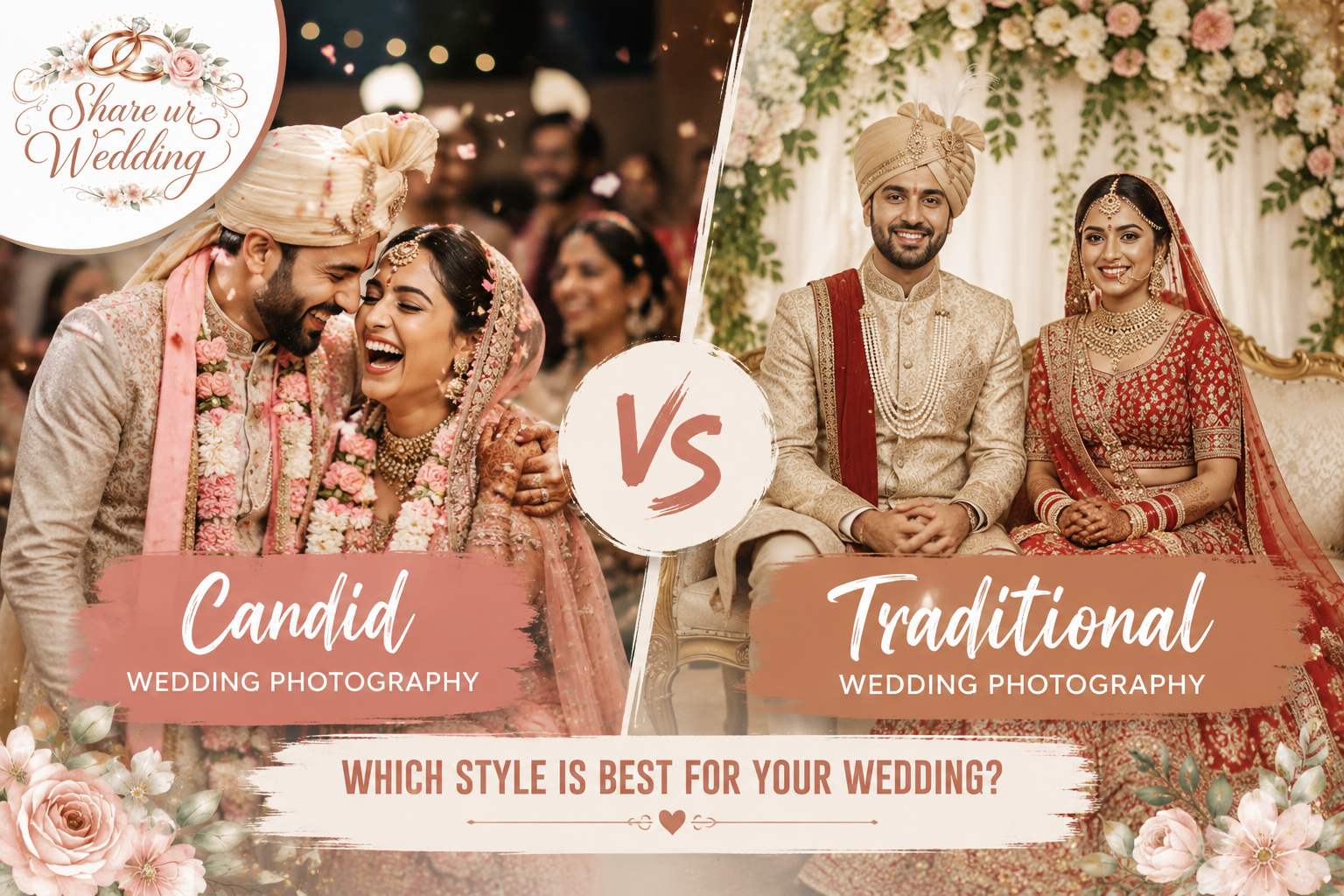
This is the classic crossroads every Indian couple faces when planning their big day. Choosing between candid vs traditional wedding photography India has become one of the most significant visual decisions you will make for your celebrations. It is no longer just about hiring someone with a high-end camera; it is about deciding how your children and grandchildren will look back at your love story decades from now. Will they see a beautifully curated, flawless gallery of perfectly orchestrated moments, or will they feel the actual heartbeat, tears, and unfiltered energy of the room? As we navigate the gorgeous wedding landscape of 2026, let us break down what these styles really mean for your multi-day celebration so you can choose the absolute perfect fit.
What Is Traditional Wedding Photography?
To truly appreciate where wedding visuals are going, we have to look at the foundational bedrock of Indian marriage documentation. Traditional wedding photography is the structured, formal approach that has captured generations of unions across our country. Think back to your parents’ wedding album—the heavy, velvet-bound book filled with crisp, evenly lit photographs where every single relative is looking straight at the camera, smiling in unison. That is the timeless hallmark of the traditional style.
This approach is highly deliberate and organized. A traditional photographer does not sit back and wait for a moment to happen; they actively create it. They ensure the lighting on the stage is absolutely flawless, using external flash setups and umbrellas that wash out any harsh shadows. When you are standing on the stage during your reception, greeting a seemingly endless line of three hundred extended family members, the traditional photographer is the anchor. They organize the groups, tell your cousins where to stand, make sure your heavy bridal dupatta is pinned perfectly straight, and call out “one, two, three, smile!” right before the shutter clicks.
For an Indian wedding, this structured methodology is an absolute necessity for documentation. Traditional wedding photography ensures that no key ritual is missed. When the priest asks the bride’s father to place her hand in the groom’s for the Kanyadaan, the traditional photographer is right there, capturing a clear, unobstructed, technically perfect image of that specific mudra. It is a style that values clarity, technical perfection, and completeness over emotional spontaneity.
What Is Candid Wedding Photography?
Now, let us flip the coin completely. Candid wedding photography, often referred to in global circles as documentary wedding photography, is an entirely different philosophy of capturing a marriage. Instead of directing the action, a candid photographer acts like an invisible storyteller, melting into the background of your venue. They do not ask you to pose, they do not tell you to look at the camera, and they almost never use large, intrusive flash setups that break the ambient mood of a dimly lit evening ceremony.
The core essence of this style lies in raw, unfiltered human emotion. It focuses on the split seconds that happen between the big rituals. It is the tear rolling down your mother’s cheek during the Haldi when she thinks no one is watching. It is the groomsmen sharing a secret joke over a flask of cold coffee before the Baraat leaves the hotel room. A candid photographer anticipates these human interactions, using fast lenses with wide apertures to create that soft, beautiful, blurry background that makes the emotional subject truly pop out of the frame.
In 2026, this style has evolved into a highly sophisticated form of art. It is no longer just about taking “unposed” shots; it is about capturing the atmospheric narrative of the day. The resulting wedding photo styles India couples love today feel more like cinematic stills from an indie film rather than a standard event gallery. You see the movement of the fabric, the genuine exhaustion at 3:00 AM during the pheras, and the explosive, messy joy of a modern Indian celebration.
Side-by-Side Comparison Table
To help you see how these two heavyweights stack up against each other across the metrics that matter most to your wedding planning, I have put together a comprehensive comparison matrix.
| Feature / Metric | Traditional Wedding Photography | Candid Wedding Photography |
| Primary Visual Style | Formal, posed, well-lit, and systematically structured portraits. | Documentary, spontaneous, storytelling, and emotion-driven imagery. |
| Average Cost (Per Day in 2026) | ₹50,000 to ₹1,200,000 (More predictable and highly budget-friendly). | ₹1,500,000 to ₹4,000,000+ (Premium pricing based on artistic skill). |
| Post-Processing & Editing Time | 3 to 5 weeks (Standard color correction and global adjustments). | 8 to 12 weeks (Detailed, custom cinematic grading for every frame). |
| Primary Deliverables Provided | Mass volume of images (1,000+ shots) and a massive physical printed album. | Curated selection of high-impact shots (300-400), digital galleries, premium photobooks. |
| Intrusiveness During Events | Higher on stage (Directing guests, adjusting poses, managing lines). | Very low (Blending into the crowd, using silent shutters, working with natural light). |
| Best Suited For… | Large stage receptions, extensive family group shots, and formal rituals. | Intimate functions, emotional pre-wedding rituals, and energetic dance floors. |
The Pros and Cons of Traditional Photography for Indian Weddings
Let us look at traditional wedding photography with absolute honesty. The biggest, most undeniable advantage of this style is its flawless ability to document your entire guest list. If you are having a massive guest count of eight hundred people at a conventional convention center, you need a traditional team. Why? Because they will systematically ensure that every single aunt, uncle, boss, and neighbor who came to bless you has a clear, well-lit photograph with the couple.
Furthermore, traditional photos are incredibly reliable. Because the lighting is controlled and the poses are tried-and-tested, you run a near-zero risk of having a technically bad photograph. Your jewelry will look sharp, your outfit colors will be highly accurate to real life, and your grandparents will be absolutely thrilled because they can clearly see everyone’s faces. It is also incredibly budget-friendly, allowing you to allocate funds to other premium elements like elaborate floral setups or luxury catering.
However, the downsides are hard to ignore if you want an artistic wedding album. The structured nature of traditional photography can feel incredibly repetitive. Look at five different traditional albums from the same venue, and they will likely look almost identical. The poses can sometimes feel rigid, stiff, and unnatural. If you are forced to hold a fake, smiling pose for forty-five minutes while the lighting is adjusted, your genuine joy can quickly transform into physical exhaustion. It documents who was at your wedding, but it often misses how it actually felt to be there.
The Pros and Cons of Candid Photography for Indian Weddings
Candid wedding photography is where the poetry of your wedding day truly lives. The greatest advantage here is the sheer emotional weight of the final deliverables. When you look at a great candid shot five years from now, you won’t just remember that you were happy—you will remember the exact joke that made you laugh. It captures the unique, unrepeatable essence of your specific chemistry as a couple.
These images also double as fine art prints. A master candid wedding photographer India knows how to use architectural shadows, the golden light filtering through a courtyard, and the ambient glow of fairylights to create visually arresting masterpieces. It makes your wedding look deeply personal, highly editorial, and completely authentic.
The trade-off, however, comes down to two major elements: cost and coverage gaps. Candid photography is an elite, highly specialized skill, and the price tag reflects that. Because these photographers are hunting for specific emotional moments, they cannot focus on systematic guest documentation. If you rely solely on a candid photographer, you might end up with an incredibly artistic shot of a teary-eyed kid playing with marigold petals, but completely miss a clear picture of your father’s business partners or your maternal aunt who traveled from Canada. It can also create tension with older family members who expect traditional, front-facing stage photos.
Which Ceremonies Need Which Style?
An Indian wedding is not a single event; it is a beautiful, shifting ecosystem of entirely different moods across multiple days. Therefore, applying a single photographic style across every single ritual is a massive mistake. Let us break down how to strategically deploy these styles across your itinerary.
The High-Energy Haldi and Mehendi
These daytime events are fluid, chaotic, messy, and filled with movement. People are throwing yellow powder, splashing water, dancing spontaneously, and getting henna applied to their palms. This is the absolute playground for candid wedding photography. You want a photographer who can move fast with a lightweight camera body, capturing the flying droplets of water, the genuine laughter of your friends, and the vibrant daytime colors without making anyone freeze or pose. Posing during a Haldi completely kills the spontaneous energy of the ritual.
The Sangeet Night
The Sangeet is all about high-octane performance, dramatic stage lighting, and late-night partying. Here, you actually need a hybrid strategy. You need a traditional setup with fast shutter speeds focused on the stage to crisply capture your choreographed dance sequences without motion blur. At the same time, you want a candid photographer down in the mosh pit of the dance floor, capturing the sweaty, unbuttoned-collar joy of your friends letting loose after the formal performances are over.
The Main Wedding Rituals and Pheras
When it comes to the actual marriage ceremony—whether it is happening under a daytime mandap in Hyderabad or a heritage courtyard in Udaipur—both styles must work in perfect harmony. The traditional photographer must secure the clear, unobstructed shots of the core religious milestones: the Agni Sakshi, the tying of the Mangalsutra, and the Saptapadi. Meanwhile, the candid photographer should be positioned to capture the glances shared between the couple during the long mantras, the emotional expressions of the parents sitting around the mandap, and the quiet solemnity of the morning or evening light.
The Grand Reception
If you are doing a classic stage reception where you stand in one place and greet hundreds of guests, this is the prime domain of traditional photography. Save your candid photographer’s energy here. Let the traditional team handle the heavy lifting of the endless group rotations on stage, ensuring every guest gets their formal portrait with the newlyweds.
How to Decide Based on Your Wedding Size and Venue
Honestly, the best wedding photography style 2026 demands is one that is perfectly tailored to your physical surroundings and your guest density. You cannot choose a style in a vacuum without looking at your venue contracts and your guest list parameters.
If you are planning an intimate, residential destination wedding with less than a hundred guests at a beautiful heritage boutique property in Goa, you should heavily tilt your budget toward premium candid wedding photography. With a smaller guest list, the photographer has the luxury of time to observe every single guest, capturing deep, meaningful interactions without feeling rushed. The architecture of a boutique venue provides the perfect storytelling backdrop for a documentary filmmaker style.
Conversely, if your family is hosting a massive, traditional celebration with over a thousand guests in a grand matrimonial hall in Chennai or a massive open lawn in Delhi, a standalone candid photographer will get completely swallowed by the crowd. In these high-density environments, a robust, highly organized traditional photography team is your absolute structural spine. They have the physical infrastructure—the massive studio lights, the crane cameras, the multiple roaming shooters—to handle a venue of that scale effectively.
Can You Book Both? The Hybrid Approach Explained
Now, let us talk about the absolute sweet spot for modern couples. Honestly, the hybrid approach wins for most Indian weddings, and it is exactly what I recommend to ninety percent of the couples I consult with. You do not have to choose between these two styles like they are warring political parties; you can build a cohesive team that leverages the strengths of both worlds.
The hybrid model involves hiring a primary photography agency that provides a combined package: a dedicated team of traditional shooters to handle the documentation, alongside an elite team of candid photographers and cinematic filmmakers to handle the artistic storytelling. When you book a unified hybrid team, it completely eliminates the biggest nightmare of wedding documentation: photographers fighting over physical space on the mandap.
Imagine a freelance candid specialist who doesn’t know your traditional team. They will constantly step into each other’s frames, block each other’s light, and cause immense friction during critical rituals like the Sindoor daan. A coordinated hybrid team operates like a choreographed dance troupe. The traditional shooter will stay at a specific angle to capture the wide formal shot, while the candid shooter slips into the shadows to grab a tight, emotional close-up of the bride’s expression, completely staying out of each other’s lines of sight.
Questions to Ask Your Photographer Before Booking
Before you transfer that initial booking advance to an agency, you need to look past their beautifully curated Instagram feed. A stunning social media grid represents their top five percent of all-time work. You need to know what they deliver on a regular, exhausting weekend during peak wedding season. Sit down with them—either over a coffee or a detailed video call—and ask these precise questions:
-
“Can we see two or three complete, unedited galleries from full multi-day weddings delivered to clients in the last six months, rather than just a highlight reel?”
-
“How exactly do your candid and traditional teams coordinate on the mandap to ensure they do not block each other’s shots during key rituals?”
-
“In our final contract deliverables, what is the exact number of fully edited, color-graded candid images we will receive, versus the volume of raw or traditionally corrected shots?”
-
“Will the main photographer whose name is on the brand portfolio actually be present at our venue directing the shoot, or will our project be assigned to an associate team of junior shooters?”
-
“What is your backup protocol if a primary camera sensor fails, a memory card gets corrupted, or an editing server crashes during our post-processing timeline?”
Real Couple Stories
To put this into perspective, let us look at how two real couples navigated this exact dilemma during their recent planning journeys.
Ananya and Vikram (The Candid Enthusiasts)
Ananya and Vikram were planning an intimate autumn wedding at a beautifully restored haveli in Jaipur. Ananya was completely obsessed with editorial, moody candid imagery. She wanted zero stage shots and zero formal posing. They decided to hire an exclusive, high-end candid documentary photographer for their three days.
The resulting album was visually spectacular—it looked like it belonged on the pages of an international design magazine. But three months later, when the digital gallery arrived, Ananya’s father was deeply upset. There wasn’t a single clear, front-facing, formal portrait of him standing next to his lifelong business partners who had flown in from Mumbai. The couple had to spend extra money months later trying to crop and upscale screenshots from their friends’ iPhone videos just to get a standard family frame for their living room wall.
Rohan and Meera (The Traditional Balance)
Rohan and Meera hosted a vibrant, chaotic six-hundred-guest wedding across multiple venues in Bengaluru. Meera initially thought traditional photography was outdated and wanted to skip it entirely to save on their budget. However, Rohan’s parents insisted on having a dedicated traditional team for the grand reception evening.
They ultimately opted for a balanced hybrid package. The outcome was the perfect compromise. Meera got her deeply emotional, artistic shots of her getting her makeup done with her childhood friends and her quiet, tearful vidaai. Meanwhile, Rohan’s parents received a beautiful, systematically organized physical album containing over four hundred flawless group photos of every single family unit that attended the reception stage. Everyone walked away completely satisfied, proving that balance always triumphs over extremes.
Budget Breakdown for Both Styles in India 2026
Let us talk numbers, because at the end of the day, your wedding budget dictates your creative realities. The wedding photography market in India has become highly sophisticated in 2026, with clear tiers of pricing based on experience, gear infrastructure, and artistic reputation. Here is what you can realistically expect to plan for across a standard three-day multi-event celebration.
+-------------------------------------------------------------------+
|               ESTIMATED THREE-DAY WEDDING PHOTOGRAPHY             |
|                       BUDGET TIER GUIDE (INR)                     |
+-------------------------------------------------------------------+
|                                                                   |
|  [TIER 1: BUDGET / LOCAL AGENCY]                                  |
|  Ideal for straightforward documentation.                          |
|  Traditional Team Only:  INR 1,50,000 - 3,00,000                  |
|  Basic Hybrid Package:   INR 3,00,000 - 5,00,000                  |
|                                                                   |
|  [TIER 2: MID-RANGE PREFERRED]                                    |
|  Experienced teams with distinctive editing styles.               |
|  Standalone Candid Team: INR 4,50,000 - 8,00,000                  |
|  Comprehensive Hybrid:   INR 6,00,000 - 12,00,000                 |
|                                                                   |
|  [TIER 3: PREMIUM / LUXURY COUTURE]                               |
|  Award-winning artists and celebrity filmmakers.                  |
|  Elite Standalone Candid: INR 12,00,000 - 20,00,000                |
|  Full Luxury Hybrid:      INR 18,00,000 - 35,00,000+              |
|                                                                   |
+-------------------------------------------------------------------+
When analyzing these figures, remember that candid wedding photos cost more primarily because of the intense labor involved after the wedding wraps up. A traditional photographer applies a uniform color preset to thousands of stage photos because the lighting remained perfectly consistent throughout the night. A candid photographer, however, treats every single frame like an individual canvas. They adjust the exposure, fine-tune the color grading to match the emotional mood, and remove distracting background elements manually. You are not paying just for their time on site; you are paying for the hundreds of hours spent in a dark editing studio over the subsequent three months.
Frequently Asked Questions
Is candid photography more expensive than traditional?
Yes, candid wedding photography is almost universally more expensive than traditional documentation across the Indian market. This premium price tag is not a markup for a trendy buzzword; it reflects a significantly higher level of technical difficulty, advanced camera gear, and an intensive post-production workflow. A candid photographer must constantly adapt to unpredictable lighting conditions, rapid human movements, and fluid emotional shifts without any ability to hit a pause button or reset a stage frame. Furthermore, their post-wedding timeline involves custom, individual color-grading for every delivered photograph, which demands an immense amount of professional editing hours compared to the automated batch-processing used for traditional stage galleries.
How many photographers do I need for a multi-day Indian wedding?
The ideal number of photographers depends heavily on your overall guest count and the complexity of your event flow, but for a standard Indian wedding of 300 to 500 guests, a team of four to five professionals is the absolute sweet spot. This typical breakdown consists of two traditional photographers to permanently anchor the main stage documentation and wide ritual tracking, alongside two candid photographers who are completely free to roam the venue to capture emotional sub-narratives, guest interactions, and creative angles. If your guest list expands beyond seven hundred people, or if you have multiple grand events happening simultaneously in different areas of a resort, you should consider scaling up to six or seven shooters to ensure zero blind spots across your timeline.
Can I share candid photos on Instagram directly?
While you can absolutely share your candid photos on social media channels the moment your photographer delivers your final high-resolution digital gallery, you should never upload raw or unedited sneak-peeks without their explicit guidance. Candid images rely incredibly heavily on the artist’s custom color grading, contrast balance, and specific atmospheric tones to achieve that signature cinematic appearance. Applying a generic Instagram filter or an automated mobile edit over a professional photographer’s incomplete work completely destroys the artistic integrity of the image. Always wait for your official curated digital highlights folder, which is specifically optimized, compressed, and color-tuned for flawless presentation on modern smartphone screens.
What equipment do candid photographers use?
Candid photographers utilize highly specialized, professional equipment designed to prioritize speed, silent operation, and exceptional low-light performance. Unlike traditional shooters who rely on heavy external flash units and bulky light modifiers, candid experts primarily use top-tier full-frame mirrorless camera bodies equipped with dual memory card slots for instant real-time data backup. They pair these bodies with premium prime lenses—lenses with a fixed focal length like a 35mm, 50mm, or 85mm—featuring ultra-wide apertures ranging from f/1.2 to f/1.8. This specific optical setup allows them to pull in massive amounts of ambient light in dim banquet halls while creating that gorgeous, creamy background blur that isolates the emotional subject perfectly from background distractions.
How long does it take to get wedding photos delivered?
The standard delivery timeline for a comprehensive Indian wedding photography package ranges anywhere from 8 to 12 weeks during the peak winter marriage season. Traditional photos and raw documentation reels can often be delivered within 3 to 4 weeks because their post-processing involves basic global color adjustments and straightforward layout sorting. However, the meticulously curated candid gallery and your cinematic wedding film require a massive amount of manual editing, audio balancing, storytelling structure design, and custom color grading. A premium photography house will never rush this creative process, as a rushed post-production timeline always results in a generic, poorly polished final product that fails to reflect the true premium value of your initial investment.
At the end of the day, as you look forward to your beautiful celebrations in 2026, take a deep breath and remind yourself that there is absolutely no wrong answer here. Your wedding album is not a test to be passed; it is a living, breathing container for your memories. Whether you fall completely in love with the unscripted, poetic frames of a candid master or find deep comfort in the crisp, flawless symmetry of a traditional family portrait, the right choice is simply the one that feels most like you. Trust your instincts, find a team that respects your vision, and then put your worries away. When the dhol starts playing and those rose petals finally fall, look at your partner, live completely in that unrepeatable moment, and let your photography team handle the magic.