

Before the wedding invitations are printed, before the mehndi paste is mixed, and before the sangeet playlist is finalised, there is a quieter moment that sets everything in motion. It is the moment when two families sit across from each other in a living room or a decorated hall, look at one another with hope in their eyes, and say — yes, this is the one.
That moment is the Roka ceremony.
If the wedding is the grand destination, the Roka is where the journey officially begins. It is not as loud as the sangeet, not as elaborate as the reception, and not as sacred as the pheras. But ask any couple, and they will tell you the Roka holds a special, almost tender place in their memory. It is the first time both families come together, not as strangers or distant relatives, but as people who have decided to become one.
And yet, despite its emotional significance, the Roka ceremony is one of the most frequently misunderstood pre-wedding rituals. Couples google “what is Roka ceremony” more often than you would expect. Families disagree on the rituals. Brides-to-be spend sleepless nights figuring out what to wear. And gifts? That is an entire conversation no one quite knows how to start.
This guide is here to settle all of that. Whether you are planning your own Roka, helping your sibling or best friend prepare for theirs, or simply trying to understand what all the fuss is about, consider this your one-stop resource. From the meaning and history of the ceremony, to step-by-step rituals, outfit inspiration, gift ideas, decoration themes, budget breakdowns, and a printable planning checklist — everything is right here.
Let us begin where every Roka begins: with a meaning that runs deeper than most people realise.
What Does Roka Mean? Understanding the Heart of the Ceremony
The word “Roka” comes from the Hindi verb rokna, which translates to “to stop.” In the context of an Indian wedding, the meaning is beautifully specific — it signifies that the bride and groom have stopped their search for a life partner. They have found each other. And both families have agreed to stop looking any further.
Think about that for a moment. In a culture where marriage involves not just two individuals but two entire families, the Roka is the first collective agreement that says: we are ready to move forward together.
Historically, the Roka ceremony was practised most commonly in Punjabi, Sikh, and North Indian Hindu families. It was a simple, private affair — the groom’s parents would visit the bride’s home, sweets would be exchanged, a tilak would be applied, and both sides would give their verbal consent to the match. There were no decorators involved, no photographers, and certainly no hashtags.
But weddings evolve, and so do their rituals. In 2026, the Roka has grown into something that sits beautifully between tradition and modernity. Some families still keep it intimate — a dozen people, a living room decorated with marigolds, and homemade sweets on a silver thali. Others treat it as a mini celebration with curated decor, professional photographers, coordinated outfits, and carefully styled gift hampers.
Neither approach is wrong. What matters is that the essence remains: two families, one decision, and the shared joy that a wedding is now on the horizon.
Roka vs Engagement: What Is the Difference?
This is one of the most commonly asked questions, and the confusion is understandable because both events mark a commitment.
The Roka comes first. It is the initial agreement between the two families — the acknowledgement that a match has been found and accepted. Rings may or may not be exchanged. The gathering is usually smaller, and the tone is warm and familial rather than celebratory and grand.
The engagement, or sagai, comes later. It is a larger, more formal affair where rings are exchanged, the couple is officially declared engaged, and the guest list typically expands to include extended family and friends. The engagement is outward-facing — it announces the union to the community. The Roka is inward-facing — it solidifies the bond within the family.
Some modern families combine both events into one, especially if the wedding timeline is short. But traditionally, they are two separate milestones, and there is beauty in giving each one its own moment.
What Does “Rokafied” Mean?
If you have spent any time on Instagram wedding pages or Bollywood gossip columns, you have likely come across the term “Rokafied.” It is a playful, modern twist that simply means “having completed the Roka ceremony.” It has become a popular social media caption, a hashtag (#Rokafied), and even a cultural shorthand for saying: “It’s official. We’re getting married.”
It is fun. It is lighthearted. And honestly, it has helped bring mainstream attention to a ceremony that was often overshadowed by the grander events that follow.
Step-by-Step Roka Ceremony Rituals
While every family adds their own flavour to the Roka, there is a general flow that most ceremonies follow. Here is what to expect, step by step.
1. The Arrival and Welcome (Swagat)
The groom’s family typically travels to the bride’s home. In modern setups, this meeting may also happen at a restaurant, a farmhouse, or a banquet hall — but the tradition of the groom’s side travelling first has endured.
The bride’s family welcomes the arriving guests with aarti (a plate with a diya, rice, and kumkum), applies a tilak to the groom’s father or the eldest male member, and offers sweets or a welcome drink. This is a gesture of warmth and hospitality — a way of saying, we are honoured that you are here.
2. The Tilak Ceremony
This is the centrepiece of the Roka. The bride’s father (or the eldest male member of her family) applies a tilak — a mark made with vermilion paste (roli) and rice grains — on the groom’s forehead. This is not decorative. It is deeply symbolic. The tilak represents acceptance, respect, and the formal acknowledgement that the bride’s family has chosen the groom for their daughter.
Similarly, the groom’s mother or a senior female relative from his side places a chunni (a decorative scarf or dupatta) over the bride’s head and applies a small tilak to her forehead. This is the groom’s family saying: we accept her as our own.
In some families, the tilak is accompanied by the offering of a coconut, a box of sweets, and a shagun envelope containing cash (usually an amount ending in the number one — ₹1,001, ₹5,001, ₹11,001 — because the extra rupee symbolises good luck and continuity).
3. The Exchange of Gifts (Shagun)
Once the tilak is done, both families exchange gifts. This is where the Roka starts to feel less like a ritual and more like a celebration. The gifts are tokens of goodwill, not extravagance. Traditionally, the exchange includes sweets, dry fruits, seasonal fruits arranged on decorated trays, clothing (a sari or suit for the bride from the groom’s side, and a kurta or sherwani piece for the groom from the bride’s side), and of course, the shagun envelope.
In modern Rokas, families have started giving more personalised gifts — luxury watches, custom perfume sets, designer wallets, engraved jewellery, or curated gift hampers. But the spirit remains the same: generosity without ostentation.
4. Blessings from Elders (Ashirvaad)
After the gifts are exchanged, the couple seeks blessings from all the elders present. This is often an emotional moment, especially for parents. The couple touches the feet of their grandparents, parents, uncles, and aunts, and receives blessings in the form of kind words, tight embraces, and often, happy tears.
There is no script for this part. It is the most human, most unscripted part of the ceremony — and usually the part that everyone remembers the longest.
5. Sweets, Meal, and Celebration
The ceremony concludes with the sharing of sweets (mithai) and a meal. In a home setting, this might be a lovingly prepared lunch or dinner by the bride’s family. In a venue, it could be a catered spread. Either way, this is the moment when formality melts away, the families start getting to know each other over food, and the excited chatter about wedding dates, guest lists, and outfit shopping begins.
Some families also cut a cake, open champagne (or sparkling juice), or take a formal family photograph to mark the occasion. There is no rule here — only joy.
Roka Ceremony Thali: What You Need to Prepare
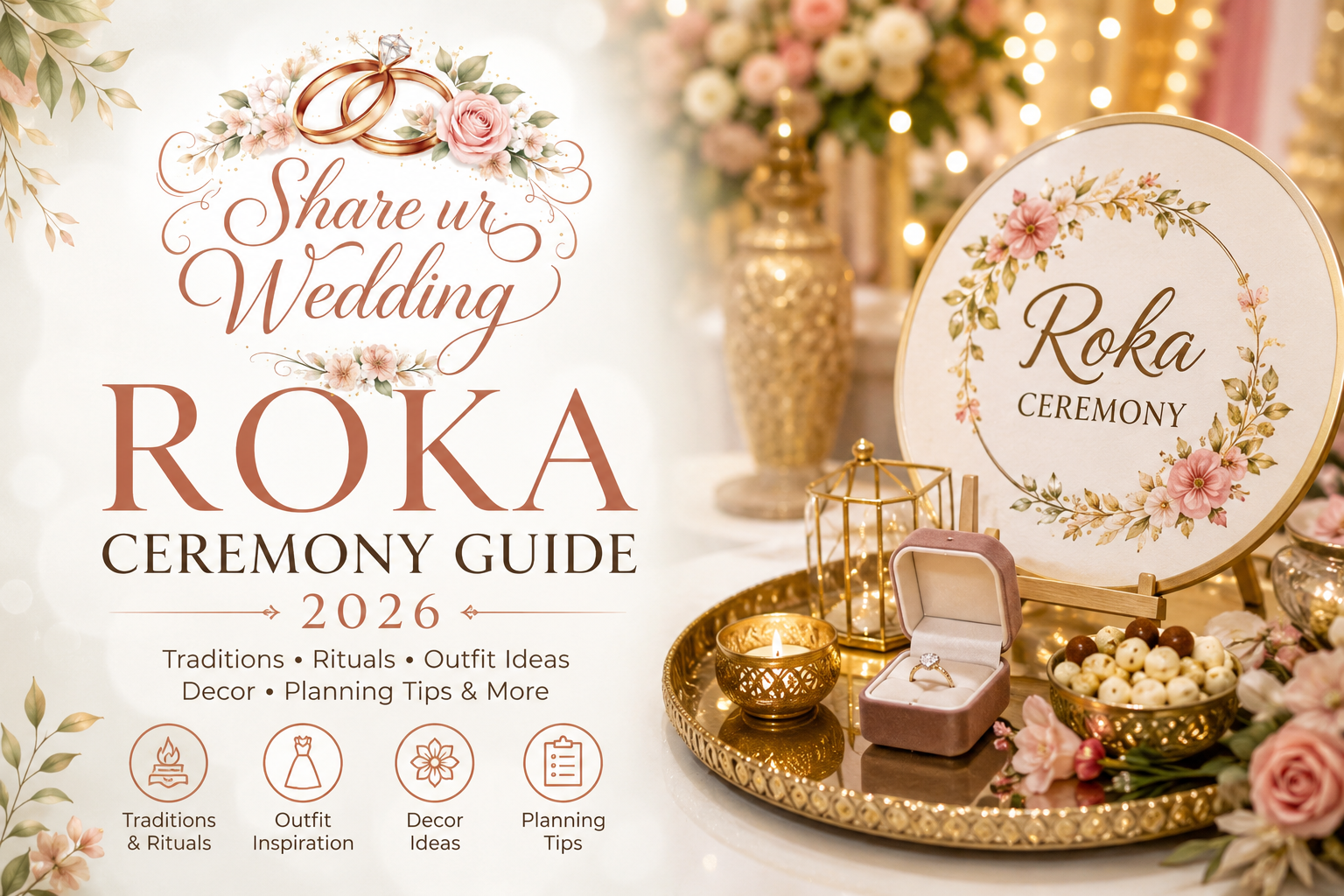
The Roka thali is the ceremonial plate used during the tilak ritual. Getting it right is important because it is both a religious and visual centrepiece. Here is a complete list of what your thali should include.
Essential items for the Roka thali: a small bowl of roli (vermilion), uncooked rice grains (akshat), a diya with ghee or oil and a cotton wick, fresh flowers (marigold or rose petals work well), a coconut wrapped in a red cloth, mithai (one or two pieces of a traditional sweet like ladoo or barfi), a shagun envelope with cash, and supari (betel nut).
Optional but elegant additions: kumkum, haldi, a small Ganesh idol, a decorative kalash, incense sticks, and a silver coin or gold ginni.
You can arrange these on a stainless steel thali, a brass thali, a silver-plated tray, or a decorated wooden platter. Many families now order custom-decorated Roka thalis from Instagram-based vendors or wedding packaging specialists who create floral, ribboned, and colour-coordinated trays that look stunning in photographs.
What to Wear to a Roka Ceremony: Outfit Guide for 2026
The Roka is the bride’s and groom’s first public appearance together as a couple-to-be. The outfit matters — not because it needs to be extravagant, but because it sets the tone for every function that follows. The golden rule for Roka dressing in 2026 is this: festive but not bridal, elegant but not overdressed.
Roka Outfits for the Bride
The most popular outfit choices for brides in 2026 are leaning towards softer, lighter silhouettes that feel graceful without competing with the wedding-day look.
Pastel lehengas are dominating the Roka outfit trend this year. Powder pink, sage green, lavender, champagne gold, and icy blue are the colours brides are gravitating towards. A lightweight organza or georgette lehenga with delicate sequin work or threadwork embroidery looks stunning without being heavy. Pair it with minimal gold jewellery — a single-strand choker, small jhumkas, and a statement ring — and you have a look that photographs beautifully.
Anarkali suits are a timeless Roka choice. A flowy, floor-length anarkali in a soft colour with dupatta draping adds elegance without effort. This silhouette works especially well for home Rokas where you want to move around comfortably.
Designer sarees are making a strong comeback for Roka ceremonies in 2026. A lightweight chiffon or organza saree in a contemporary drape — perhaps with a pre-stitched pallu or a modern blouse cut — gives a refined, fashion-forward look. Brides who inherit a family saree from their mother or grandmother often choose to wear it to the Roka as a tribute, which adds emotional depth to the outfit.
Indo-western outfits are perfect for couples who prefer a modern aesthetic. Think: a sharara set with a cape, a lehenga skirt paired with a corset blouse, or a pre-draped saree gown. These options allow you to express personal style while staying within the festive dress code.
Tip for brides: Avoid heavy reds, maroons, and deep bridal colours for the Roka — those are traditionally reserved for the wedding day itself. Pastels, soft metallics, and muted tones are the sweet spot.
Roka Outfits for the Groom
The groom’s outfit is just as important, and in 2026, grooms are finally getting the style attention they deserve.
A well-fitted kurta-pyjama set remains the most popular Roka choice for grooms. Choose a cotton silk or raw silk kurta in neutral tones — ivory, beige, powder blue, dusty pink, or mint green. Pair it with churidar bottoms, a pair of embroidered juttis, and a simple brooch or pocket square for a touch of personality.
A Nehru jacket layered over a kurta instantly elevates the look. Go for a textured or embroidered jacket in a complementary shade — say, a navy Nehru jacket over a white kurta or a champagne jacket over a sage green kurta.
A bandhgala suit is the power move for grooms who want a sharp, contemporary look. A well-tailored bandhgala in deep teal, charcoal, or wine paired with trousers and loafers looks distinguished without trying too hard.
Indo-western fusion options — like a short sherwani, a bundi with a printed shirt, or tailored ethnic trousers with a structured kurta — are gaining traction among younger grooms who want to stand out.
Tip for grooms: Coordinate with the bride’s colour palette, but do not match identically. Complementary tones — not twinning outfits — create better photographs and show intentional styling.
What Should Guests and Family Members Wear?
Immediate family — especially the mothers — should dress in elegant ethnic wear. Silk sarees, chiffon suits, or embroidered kurta sets in festive colours work perfectly. Avoid all-black outfits and overly casual Western wear. The Roka is intimate, but it is still a ceremony, and dressing respectfully honours the occasion.
Roka Ceremony Gift Ideas: Thoughtful, Elegant, and Budget-Friendly
Gift-giving at the Roka is not about showing off. It is about expressing warmth, goodwill, and the beginning of a relationship between two families. Here are gift ideas that hit the right note.
Gifts from the Bride’s Family (for the Groom and His Family)
For the groom: A designer kurta or sherwani fabric piece, a premium watch, a personalised leather wallet, a luxury perfume set, a pair of handcrafted juttis, or a curated grooming kit. Many families now create a “groom hamper” — a beautifully packed basket containing several coordinated gifts arranged with flowers, ribbons, and a handwritten note.
For the groom’s parents: A silk saree for his mother, a fine shawl or stole, a silver coin set, a box of premium dry fruits, or a customised photo frame. For his father, a kurta piece, a pashmina shawl, or a traditional pagdi (turban) if the family follows that tradition.
For the groom’s siblings and close relatives: Smaller tokens like silver coin pouches, potli bags with sweets, dry fruit boxes, or personalised candles.
Gifts from the Groom’s Family (for the Bride and Her Family)
For the bride: A chunni (ceremonial dupatta), a set of bangles or chooda, a jewellery piece (a pendant, bracelet, or ring), a designer outfit, or a curated beauty hamper. The chunni is non-negotiable in most North Indian and Punjabi families — it is placed on the bride’s head during the ceremony as a symbol of acceptance.
For the bride’s parents: Sweets, dry fruits, seasonal fruits, a saree or suit for her mother, and a shagun envelope for her father. Some families also gift silver utensils, decorative pieces, or traditional household items.
Modern and Personalised Gift Ideas
If you want to move beyond traditional options, consider personalised gifts that feel intimate and thoughtful. Customised couple mugs, an engraved jewellery box, a framed illustration of the couple, a custom Spotify plaque with “their song,” or a handwritten letter from the family expressing their joy and blessings. These touches may seem small, but they are the gifts that couples remember years later.
Budget-Friendly Gift Options
Not every Roka needs to be extravagant. If you are working within a budget, focus on presentation over price. A ₹500 box of sweets arranged on a ₹200 decorated tray with ₹100 worth of flowers and ribbons will look more thoughtful than a ₹5,000 gift tossed in a plastic bag. Invest in beautiful packaging — organza bags, velvet boxes, floral wrapping, or hand-tied ribbons — and even modest gifts will feel special.
Roka Ceremony Decoration Ideas for 2026
The Roka decoration should feel warm, inviting, and festive — but not like a wedding reception. Think of it as dressing up your living room or venue just enough to say, “Something beautiful is happening here today.”
At-Home Roka Decoration Ideas
Floral rangoli at the entrance creates an immediate first impression. Use fresh marigolds, rose petals, and jasmine to craft a welcoming pattern at your door.
A marigold and fairy-light backdrop behind the seating area where the couple sits is the most photographed spot at any Roka. Keep it simple — a wall of strings of orange and yellow marigolds, with warm fairy lights woven through, creates a stunning visual without needing a professional decorator.
Decorated seating for the couple — a small diwan or sofa dressed with cushions, a dupatta throw, and scattered flower petals. Add a low table in front for the thali, sweets, and gifts.
Fresh flowers everywhere — in vases, on tables, along staircases, and in the washroom. Genda phool (marigold), mogra (jasmine), roses, and rajnigandha (tuberose) are all affordable, fragrant, and beautiful.
Diyas and candles placed along pathways, on windowsills, and around the seating area add a soft, golden glow that makes everything look dreamy, especially for evening Rokas.
Venue or Banquet Hall Decoration Ideas
If you are hosting the Roka at a venue, you have more room to play with themes.
Pastel floral theme: Soft pink, white, and peach flowers arranged in clusters with draped fabric and fairy lights. This works beautifully for daytime Rokas.
Marigold and gold traditional theme: Bright orange marigolds, brass urlis, floating candles, and gold accents. This is the classic Indian look that never goes out of style.
Garden or terrace Roka: If the venue has outdoor space, set up under a canopy or shamiana with hanging florals, lanterns, and a small mandap-style seating arrangement for the couple.
Minimalist modern theme: White and green palette with eucalyptus leaves, pillar candles, and clean linen draping. Ideal for couples who want understated elegance.
How Much Does a Roka Ceremony Cost? Budget Breakdown for 2026
One of the most practical questions families ask — and one that very few guides answer honestly.
The cost of a Roka ceremony can range dramatically depending on the scale. Here is a realistic breakdown.
Intimate home Roka (15-30 guests): This is the most budget-friendly option. Decoration with fresh flowers and diyas can cost ₹3,000 to ₹8,000. Home-cooked food eliminates catering costs. Sweets and dry fruits for gifting run ₹2,000 to ₹5,000. Shagun and gifts depend entirely on the family’s capacity, but a reasonable range is ₹10,000 to ₹50,000 for both sides combined. Outfits for the bride and groom can cost ₹5,000 to ₹30,000 each. Photography, if hired separately, costs ₹5,000 to ₹15,000. Total estimate: ₹30,000 to ₹1,00,000.
Mid-range Roka at a restaurant or small venue (30-60 guests): Venue rental or minimum spend at a restaurant might be ₹20,000 to ₹60,000. Professional decoration costs ₹15,000 to ₹40,000. Catering for 50 guests runs ₹25,000 to ₹60,000. Add gifts, outfits, and photography, and the total comes to roughly ₹1,00,000 to ₹3,00,000.
Grand Roka at a banquet hall or hotel (60-150 guests): Venue, decor, catering, photography, gifts, and outfits can push the total to ₹3,00,000 to ₹5,00,000 or more. At this scale, the line between a Roka and an engagement party blurs significantly.
The key takeaway: there is no “correct” budget for a Roka. Spend what feels comfortable and meaningful. An intimate ₹40,000 Roka at home can be just as beautiful and memorable as a ₹4 lakh event at a five-star hotel. The ceremony is about the emotion, not the expense.
Planning Your Roka: The Complete Checklist
Planning a Roka does not require a wedding planner, but it does require organisation. Here is a timeline-based checklist to make sure nothing falls through the cracks.
4-6 Weeks Before the Roka
Confirm the date and time with both families. Ideally, consult a pandit or check a muhurat calendar for an auspicious date. Decide on the venue — home, restaurant, farmhouse, or banquet hall. If booking a venue, confirm availability and make the reservation. Set a rough budget and discuss it openly with both families to avoid misunderstandings later. Start outfit shopping for the bride and groom. Decide on a colour palette so that outfits and decor feel coordinated.
2-3 Weeks Before the Roka
Finalise the guest list. Remember, the Roka is meant to be intimate — close family and the nearest friends only. Order or prepare gift hampers, shagun envelopes, dry fruit boxes, and sweet boxes. Book a photographer or videographer if you want professional coverage. Arrange decoration — either DIY with flowers and lights, or hire a decorator for a more polished setup. Plan the menu — whether home-cooked or catered. Confirm dietary requirements for guests from both sides.
1 Week Before the Roka
Do a final outfit trial — for the bride, groom, and their immediate family. Prepare the Roka thali with all essential items. Confirm all bookings — venue, caterer, photographer, decorator. Buy fresh flowers for decoration (order in advance if using a florist). Prepare the seating arrangement and decide where the ceremony will take place within the venue or home. Coordinate logistics — who is arriving when, parking arrangements, and any special needs for elderly family members.
On the Day
Set up decorations early — at least three to four hours before guests arrive. Arrange the thali, gifts, and sweets in their designated spots. The bride should start getting ready two to three hours before the ceremony (hair, makeup, draping). The groom should be ready at least an hour before. Brief the photographer on the key moments — the tilak, the chunni, the gift exchange, and the blessings. Assign a family member to coordinate the flow of events so that the ceremony moves smoothly. Relax. Breathe. Enjoy. This is the beginning of something wonderful.
Roka Ceremony Etiquette: What Every Family Should Know
Every family has its own customs, but there are some universal etiquettes that help the ceremony go smoothly.
The groom’s family travels first. Traditionally, the groom’s family visits the bride’s home for the Roka. Even if you are hosting at a neutral venue, this tradition is worth honouring — it shows respect and follows protocol.
Keep the guest list small. The Roka is not the wedding. Invite immediate family — parents, grandparents, siblings, and a handful of close uncles and aunts. Childhood friends or the couple’s best friends may attend, but this is primarily a family affair.
Discuss gifts and shagun amounts beforehand. This might feel awkward, but a quiet conversation between the families about expected gifts and shagun amounts prevents mismatched expectations and potential embarrassment on the day.
Switch off the phone (or at least the ringer) during the ceremony. The tilak and blessing moments are sacred and emotional. Give them the undivided attention they deserve.
Do not upstage the couple. This sounds obvious, but it happens — especially with well-meaning relatives who wear outfits more elaborate than the bride’s or dominate the conversation. The spotlight belongs to the couple and their parents.
Be punctual. Both families arriving on time shows mutual respect and keeps the ceremony on schedule.
How to Announce Your Roka on Social Media
In 2026, the Roka announcement has become a moment in itself. Here are some ideas for sharing the news online.
Post a candid photograph from the ceremony — the tilak moment, the couple laughing together, or a detail shot of the thali or gifts — with a heartfelt caption. Something simple like: “He asked. She said yes. Both families agreed. And just like that, forever begins.” works beautifully.
Use hashtags that are personal and fun. Combine your names into a couple hashtag (#RohanKiRoka, #ShivaAndNehaForever, #Rokafied2026) and use it consistently across all your wedding events for easy photo collecting later.
If you want to keep it low-key, a simple Instagram story with a picture of your hands, the thali, or a close-up of the gifts, tagged with a date and a heart emoji, says everything without saying too much.
Regional Variations of the Roka Ceremony
While the Roka is most closely associated with Punjabi and North Indian families, similar ceremonies exist across India under different names.
In Punjabi families: The Roka is often combined with a thaka (formal acceptance) where both families verbally confirm the match. It is followed by the exchange of a shagun and sweets. Some Punjabi families also perform a chunni chadai at the Roka, where the groom’s mother drapes a red or pink chunni over the bride’s head.
In Marwari and Rajasthani families: A similar ceremony is called Tilak or Tika, where the bride’s father applies a tilak on the groom and gifts him a turban, sweets, and cash. The emphasis is on the groom being formally honoured and accepted.
In Sindhi families: The equivalent is often called Berana or Pakki Mishri, where both families exchange mishri (crystallised sugar) as a symbol of sweetening the bond. The elders feed mishri to the couple.
In Gujarati families: The Gol Dhana ceremony serves a similar purpose — the girl’s family sends gol dhana (jaggery and coriander seeds) to the boy’s family as a symbol of the match being finalised.
In Bengali families: The Aashirbad ceremony, where elders from both sides formally bless the couple and exchange gifts, shares the spirit of the Roka, though the rituals differ.
No matter what it is called, the essence is universal: two families acknowledging that their children have found each other, and giving their collective blessing for the journey ahead.
Common Mistakes to Avoid When Planning a Roka
Over-inviting. The number one mistake families make is treating the Roka like a wedding reception. Keep the guest list tight. A crowded Roka loses its intimacy and becomes a logistical headache.
Under-communicating between families. The Roka involves coordination between two families who may not know each other well yet. Discuss everything — timing, gifts, dress code, food preferences, and the flow of ceremonies — in advance. Assumptions lead to awkwardness.
Ignoring the groom’s involvement. In many families, the Roka planning falls entirely on the women. Grooms, participate. Choose your outfit. Help with decisions. This is your ceremony too.
Spending beyond your means. The Roka is the first event in a long wedding journey. If you exhaust your budget here, the pressure compounds for every ceremony that follows. Be generous but realistic.
Forgetting the photographer. You will want these photos. The Roka often produces the most candid, emotionally raw images of the entire wedding journey because the setting is small and the emotions are genuine. Do not rely on phone cameras alone — hire a professional or at least assign a family member with a good camera to capture the moments.
Final Thoughts: Why the Roka Matters More Than You Think
In the whirlwind of a big Indian wedding — the sangeet rehearsals, the lehenga fittings, the late-night seating chart debates, and the hundred WhatsApp groups — it is easy to lose sight of why you are doing all of this in the first place.
The Roka brings you back to that why.
It is the first time your partner’s family looks at you and says, not with words but with a tilak, a chunni, and a box of sweets: you are ours now. It is the moment your parents, who may have spent years worrying about your future, finally exhale. It is the ceremony where two strangers’ living rooms become one family’s story.
No matter how you choose to celebrate it — at home in your mother’s drawing room or at a five-star hotel with coordinated hampers — the Roka is worth doing with intention, with warmth, and with the full understanding that this small, beautiful step is where forever begins.
Liked this guide? Share it with a friend who is planning their Roka, and explore more wedding planning tips on ShareUrWedding.