

Your lehenga is finalized. The photographer is booked. The videographer has sent the contract. But there is a new vendor on every savvy couple’s checklist in 2026 — and most Indian brides have never heard of them until a friend’s wedding reel showed up on Instagram at 9 AM the morning after the sangeet.
Meet the wedding content creator: the person whose entire job is to capture your wedding through a smartphone, edit it into scroll-stopping reels and stories, and deliver everything to your phone within 24 hours — sometimes the same night.
This is not your photographer. This is not your videographer. This is something entirely new, and it is quietly becoming the most talked-about vendor hire in the Indian wedding industry.
In this guide, we will break down exactly what a wedding content creator does, how they differ from the vendors you already know, what they cost in India, how to find the right one, and the mistakes couples make when hiring one for the first time.
What Exactly Is a Wedding Content Creator?
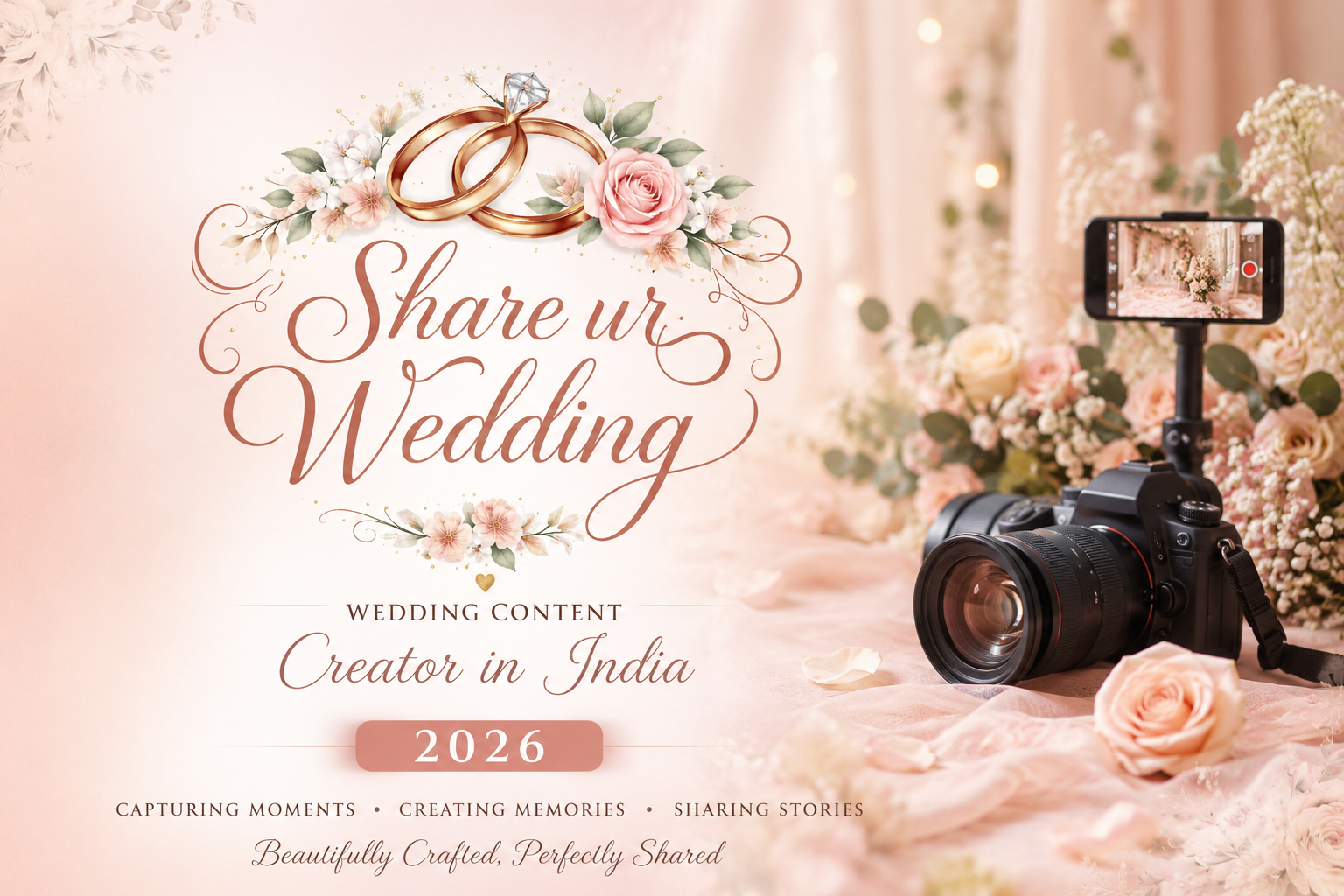
A wedding content creator is a professional who documents your wedding day using a smartphone — often paired with a gimbal or stabilizer — and produces short-form vertical content designed specifically for Instagram Reels, YouTube Shorts, and TikTok.
Their deliverables are not cinematic wedding films. They are not high-resolution gallery images. Instead, they capture the raw, behind-the-scenes, guest-POV energy of your celebration and turn it into the kind of content that gets shared in family WhatsApp groups, reposted by your friends, and rewatched on random Tuesday evenings when you miss the day.
Think of it this way: your photographer freezes the moment. Your videographer tells the cinematic story. Your content creator captures how the day actually felt — the chaos, the laughter, the tears, the dance floor madness — and puts it on your phone before the mehendi has even faded.
Here is what a typical wedding content creator delivers:
- 15 to 30 edited Instagram Reels or TikToks with trending audio
- 100 to 300+ candid smartphone photos (the “camera roll dump”)
- Behind-the-scenes clips of getting ready, vendor setups, guest arrivals
- Raw unedited footage of key moments (vows, pheras, first dance, bidaai)
- Same-day or next-day delivery of highlight content
- Optional: live posting to the couple’s Instagram Stories during the event
Wedding Content Creator vs Photographer vs Videographer: The Real Difference
This is the question every couple asks first, and the confusion is understandable. All three professionals use cameras. All three produce visual content. But their purpose, equipment, deliverables, and timelines are fundamentally different.
The Photographer uses professional DSLR or mirrorless cameras with multiple lenses, lighting setups, and years of technical training. They produce high-resolution images meant for printing, framing, and albums. Delivery takes 4 to 8 weeks. These are the images your parents will hang on the wall.
The Videographer uses cinema cameras, drones, multiple angles, and professional audio equipment. They produce a 5 to 15-minute cinematic highlight film and sometimes a full ceremony edit. Post-production involves colour grading, audio syncing, and narrative editing. Delivery takes 8 to 16 weeks. This is the film that will make you cry on your anniversary.
The Content Creator uses a smartphone — usually the latest iPhone or Samsung flagship — with a gimbal stabilizer. They move through the wedding like a guest, capturing candid moments, reactions, and behind-the-scenes energy. Editing happens on mobile apps with trending audio and quick cuts. Delivery happens within 24 to 72 hours. These are the reels you will rewatch most often and the clips your friends will actually share.
None of these vendors replace each other. They serve completely different emotional needs at different moments in time. The content creator gives you the present — instant, shareable memories while the excitement is still fresh. The videographer gives you the future — a legacy film you will treasure for decades. The photographer gives you the permanent — images that will outlast every platform and algorithm.
Why Indian Weddings Are Perfect for Content Creators
Indian weddings were practically designed for this role. Here is why:
Multi-day celebrations mean more content opportunities. A typical Indian wedding spans three to five days — mehendi, haldi, sangeet, wedding ceremony, and reception. That is five separate events, each with its own outfits, energy, decor, and emotional moments. A content creator can produce a unique reel for each function, giving you a week’s worth of social media content from a single wedding.
The guest energy is unmatched. Indian weddings are loud, joyful, chaotic, and deeply emotional — all the ingredients that make short-form content go viral. The baraat entry, the jaimala competition, the sangeet performances, the emotional bidaai — these moments are tailor-made for reels.
Families want to see content immediately. In Indian families, there are always relatives who could not attend — elderly grandparents, cousins abroad, NRI family members. A content creator’s same-day delivery means these family members can feel part of the celebration in real-time through WhatsApp and Instagram.
Couples are investing more in personal branding. Whether it is an entrepreneur couple, an influencer bride, or simply a Gen Z pair who wants their wedding to reflect their personality online, Indian couples in 2026 are treating their wedding content as an extension of their identity.
How Much Does a Wedding Content Creator Cost in India in 2026?
Pricing in India varies significantly based on the creator’s experience, your city, the number of events covered, and the deliverables included. Here is a realistic breakdown:
Entry-Level Creators: ₹15,000 to ₹40,000 per event
These are typically newer creators with 6 to 18 months of experience. They may work solo, use basic editing apps, and deliver 8 to 15 reels per event. Quality can be inconsistent, but some talented newcomers produce exceptional work at this price point. Best suited for single-day events like a reception or sangeet.
Professional Mid-Tier Creators: ₹40,000 to ₹90,000 per event
This is the sweet spot for most Indian weddings. These creators have established portfolios, work with professional gimbals and stabilizers, understand lighting and composition, and deliver polished content with trending audio and smooth transitions. Expect 15 to 25 reels per event, 100+ candid photos, and delivery within 24 to 48 hours.
Premium and Luxury Creators: ₹1,00,000 to ₹3,00,000+ per event
These are creators with viral portfolios, national recognition, or experience with celebrity and destination weddings. They often work in teams of two or three, offer same-day delivery, provide live story posting, and create content that consistently hits high engagement. Some premium creators also offer pre-wedding content packages and social media strategy consultation.
Multi-Day Wedding Packages: ₹50,000 to ₹5,00,000+
For couples who want full coverage across mehendi, haldi, sangeet, wedding, and reception, most creators offer bundled packages. A mid-tier creator might charge ₹1,50,000 to ₹2,50,000 for three to four events. Premium teams can go well beyond ₹5,00,000 for destination weddings with travel and accommodation included.
Important note: These prices are separate from your photography and videography budget. Think of content creation as a distinct line item — similar to how you budget separately for decor, catering, and entertainment.
What to Look for When Hiring a Wedding Content Creator
Not every person who makes Instagram Reels is qualified to handle a 12-hour Indian wedding with 500 guests, four outfit changes, and a grandmother who insists on being in every frame. Here is what to evaluate:
1. Portfolio Consistency, Not Just One Viral Reel
Anyone can have one reel that performs well. What matters is whether their entire body of work maintains a consistent quality. Scroll through their last 20 to 30 posts. Are the edits clean? Is the audio selection thoughtful? Do the transitions feel intentional rather than gimmicky? Does their style match the tone you want for your wedding?
2. Experience with Indian Weddings Specifically
An Indian wedding is nothing like a Western wedding. The creator needs to understand the flow of Indian ceremonies — when the emotional moments happen during pheras, when the energy peaks during sangeet performances, when the chaos of the baraat creates the best content. Ask specifically how many Indian weddings they have covered and request samples from multi-day celebrations.
3. Ability to Work Alongside Your Photographer and Videographer
This is critical. A great content creator moves through the wedding like a shadow — never blocking the photographer’s frame, never interfering with the videographer’s audio recording, and never creating awkward moments by asking guests to “do that again for the camera.” Before booking, ask how they coordinate with other vendors. Better yet, connect them with your photographer and videographer before the wedding so everyone can align.
4. Clear Deliverables and Timeline
Before signing any contract, get crystal-clear answers to these questions: How many reels will you deliver per event? How many candid photos? Will you provide raw footage? What is your delivery timeline — same day, next day, or within a week? Will you use my Instagram audio preferences or choose your own? Will you post directly to my stories, or deliver everything privately?
5. Equipment and Technical Setup
While the beauty of content creation is its smartphone-first approach, the quality of that smartphone matters. Ask what phone they use, whether they have a gimbal or stabilizer, whether they carry portable lighting for dark reception venues, and whether they have backup equipment. A creator showing up with a three-year-old phone and no stabilizer is not going to deliver professional-quality content.
6. Personality and Energy
This one is underrated but essential. Your content creator will be closer to you and your guests than almost any other vendor. They need to have the social skills to make people comfortable on camera, the energy to keep up with a 14-hour Indian wedding, and the emotional intelligence to know when to film and when to step back — especially during intimate moments like the bidaai or the couple’s private time.
Where to Find Wedding Content Creators in India
The wedding content creator industry in India is still young, which means you will not find them on every traditional vendor directory yet. Here is where to look:
Instagram hashtags and geotags. Start with hashtags like #WeddingContentCreatorIndia, #IndianWeddingReels, #WeddingContentCreator[YourCity], and #WeddingReelsMaker. Browse the Reels tab specifically — that is where their actual work lives.
Wedding planner recommendations. If you have a wedding planner, they are likely already working with content creators. Planners see these professionals in action at multiple weddings and can give honest feedback about reliability, quality, and how well they coordinate with other vendors.
Real wedding features on wedding blogs and platforms. Platforms like WedMeGood, ShaadiSaga, and WeddingBazaar are starting to feature content creators alongside photographers and videographers. Browse real wedding features and check the credits — if a reel catches your eye, reach out to the creator directly.
Referrals from recently married friends. The most reliable source. If a friend’s wedding content blew up on Instagram, ask who created it. Personal referrals come with honest feedback about the entire experience — not just the final product.
YouTube and TikTok. Many Indian content creators showcase behind-the-scenes footage of their own process on YouTube and TikTok. This gives you a sense of their workflow, personality, and approach before you ever contact them.
Red Flags to Watch Out For
The wedding content creation industry is booming, and with that comes creators who are not yet ready for professional work. Watch for these warning signs:
- No contract or written agreement. Any professional should provide a clear contract outlining deliverables, timeline, cancellation policy, and payment terms.
- Promising “viral” content. No one can guarantee virality. A creator who promises your reel will hit a million views is selling a fantasy, not a service.
- No backup plan. What happens if their phone breaks? If they fall sick? Do they have a backup creator or contingency plan?
- Copying other creators’ exact style. Trending audio is fine, but if their entire portfolio looks like carbon copies of another creator’s work, they may struggle to adapt when things do not go as planned on your wedding day.
- Poor communication before booking. If they take days to reply to your inquiry, imagine how they will handle last-minute changes on your wedding day.
- No experience with events of your scale. A creator who has only covered 50-guest intimate weddings may struggle with the chaos and logistics of a 700-guest Indian celebration.
Questions to Ask Before You Book
Use this checklist during your initial conversation or consultation:
- How many Indian weddings have you covered as a content creator specifically (not as a photographer or videographer)?
- Can you share three to five full wedding reels — not just your best one?
- How do you coordinate with the photographer and videographer on the day?
- What is your exact deliverable list — number of reels, photos, raw clips?
- What is your delivery timeline for each type of content?
- Do you bring a team or work solo?
- What equipment do you use?
- Do you carry backup equipment?
- What is your cancellation and refund policy?
- Will you handle posting to our social media accounts, or deliver content privately?
- How do you handle low-light situations (sangeet stages, reception venues)?
- What are your travel and accommodation charges for destination weddings?
- Can we request specific moments to be prioritized (for example, the couple’s entry, a specific performance, the grandmother’s reaction)?
- Do you offer pre-wedding content creation as well?
How to Get the Best Results from Your Content Creator
Hiring the right person is step one. Setting them up for success is step two. Here is how to make sure your content creator delivers their best work:
Share a mood board. Just as you would with your photographer, create a small collection of reels and content styles you love. This helps the creator understand your aesthetic preferences — whether you lean toward emotional and cinematic, fun and trendy, or raw and documentary-style.
Introduce them to your vendor team. Send a WhatsApp group or email thread connecting your content creator with your photographer, videographer, and wedding planner at least two weeks before the wedding. Let them discuss positioning, key moments, and logistics.
Provide a timeline. Share your detailed wedding day timeline so the creator knows when every important moment happens — from getting ready to the pheras to the reception entry. This prevents them from missing anything because they were getting chai when the jaimala happened.
Designate a point of contact. Assign one person — a bridesmaid, sibling, or coordinator — who the content creator can approach with questions during the event. You and your partner should not be dealing with vendor logistics on your wedding day.
Brief them on family dynamics. Let them know if there are specific family members who should be featured (grandparents, the aunt who flew in from abroad) or anyone who has explicitly asked not to be filmed.
Trust their creative instinct. You hired them for their eye and their editing style. Micromanaging every shot will stress both of you out. Give them the brief, share your priorities, and then let them work.
Should You Hire a Content Creator If You Are on a Tight Budget?
If your budget genuinely cannot stretch to include a dedicated content creator, here are a few alternatives:
Ask your videographer if they offer a social media add-on. Some Indian videographers have started offering “reel packages” alongside their cinematic work — delivering 5 to 10 short-form clips within a week. It is not the same as a dedicated content creator, but it is a middle ground.
Assign a tech-savvy friend with clear instructions. This is the most common DIY approach, and it can work — but only if you give that friend a specific shot list, make sure they are not also responsible for other wedding duties, and accept that the editing quality will be amateur.
Hire a content creator for only one event. If you cannot afford full coverage, pick the event with the most energy — usually the sangeet or reception — and hire a creator for just those 6 to 8 hours.
Book a newer creator. Entry-level creators in the ₹15,000 to ₹25,000 range can produce surprisingly good work. Check their portfolio carefully and prioritize raw talent over years of experience.
The Bottom Line
The wedding content creator is not a trend — it is a fundamental shift in how couples document and share their celebrations. In an era where your wedding reel might be rewatched more often than your wedding album, and where your grandmother in Delhi wants to see the sangeet highlights before breakfast the next morning, having a dedicated professional capture that content is no longer a luxury. It is becoming as essential as the photographer.
The Indian wedding industry is catching up fast. In metros like Mumbai, Delhi, Bangalore, and Hyderabad, experienced content creators are already getting booked 6 to 8 months in advance for peak wedding season.
If you are planning a wedding in 2026 or 2027, add this vendor to your checklist now. Start browsing portfolios on Instagram, ask your planner for recommendations, and secure your creator before the best ones are fully booked.
Your wedding day will pass in a blur. Your photographer’s gallery arrives in six weeks. Your videographer’s film arrives in four months. But your content creator’s reels? Those will be on your phone by the time you wake up the next morning — and those are the memories you will reach for first.