

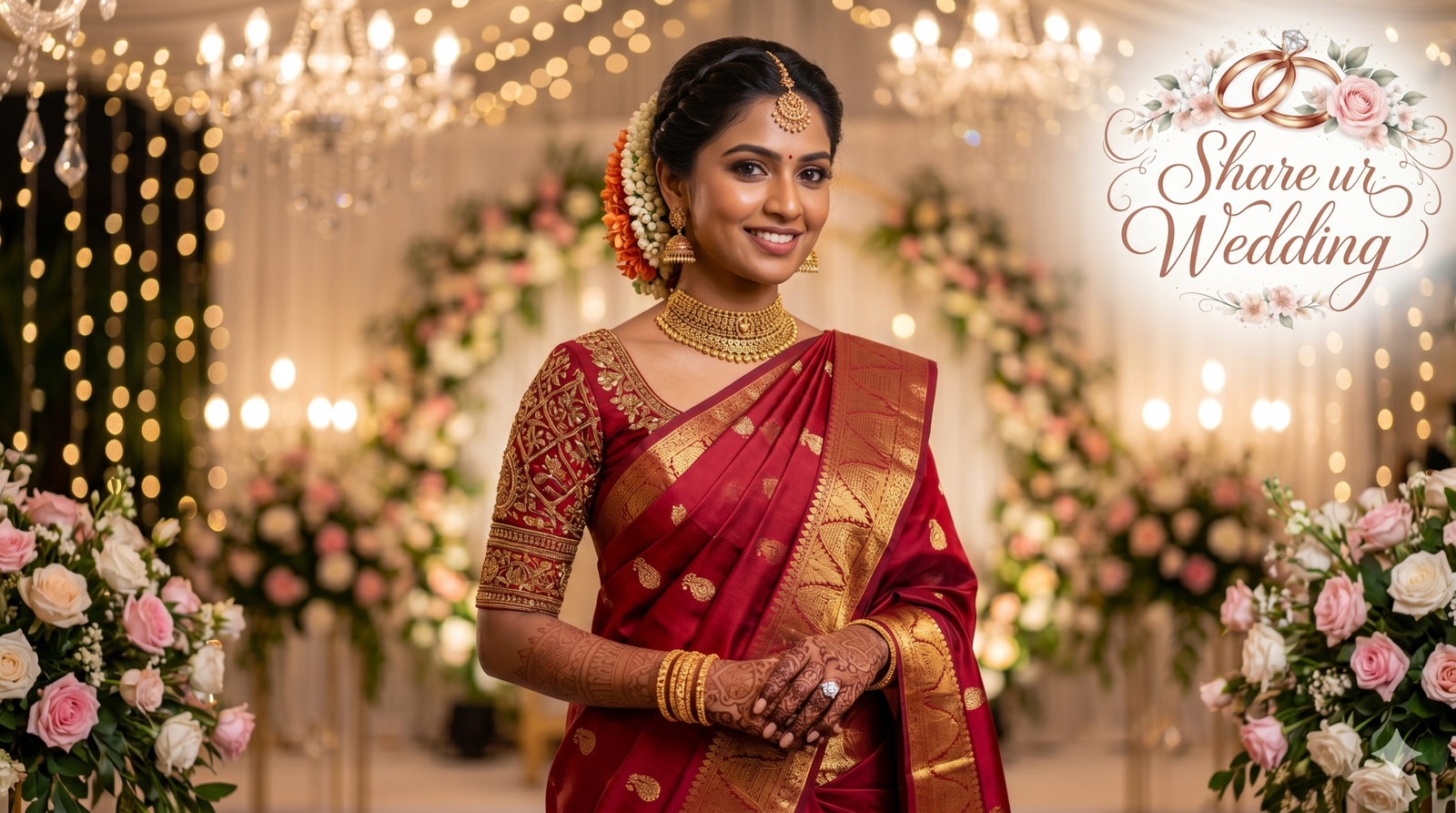
Every bride carries a dream woven into six yards of grace. As we step into the 2026 wedding season, the bridal saree designs 2026 landscape is shifting toward a philosophy of “Mindful Luxury”—a beautiful intersection of ancient handloom heritage and modern, lightweight comfort. Whether you are a traditionalist dreaming of a heavy scarlet Kanjivaram or a modern minimalist seeking a pre-draped organza drape, your wedding saree is the most significant garment you will ever own. It isn’t just an outfit; it is a legacy in the making, an heirloom that carries the whispers of culture and the vibrant energy of a new beginning.
In 2026, the trend moves away from fast-fashion replicas and back toward the “Slow Luxury” of authentic weaves. From the gold-soaked looms of Varanasi to the temple-inspired borders of Kanchipuram, this guide explores 35 quintessential looks tailored for the 2026 bride.
Silk Heritage (Kanjivaram) — Looks #1–10
The Kanjivaram bridal saree designs 2026 collection is defined by a return to “Pattu” purity. Known as the “Queen of Silks,” the Kanchipuram saree is characterized by its heavy silk base and contrasting borders. In 2026, the “Vanki” (armlet) and “Gopuram” (temple) motifs are being reimagined in softer metallic tones like rose gold and antique copper.
Look 1: The Royal Temple Border (The Muhurtham Classic)
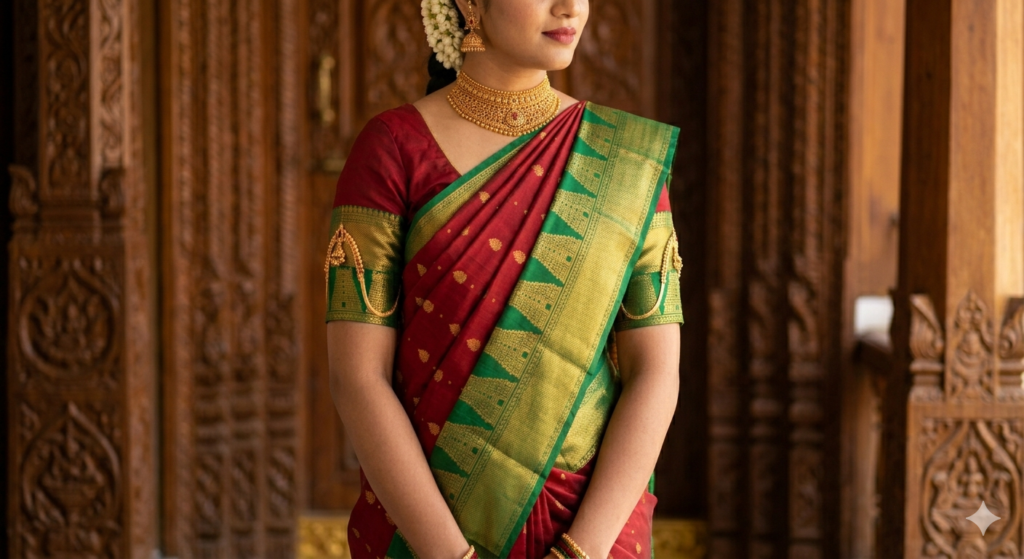
The quintessential red Kanchipuram saree for wedding ceremonies. This look features a “Thazhampoo” (screwpine flower) temple border.
-
Fabric: Pure 3-ply Mulberry Silk.
-
Key Features: Heavy gold zari border with interlocking “Korvai” weaving technique.
-
Best For: The Main Wedding Ceremony (Muhurtham).
-
Styling Note: Pair with traditional temple jewelry and a fresh jasmine veni.
-
Approx. Price: ₹65,000 – ₹1,50,000.
Look 2: The Tissue Kanjivaram (The Metallic Glow)
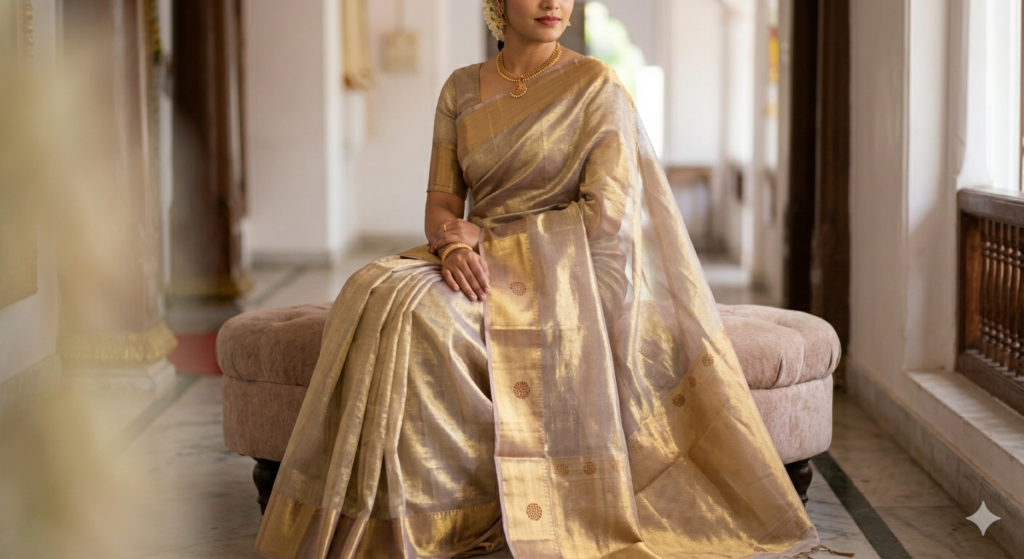
A 2026 favorite, where the silk is interwoven with gold thread throughout the body, giving the bride a literal “glow.”
-
Fabric: Tissue Silk blend.
-
Key Features: Liquid gold appearance, extremely photogenic under stage lights.
-
Best For: Evening Reception.
-
Styling Note: Keep the blouse simple—a matching tissue blouse with elbow-length sleeves.
-
Approx. Price: ₹45,000 – ₹85,000.
Look 3: The Mayil (Peacock) Butta in Teal
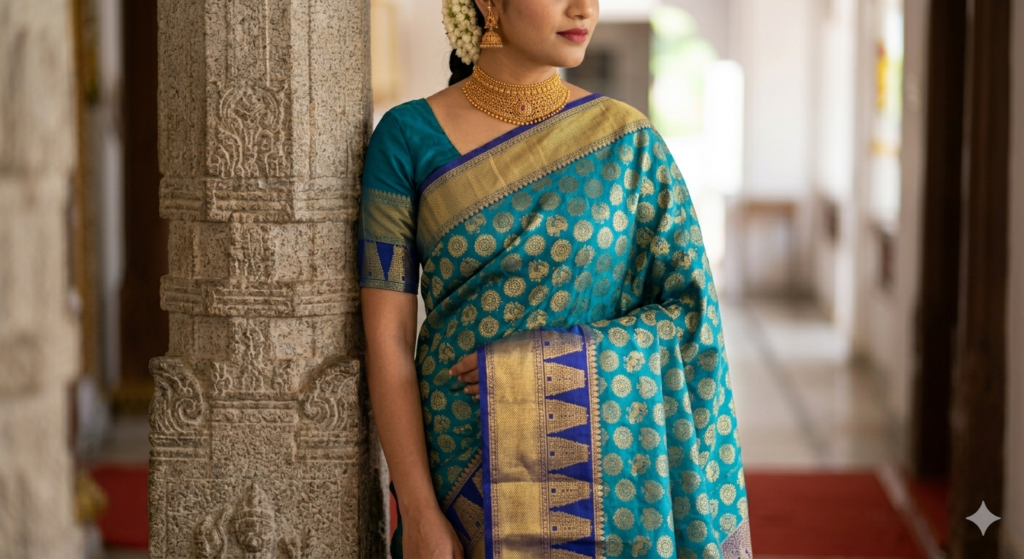
Moving away from red, modern South Indian brides are opting for deep teals and sea greens.
-
Fabric: Heavy weight pattu.
-
Key Features: Tiny “Buttas” or motifs of peacocks and chakras across the body.
-
Best For: Engagement or Betrothal.
-
Styling Note: Contrast with a hot pink blouse for a vibrant pop.
-
Approx. Price: ₹30,000 – ₹50,000.
Look 4: The ‘Palum Pazhamum’ (Vintage Checks)
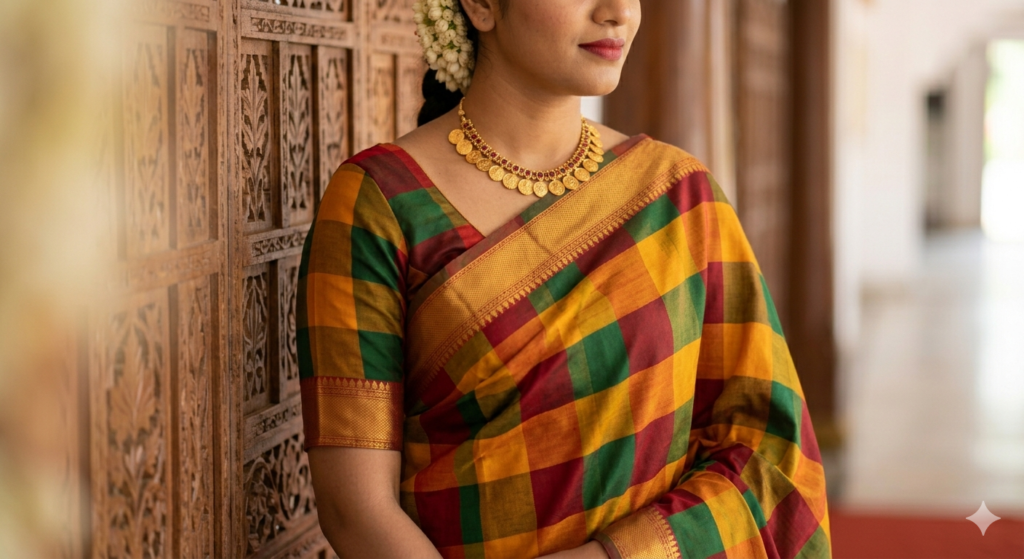
A nostalgic revival for 2026. This multi-colored checkered pattern was popularized in the 60s and is making a huge comeback.
-
Fabric: Soft Kanchipuram silk.
-
Key Features: Small checks in shades of yellow, red, and green.
-
Best For: Pre-wedding rituals (Sumangali Prarthanai).
-
Styling Note: Use a vintage-style puff-sleeve blouse.
-
Approx. Price: ₹25,000 – ₹40,000.
Look 5: The Lavender & Silver Zari (The New-Age Pastel)
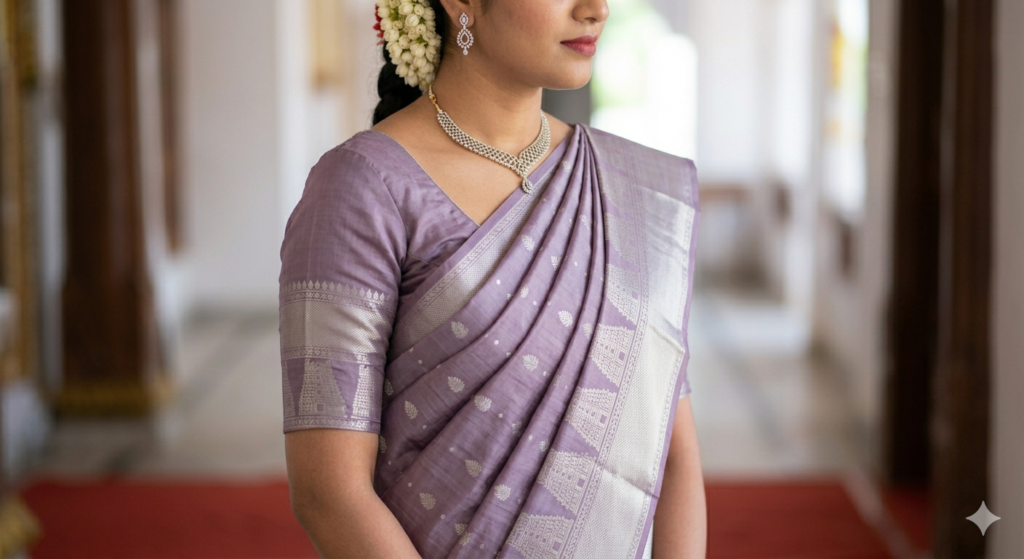
Breaking the “Gold Only” rule, silver zari on pastel shades is the top trend for South Indian bridal saree designs this year.
-
Fabric: Lightweight Mulberry Silk.
-
Key Features: Cool-toned silver weaving on a soft lavender or lilac base.
-
Best For: Morning weddings or summer ceremonies.
-
Styling Note: Diamond or white gold jewelry complements this perfectly.
-
Approx. Price: ₹35,000 – ₹60,000.
Look 6: The Borderless Kanjivaram (Minimalist Chic)
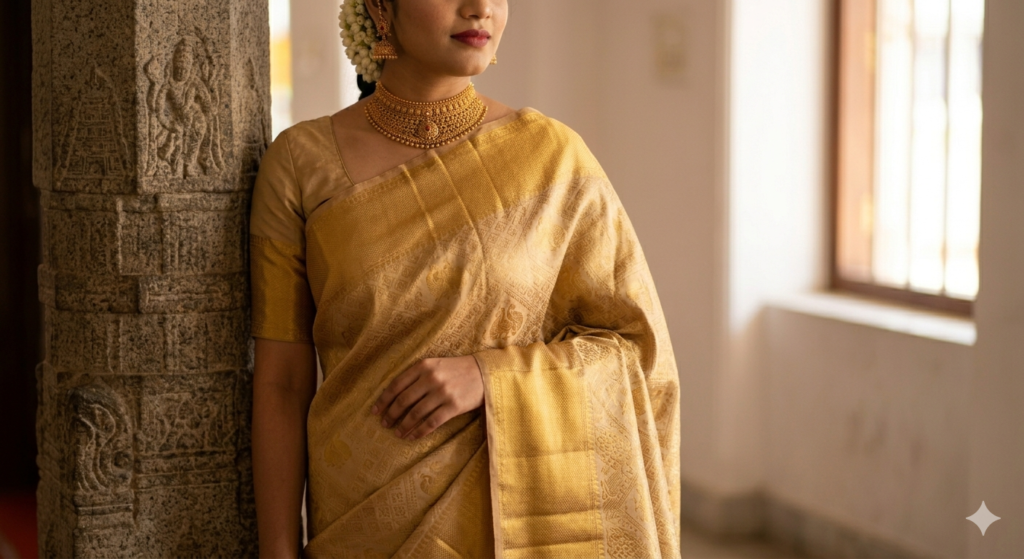
For the bride who finds heavy borders distracting, the borderless look focuses on the richness of the silk grain itself.
-
Fabric: High-density silk.
-
Key Features: No distinct border; the body pattern flows directly to the edge.
-
Best For: Post-wedding luncheons.
-
Styling Note: Wear a heavy statement necklace to compensate for the lack of border.
-
Approx. Price: ₹20,000 – ₹35,000.
Look 7: The Bridal ‘Jaal’ (Allover Weave)
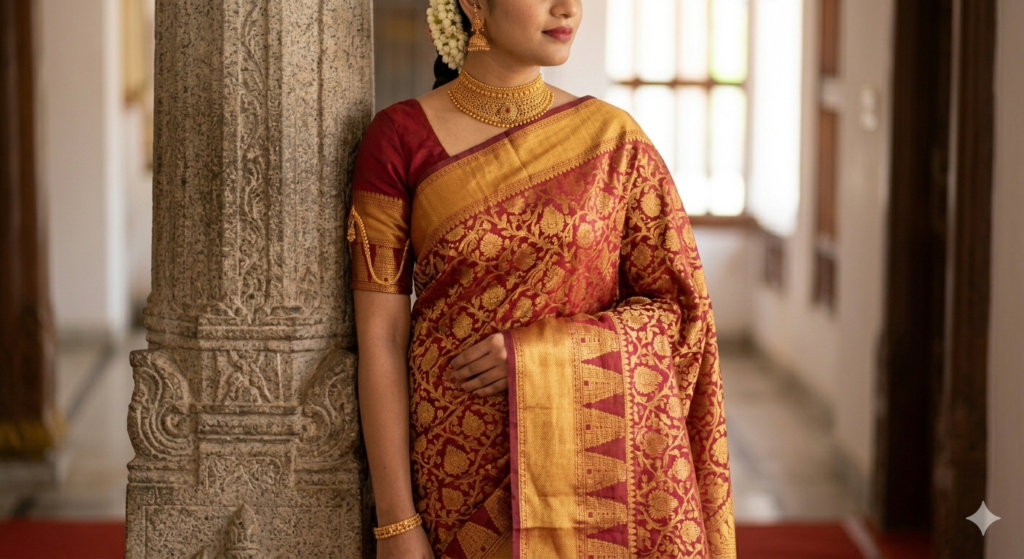
Inspired by North Indian Banarasi styles, this Kanjivaram features an all-over floral gold vine.
-
Fabric: Heavy 4-ply silk.
-
Key Features: No “empty” space on the saree; entirely covered in gold zari.
-
Best For: Grand Receptions.
-
Styling Note: This is a heavy look; keep the hair in a clean bun.
-
Approx. Price: ₹1,10,000 – ₹2,50,000.
Look 8: The Mallinaboo (Jasmine Bud) Motif in Off-White
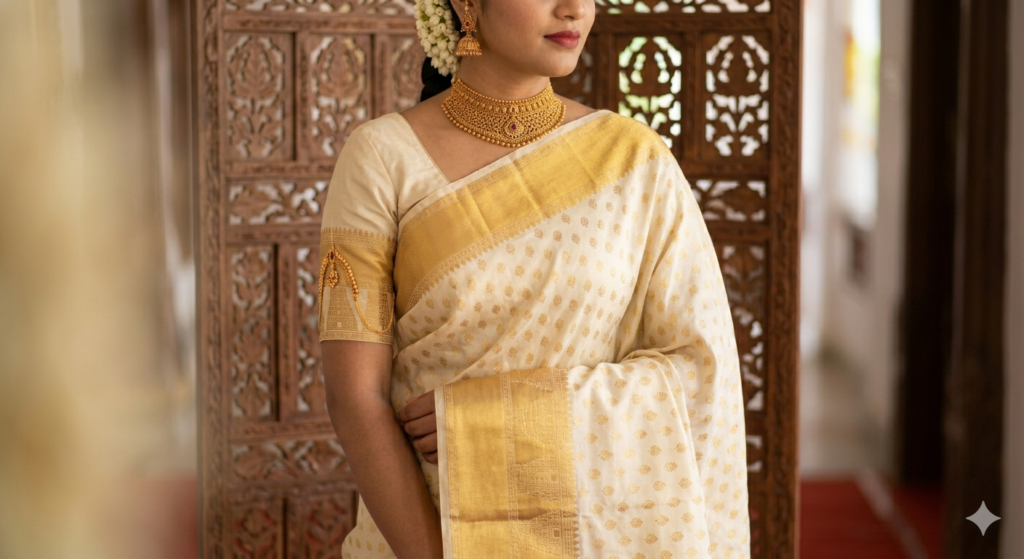
White and cream sarees are no longer “taboo” for brides; they represent the ultimate in sophistication for 2026.
-
Fabric: Cream Kanchipuram silk.
-
Key Features: Small jasmine bud motifs in “pure” gold zari.
-
Best For: Temple Weddings.
-
Styling Note: Gold jewelry with rubies (Kemp) provides a stunning contrast.
-
Approx. Price: ₹40,000 – ₹75,000.
Look 9: The Copper Zari ‘Arai Maadam’
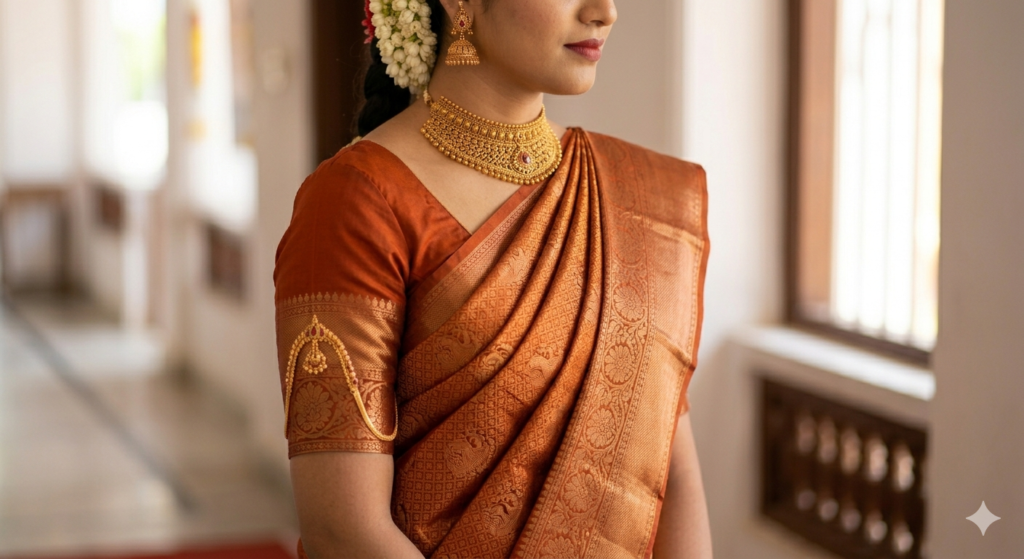
Copper zari offers a more muted, earthy elegance compared to bright yellow gold.
-
Fabric: Burnt orange or deep maroon silk.
-
Key Features: “Arai Maadam” (half-moon/niche) patterns in the border.
-
Best For: Autumn or Winter weddings.
-
Styling Note: Excellent for dusky skin tones; use bronze-based makeup.
-
Approx. Price: ₹50,000 – ₹90,000.
Look 10: The Multi-Color ‘Ganga Jamuna’ Border
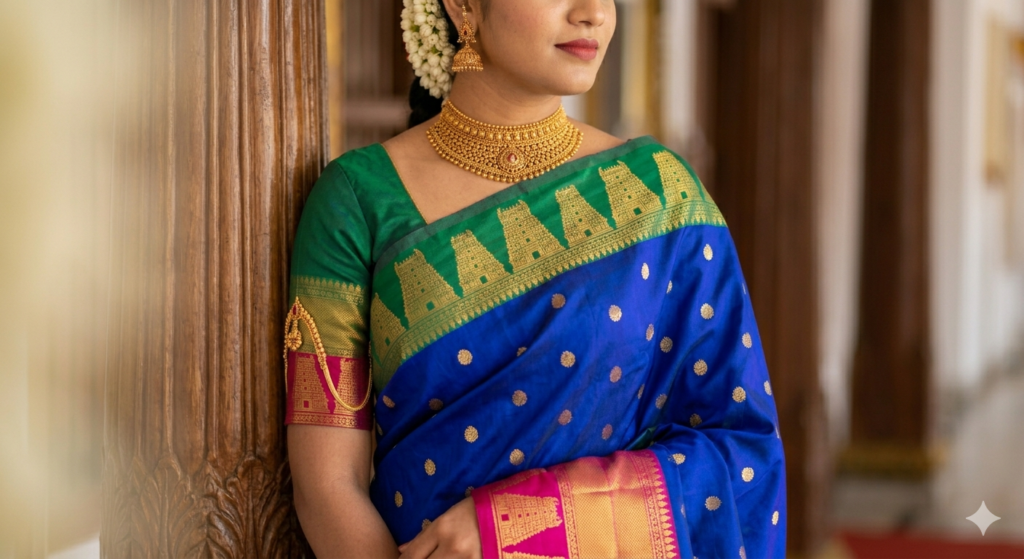
A saree featuring two different colored borders—one on top and one on the bottom.
-
Fabric: Contrasting silk shades.
-
Key Features: One border might be emerald green while the other is royal blue.
-
Best For: Sangeet or Mehendi.
-
Styling Note: A blouse that incorporates both colors will tie the look together.
-
Approx. Price: ₹35,000 – ₹55,000.
Banarasi Gold & Pastels — Looks #11–18
If the Kanjivaram is the “Queen of Silks,” the Banarasi silk wedding saree is undoubtedly the “Emperor of Weaves.” Originating from the holy city of Varanasi, these sarees are the epitome of Mughal-inspired luxury. For 2026, the trend has split into two distinct paths: the “Royal Red Revival” and the “Pastel Revolution.”
Look 11: The ‘Shikargah’ Masterpiece (The Royal Hunt)
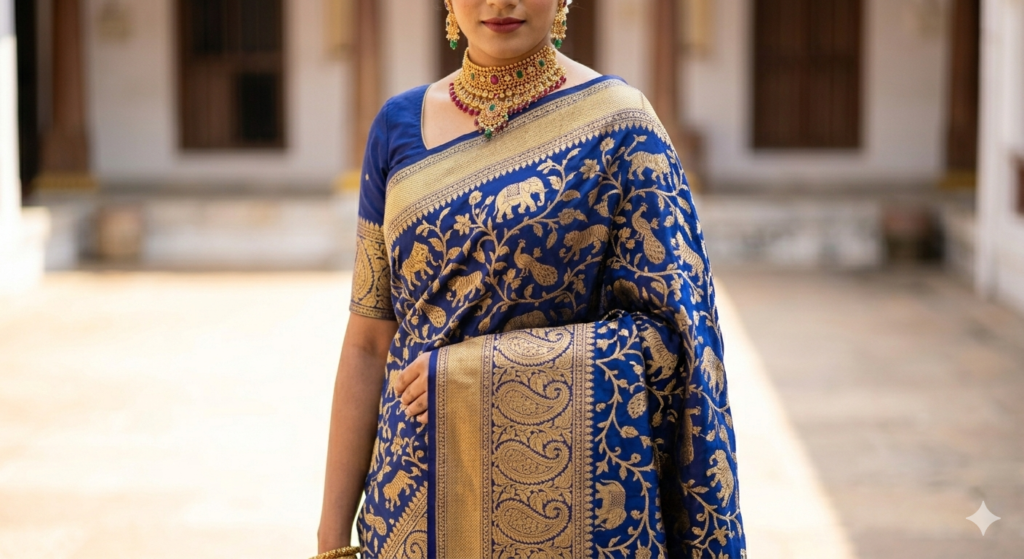
A true heirloom piece featuring an intricate “Jungle” or hunting scene woven into the fabric.
-
Fabric: Pure Katan Silk.
-
Key Features: Hand-woven motifs of lions, deer, and parrots nestled in floral vines (Latas).
-
Best For: The Grand Entrance / Main Wedding Ceremony.
-
Styling Note: Inspired by Rani Mukerji’s iconic bottle green Banarasi looks; pair with heavy gold chokers.
-
Approx. Price: ₹75,000 – ₹2,00,000+.
Look 12: Ivory & Gold Tissue (The Ethereal Glow)
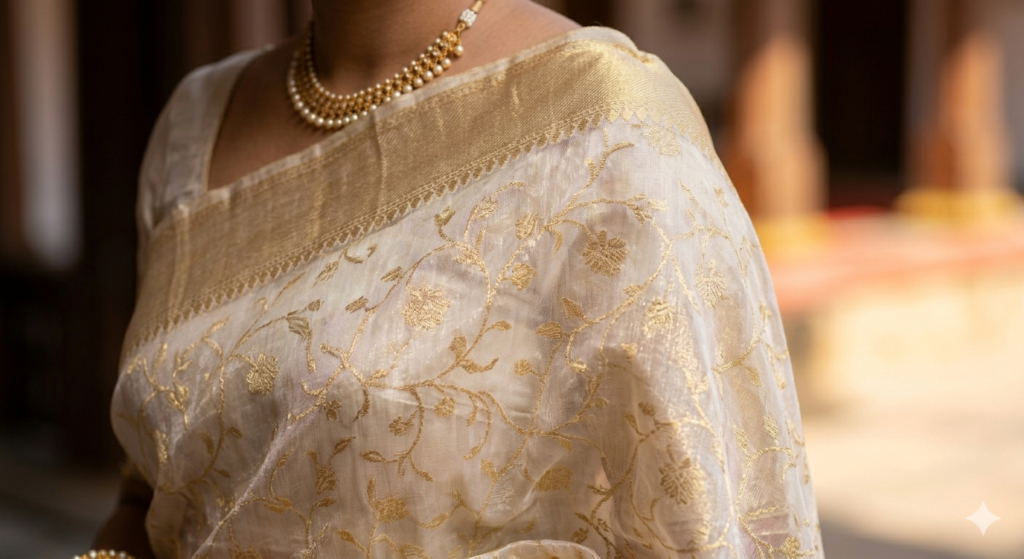
The “Anti-Red” bride’s favorite for 2026. This saree uses a gold thread warp and a silk weft to create a metallic, translucent finish.
-
Fabric: Silk Tissue.
-
Key Features: Lightweight and shimmering; often features “Zardosi” border work.
-
Best For: Summer Morning Weddings.
-
Celebrity Look: Reminiscent of Sonali Bendre’s silver-blue tissue brocade elegance.
-
Approx. Price: ₹45,000 – ₹95,000.
Look 13: Dual-Tone Peach & Rose Gold
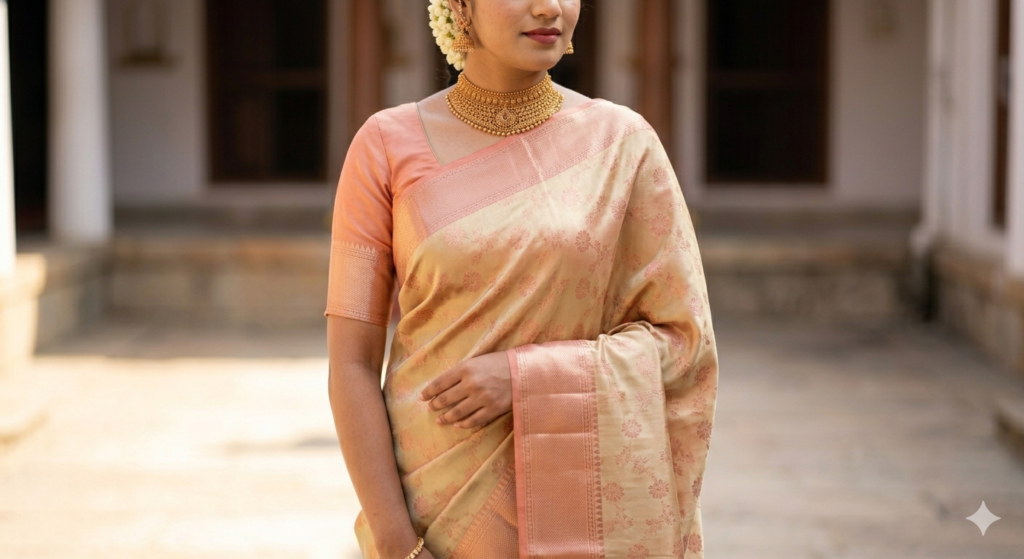
Dual-tones (Dhoop-Chhaon) are a massive wedding saree 2026 trend, where the saree changes color as you move.
-
Fabric: Satin Silk.
-
Key Features: Peach body with rose gold zari instead of traditional yellow gold.
-
Best For: Engagement or Roka.
-
Styling Note: Use a sleeveless corset blouse for a modern twist.
-
Approx. Price: ₹35,000 – ₹60,000.
Look 14: The Meenakari Jaal (Colored Zari)
“Meenakari” involves weaving colorful silk threads into the gold zari to create a stained-glass effect.
-
Fabric: Heavy Katan Silk.
-
Key Features: Vibrant motifs in pink, green, and blue within a gold “Jaal” (mesh).
-
Best For: Winter Weddings (due to its weight and warmth).
-
Approx. Price: ₹60,000 – ₹1,20,000.
Look 15: Lavender Haze & Silver ‘Chandi’ Zari
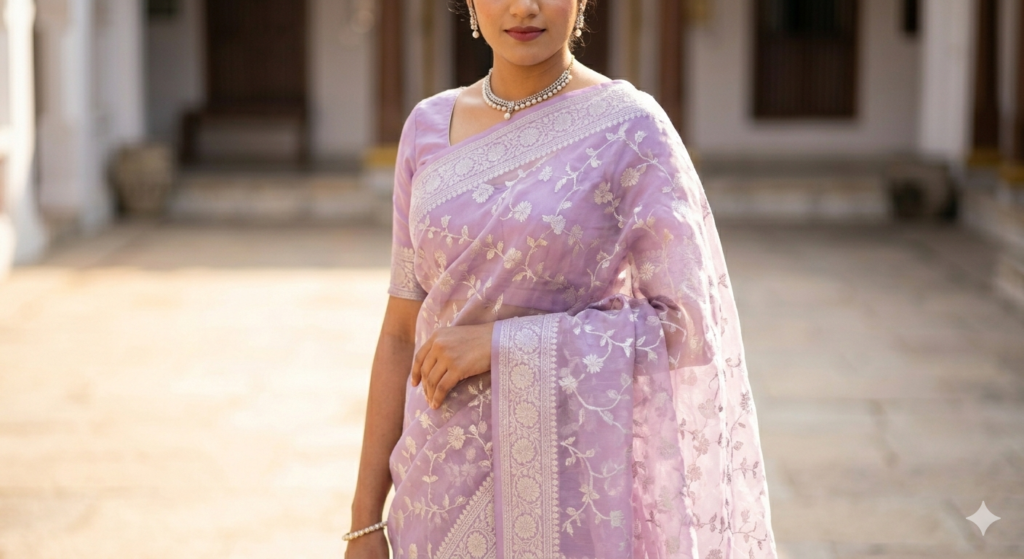
Moving away from gold, silver zari is the “it” metal for 2026 brides.
-
Fabric: Kora Organza (Banarasi).
-
Key Features: Sheer, crisp texture with cool-toned silver embroidery.
-
Best For: Daytime Reception or Sangeet.
-
Styling Note: Pair with “Sheeshpatti” (headgear) and silver-based jewelry.
-
Approx. Price: ₹25,000 – ₹55,000.
Look 16: The ‘Butidar’ Classic (Antique Gold)
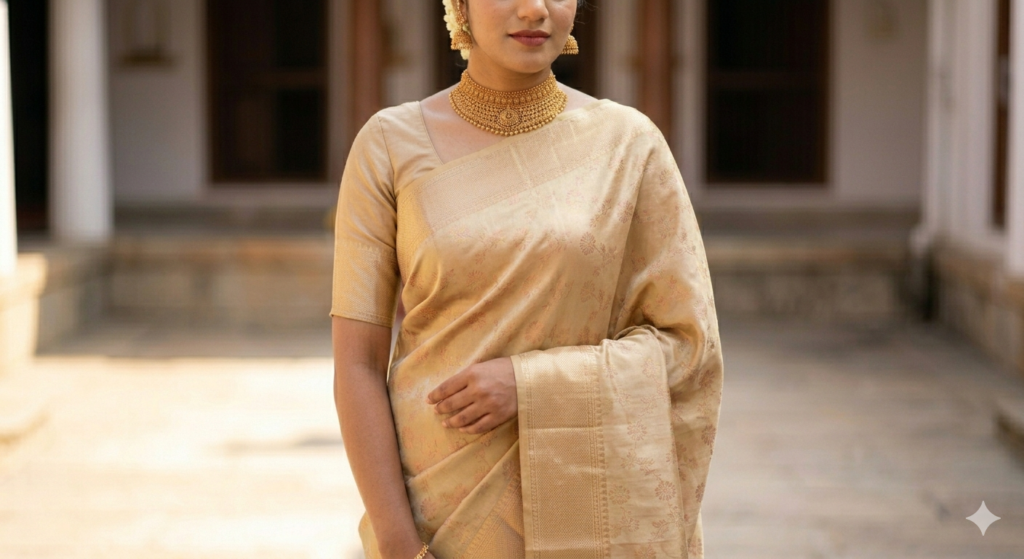
For the bride who wants a less “busy” look, the Butidar features small, scattered motifs across the body.
-
Fabric: Pure Georgette Banarasi.
-
Key Features: “Ashrafi” (coin) or “Paan” (leaf) butis; incredibly soft drape.
-
Best For: Pheras (easier to sit and move in for hours).
-
Approx. Price: ₹20,000 – ₹45,000.
Look 17: Champagne Gold Tanchoi
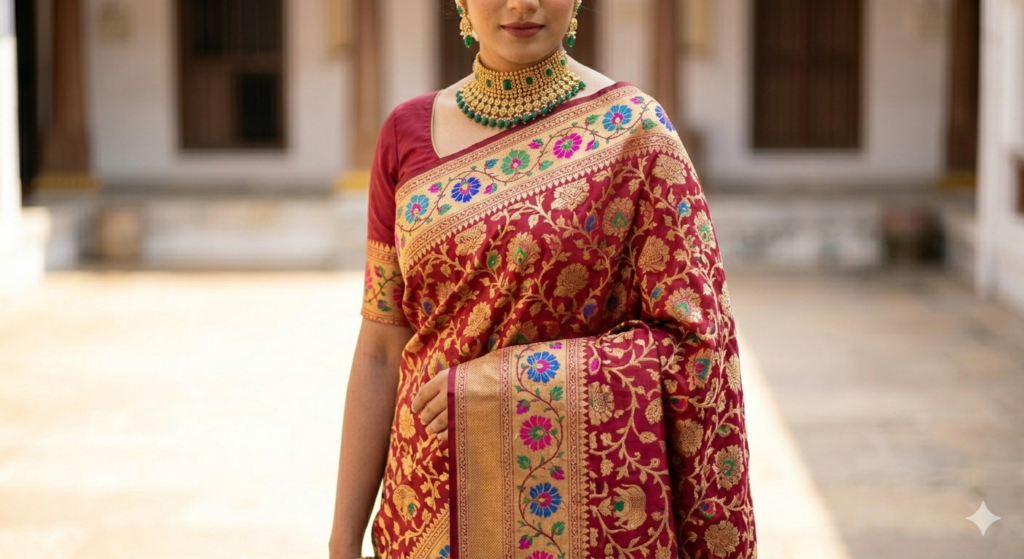
Tanchoi is a unique weaving technique that uses no zari, only colorful silk threads to create a satin-like embossed finish.
-
Fabric: Satin Silk.
-
Key Features: Monochromatic patterns that catch the light through texture rather than glitter.
-
Best For: Sophisticated Cocktail Party.
-
Approx. Price: ₹18,000 – ₹35,000.
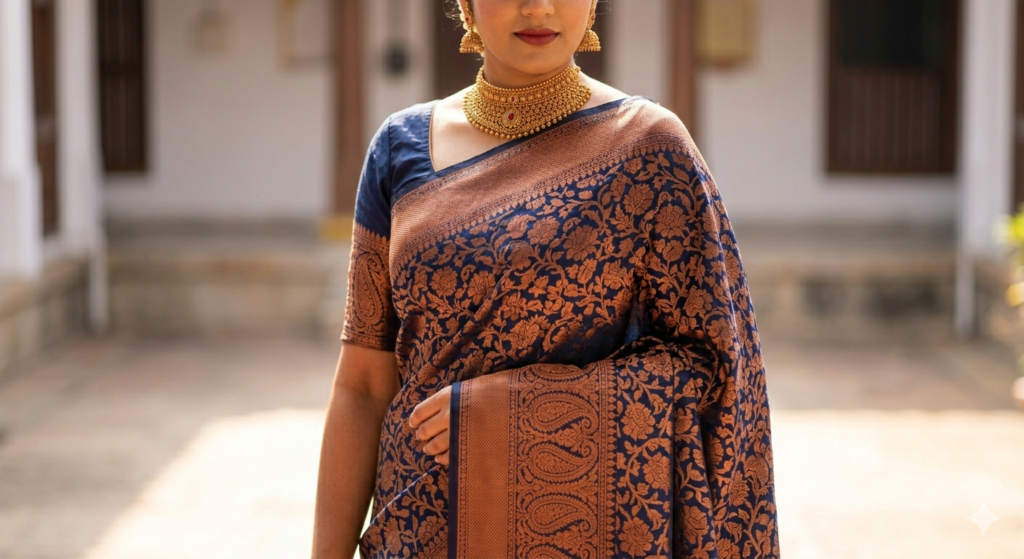
Look 18: Midnight Navy & Copper Zari
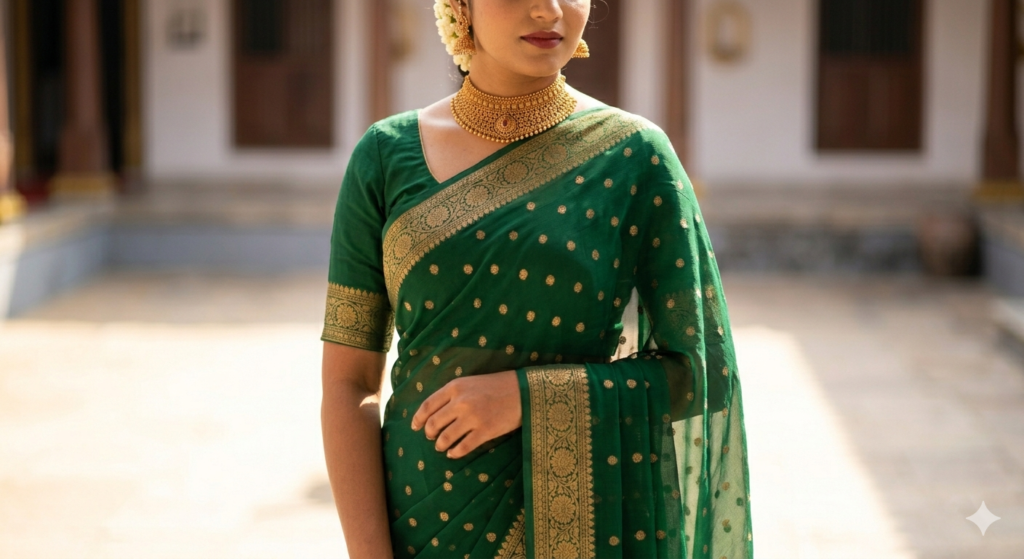
A powerful, regal combination that has overtaken black for evening events.
-
Fabric: Heavy Brocade Silk.
-
Key Features: Deep navy body with warm, burnished copper zari work.
-
Best For: Grand Reception.
-
Approx. Price: ₹55,000 – ₹1,10,000.
The Weaver’s Map — Regional Masterpieces (#19–26)
In 2026, the “Conscious Bride” is choosing regional weaves that carry the GI (Geographical Indication) tag, supporting local artisan clusters. These looks offer a map of India’s diverse textile heritage.
Look 19: Patan Patola (Gujarat) — The “Queen of Heritage”
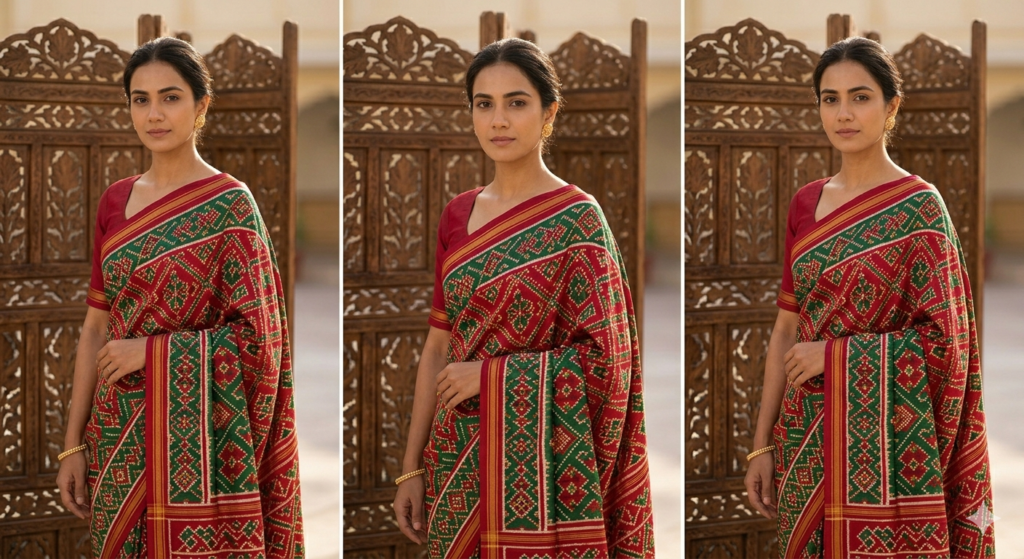
-
Map Context: Patan, Gujarat.
-
GI Tag Status: Protected since 2013.
-
The Look: Double Ikkat where the design is identical on both sides.
-
Key Feature: Geometric vibrancy (lions, parrots, elephants).
-
Price: ₹1,50,000 – ₹7,00,000 (A true luxury investment).
Look 20: Paithani (Maharashtra) — The “Poetry in Silk”
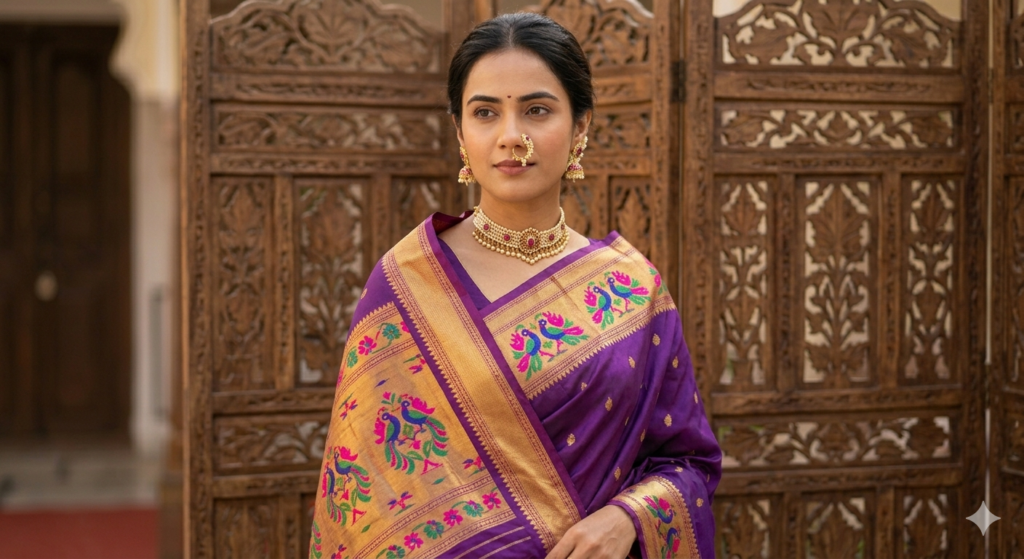
-
Map Context: Paithan/Yeola, Maharashtra.
-
The Look: Hand-woven kaleidoscope pallu with peacock (Mor) motifs.
-
Key Feature: Square-bordered “Oblique” weave.
-
Best For: Maharashtrian Nauvari (9-yard) bridal look.
-
Price: ₹25,000 – ₹1,50,000.
Look 21: Pochampally Ikat (Telangana) — “Geometric Grace”
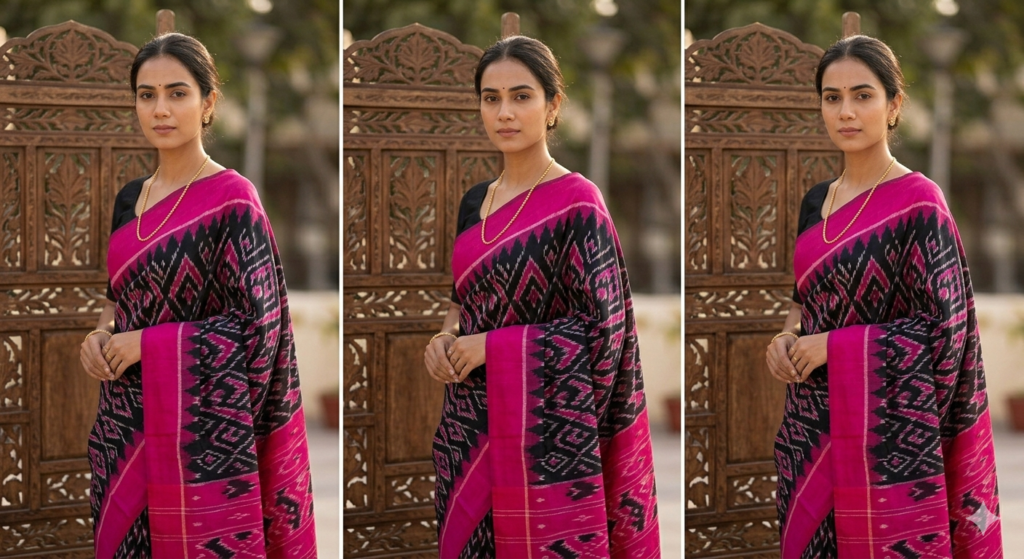
-
Map Context: Bhoodan Pochampally, Telangana.
-
The Look: Sharp, blurred geometric “Ikkat” patterns.
-
2026 Trend: Brides are opting for Pochampally Ikat in bright neon-pop borders.
-
Price: ₹15,000 – ₹45,000.
Look 22: Mysore Silk (Karnataka) — “The Royal Minimalist”
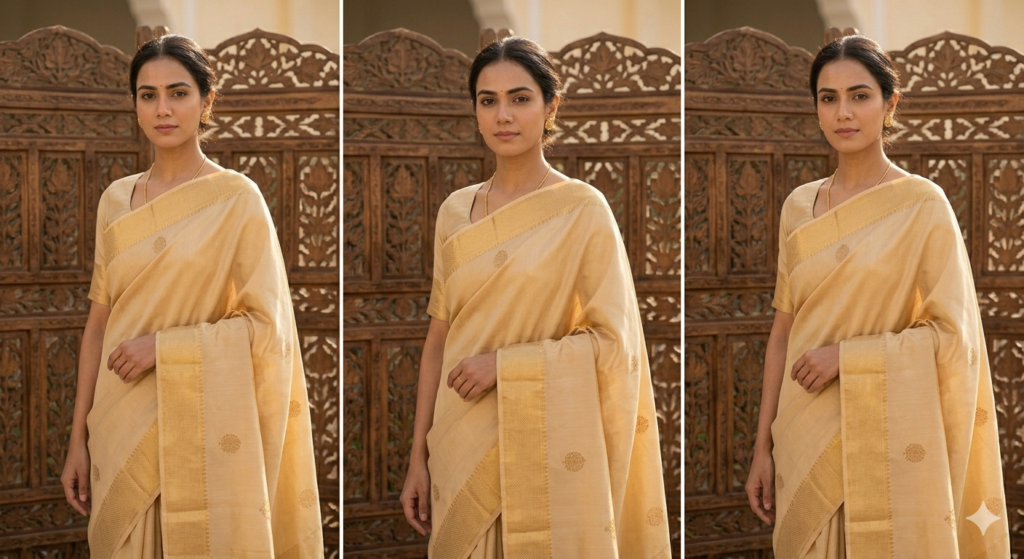
-
Map Context: Mysore, Karnataka.
-
The Look: The softest silk in India with a simple, solid gold zari border.
-
Key Feature: 100% pure silk with high durability.
-
Best For: Minimalist brides or temple-based rituals.
-
Price: ₹12,000 – ₹35,000.
Look 23: Chanderi (Madhya Pradesh) — “The Gossamer Dream”
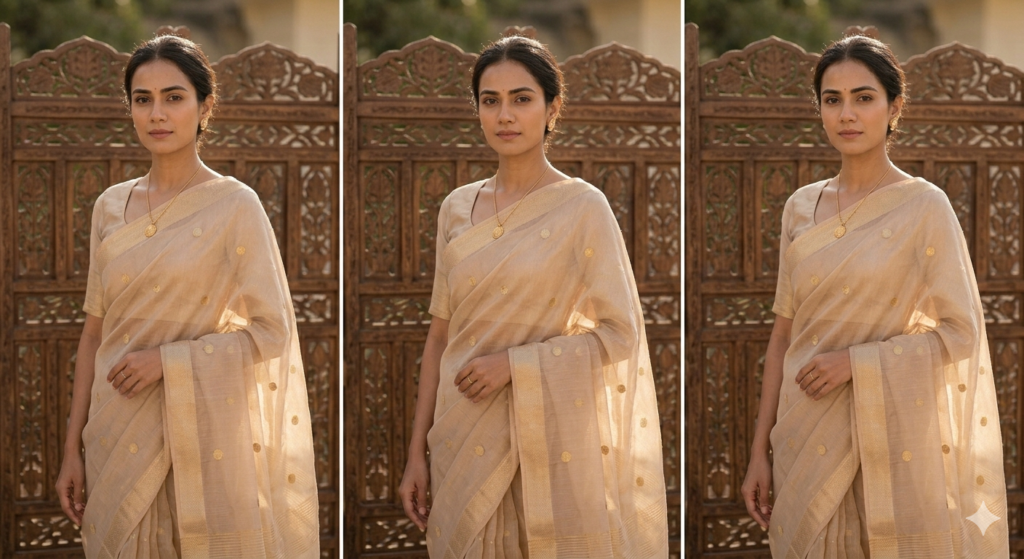
-
Map Context: Chanderi, Madhya Pradesh.
-
The Look: A sheer, shimmering blend of silk and cotton.
-
Key Feature: Delicate “Nalferma” (tubular) borders and gold coin butis.
-
Price: ₹8,000 – ₹25,000.
Look 24: Jamdani (Bengal) — “The Unspoken Art”
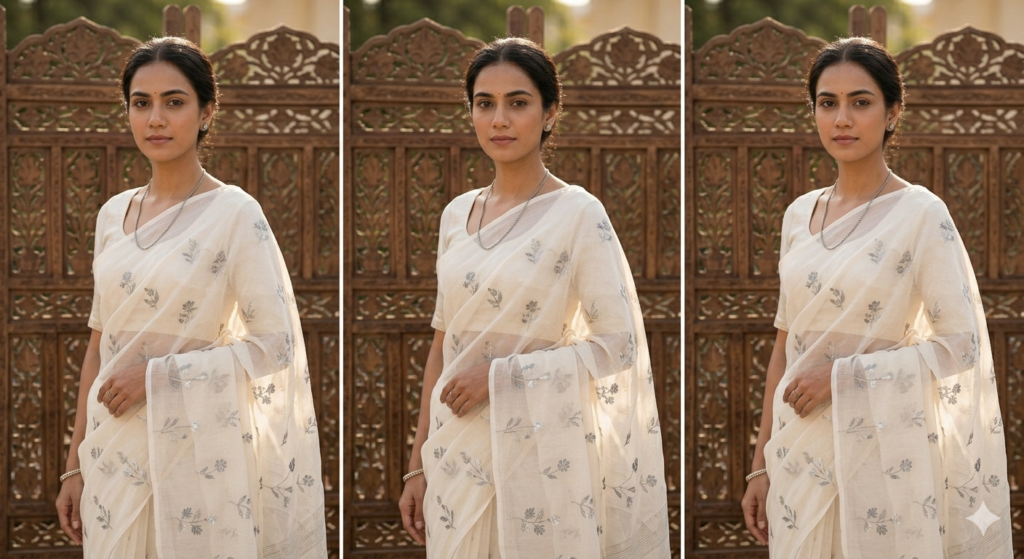
-
Map Context: West Bengal (Dhaka origin).
-
The Look: Floral motifs that seem to “float” on transparent muslin or silk.
-
Key Feature: Woven without a machine; entirely by hand using a wooden tool.
-
Price: ₹20,000 – ₹80,000.
Look 25: Sambalpuri Silk (Odisha) — “Nature’s Canvas”
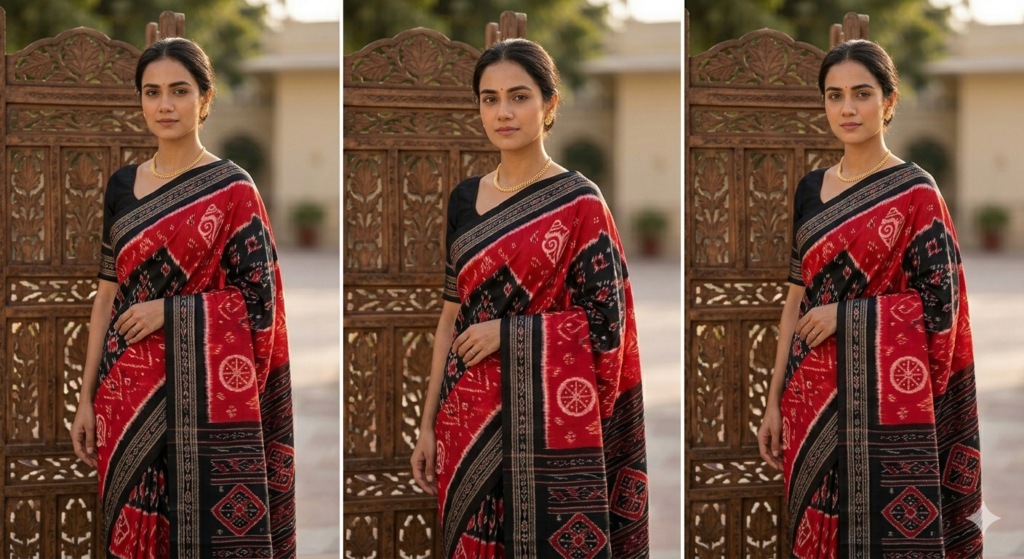
-
Map Context: Western Odisha.
-
The Look: Traditional motifs like the “Shankha” (shell) and “Chakra” (wheel).
-
Key Feature: The “Baandha” (tie-dye) technique.
-
Price: ₹15,000 – ₹50,000.
Look 26: Tussar Silk (Chhattisgarh) — “Earthy Elegance”
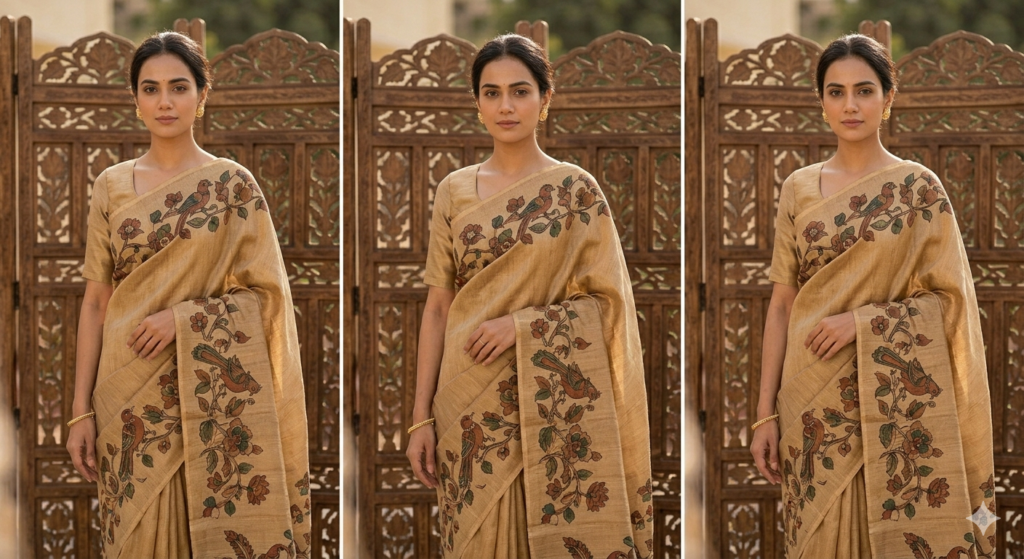
-
Map Context: Champa/Raigarh region.
-
The Look: A rich, textured gold-beige natural silk.
-
2026 Trend: Hand-painted “Kalamkari” work on Tussar for a bohemian bridal look.
-
Price: ₹10,000 – ₹30,000.
Contemporary & Designer — Looks #27–35
For the modern urban bride of 2026, the saree is no longer just a garment—it is a design statement. This section caters to the “New-Age Bride” who prioritizes comfort, speed of wear, and a high-fashion aesthetic for her reception, sangeet, or cocktail party.
Look 27: The Pre-Draped ‘5-Minute’ Saree
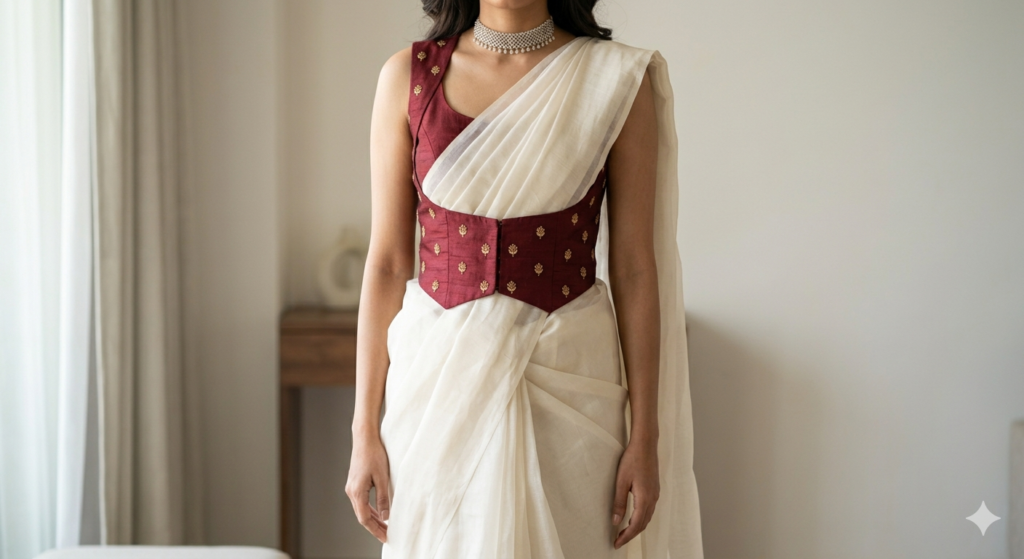
The absolute #1 request for bridal saree designs 2026. This saree comes with pre-stitched pleats and a concealed zipper, ensuring you look like a “Draping Pro” in seconds.
-
Best For: Destination Weddings where you lack professional help.
-
Key Feature: Zero pins required; stays perfect through 12+ hours of dancing.
Look 28: The Lehenga-Saree Hybrid
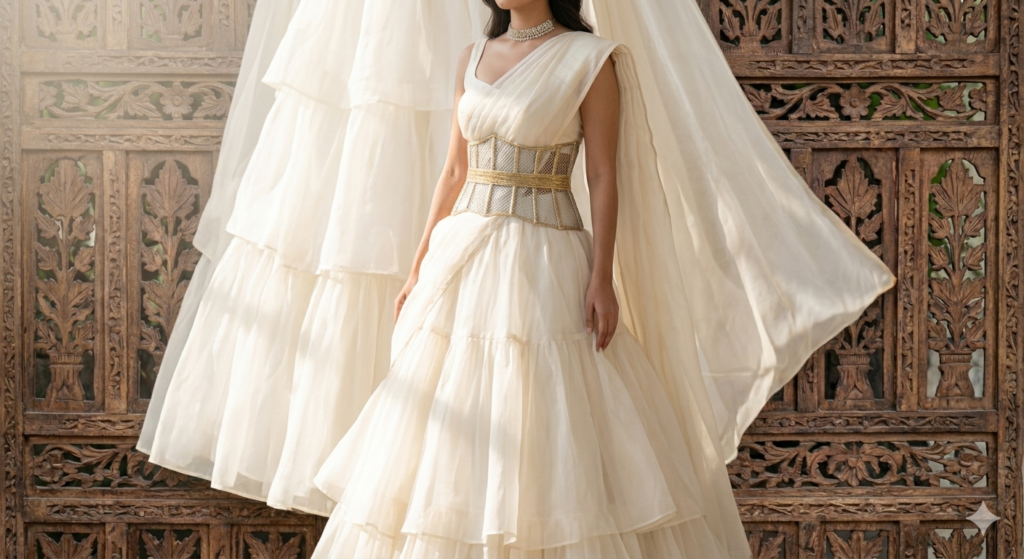
A flared, heavy-work lehenga skirt that transitions into a pre-attached pallu. It offers the volume of a lehenga with the elegance of a saree.
-
Best For: Sangeet (allows for maximum leg movement).
-
Styling Note: Pair with a waist-cinching metallic belt for a sharp silhouette.
Look 29: Organza with 3D Pearl Embroidery
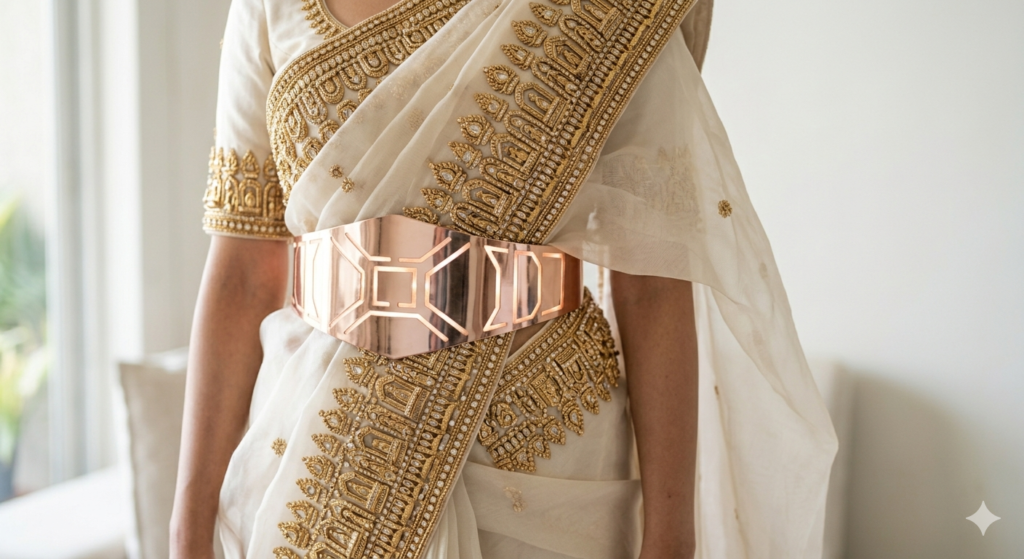
Organza is the “it” fabric of 2026. It is translucent, crisp, and creates a dreamy, ethereal halo around the bride.
-
Look: Light beige or powder blue with raised pearl and mirror work.
-
Best For: Intimate Day Weddings or Brunches.
Look 30: The Corset-Blouse Saree
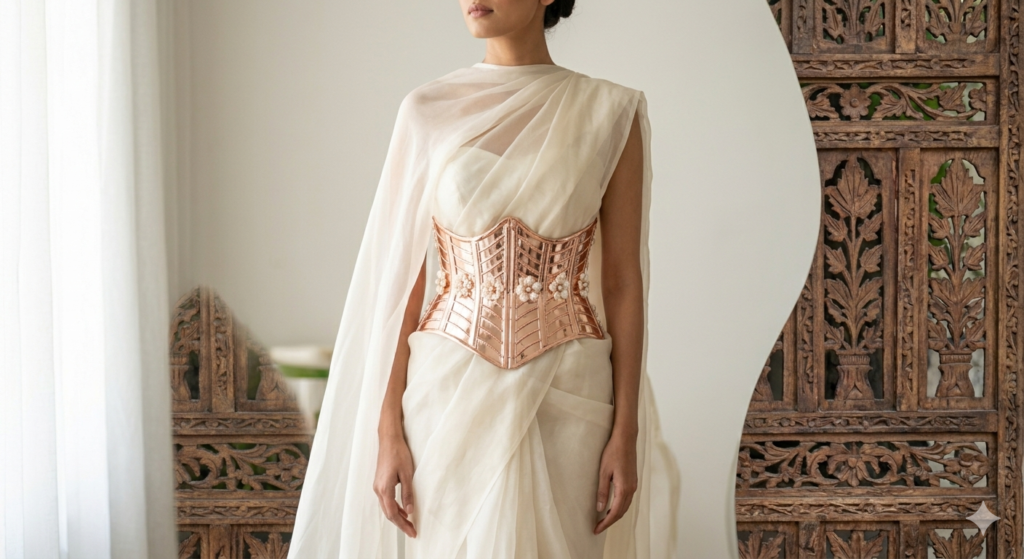
Structure meets fluidity. A rigid, hand-embroidered corset bodice paired with a fluid, lightweight Chiffon or Georgette saree.
-
Key Benefit: Built-in support and a perfect hourglass shape.
-
Approx. Price: ₹45,000 – ₹1,20,000 (Designer labels).
Look 31: Cape-Style & Jacket Pairings
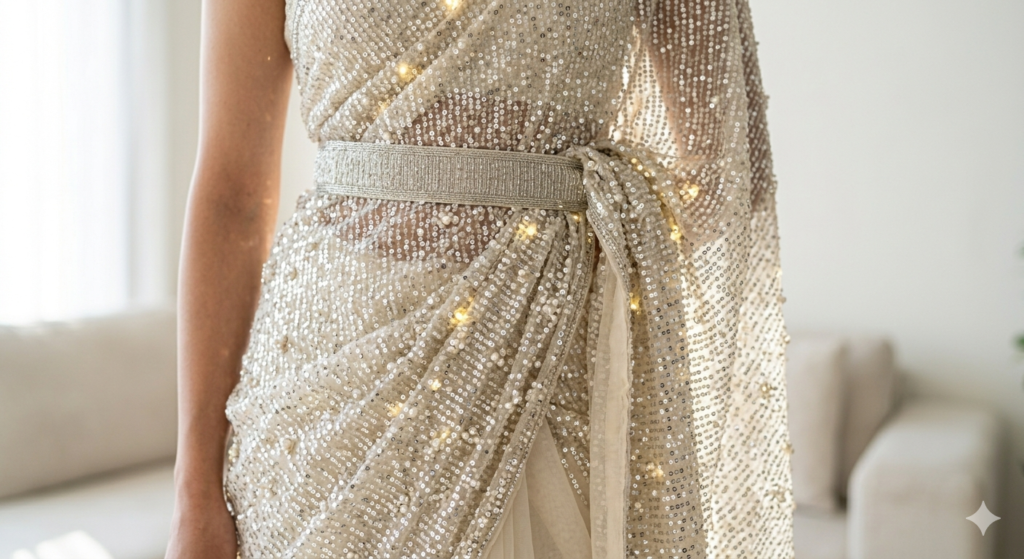
Replacing the traditional dupatta, brides are opting for sheer floor-length capes or embroidered silk jackets over their sarees.
-
The Trend: Wear the jacket for the formal ceremony and remove it to reveal a strappy blouse for the party.
Look 32: Sequin-Sheeted Glamour
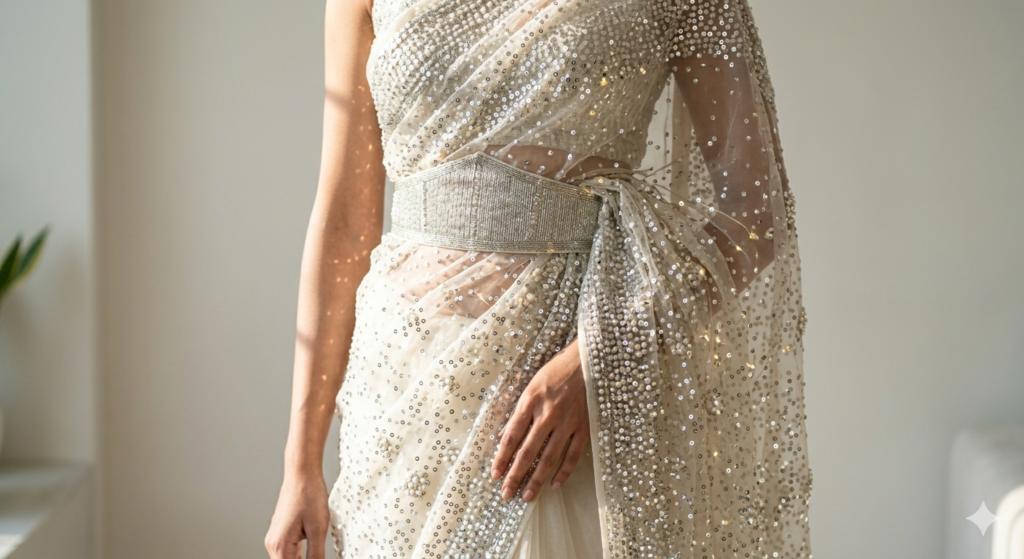
Inspired by the “Disco-Saree” trend, these sarees are entirely covered in micro-sequins, creating a liquid-metal effect.
-
Best For: Cocktail Nights.
-
Colors: Champagne, Pewter, and Midnight Rose.
Look 33: The Sustainable Vegan Silk
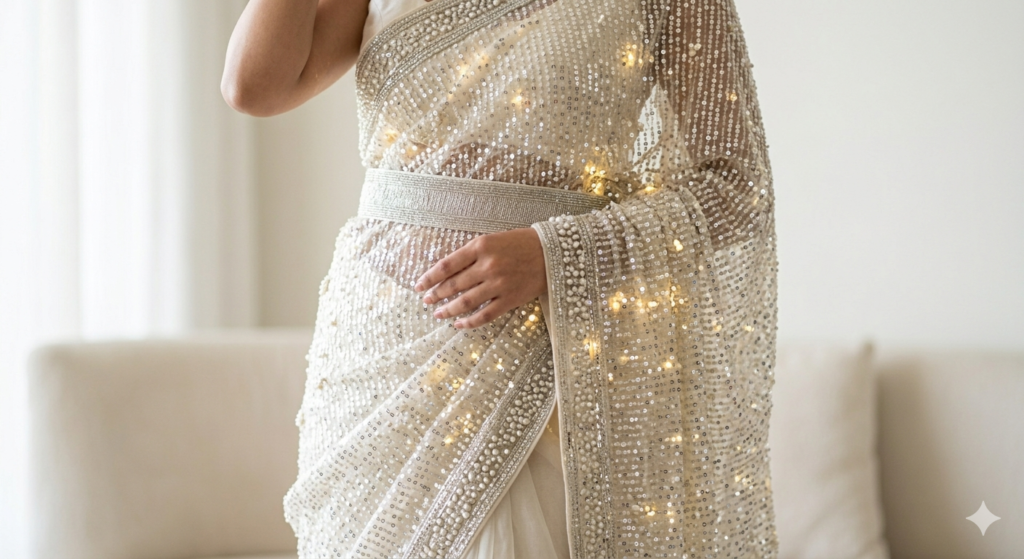
Made from lotus, banana, or rose fibers, these sarees cater to the eco-conscious 2026 bride.
-
The Feel: Extremely breathable and soft; looks identical to traditional silk but is 100% cruelty-free.
Look 34: Fusion ‘Dhoti’ Saree
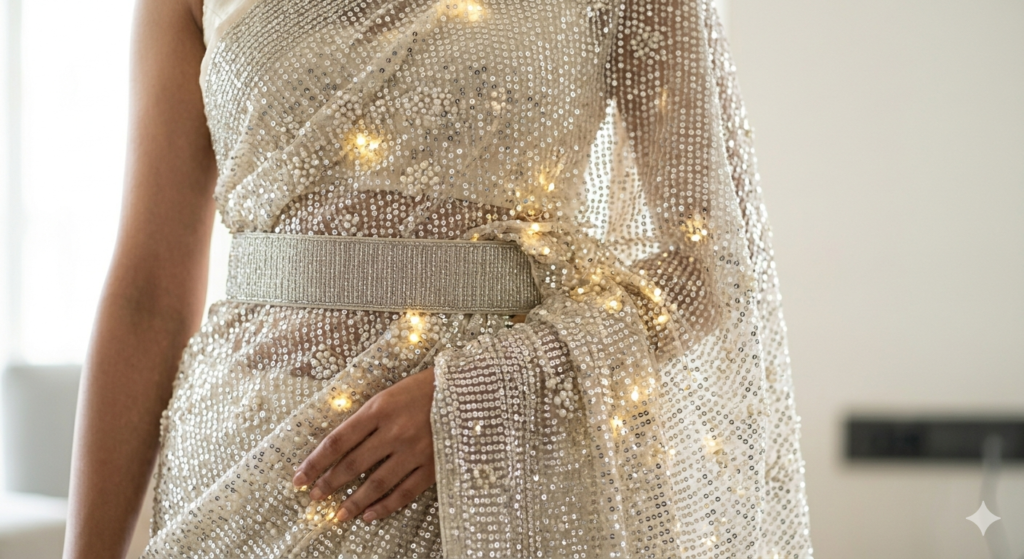
A draped saree worn over dhoti-style pants or trousers. It’s edgy, modern, and incredibly comfortable.
-
Best For: Mehendi ceremonies where you need to sit cross-legged.
Look 35: The Heirloom Restorationwedding saree 2026
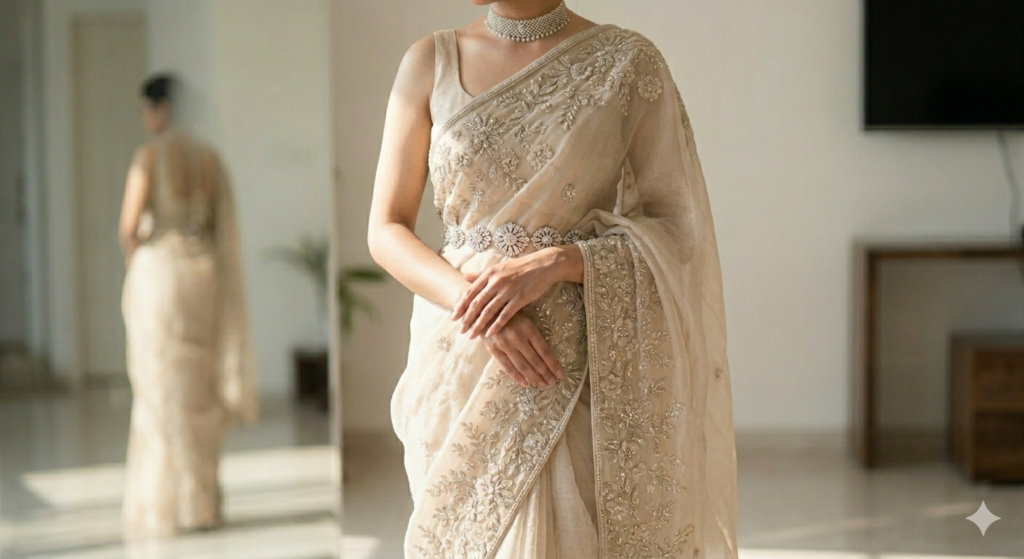
In 2026, many brides are choosing to “Restore” their mother’s wedding saree.
-
The Look: Original vintage silk body paired with a brand-new heavy work blouse and a contemporary border.
-
Value: High sentimental value and ultimate sustainability.
Buyer’s Guide & FAQ: Everything You Need to Know
The 2026 Price Index Table
| Budget Tier | Best Saree Types | Use Case |
|---|---|---|
| Budget (Under ₹25k) | Mysore Silk, Chanderi, Soft Silk Blends | Pre-wedding rituals, guest wear, or Haldi. |
| Mid-Range (₹25k–₹1L) | Pure Kanjivaram, Banarasi, Designer Organza | The primary choice for the Wedding or Reception. |
| Luxury (Above ₹1L) | Real Gold Zari, Patan Patola, Label Designers | Heirloom pieces and high-profile grand events. |
Care Tips for a Lifetime of Wear
-
Storage: Wrap in breathable muslin cloth. Never use plastic bags, as they trap moisture and turn silk brittle.
-
Air it out: Every 3–4 months, unfold your saree and air it in a shaded room for a few hours. This prevents the silk from “splitting” at the fold lines.
-
Cleaning: Always opt for Professional Dry Cleaning. For minor stains, dab (don’t rub) with cold water immediately.
-
Ironing: Use a low-heat setting and always place a thin cotton cloth between the iron and the saree.
Frequently Asked Questions (PAA)
What is the trending bridal saree color in 2026?
While Red remains auspicious, 2026 is the year of “Neo-Neutrals.” Colors like Ivory & Gold, Lavender, and Champagne are dominating the charts for their sophisticated, modern appeal.
Which saree is best for a petite bride?
Petite brides should opt for Lightweight Organza or Chiffon with small, delicate borders. Heavy Kanjivarams with massive borders can often “overpower” a smaller frame.
What is the difference between Kanjivaram and Banarasi?
Kanjivaram (Tamil Nadu) is known for its thick, 3-ply silk and temple-inspired geometric borders. Banarasi (Varanasi) is famous for its Mughal-inspired floral “Jaal” (meshes) and use of fine gold/silver thread called “Zari.”
How much does a real gold zari Kanjivaram cost?
An authentic Kanjivaram with “Pure Gold Zari” (silver thread dipped in gold) usually starts at ₹75,000 and can go up to several lakhs depending on the weight of the precious metal used.