
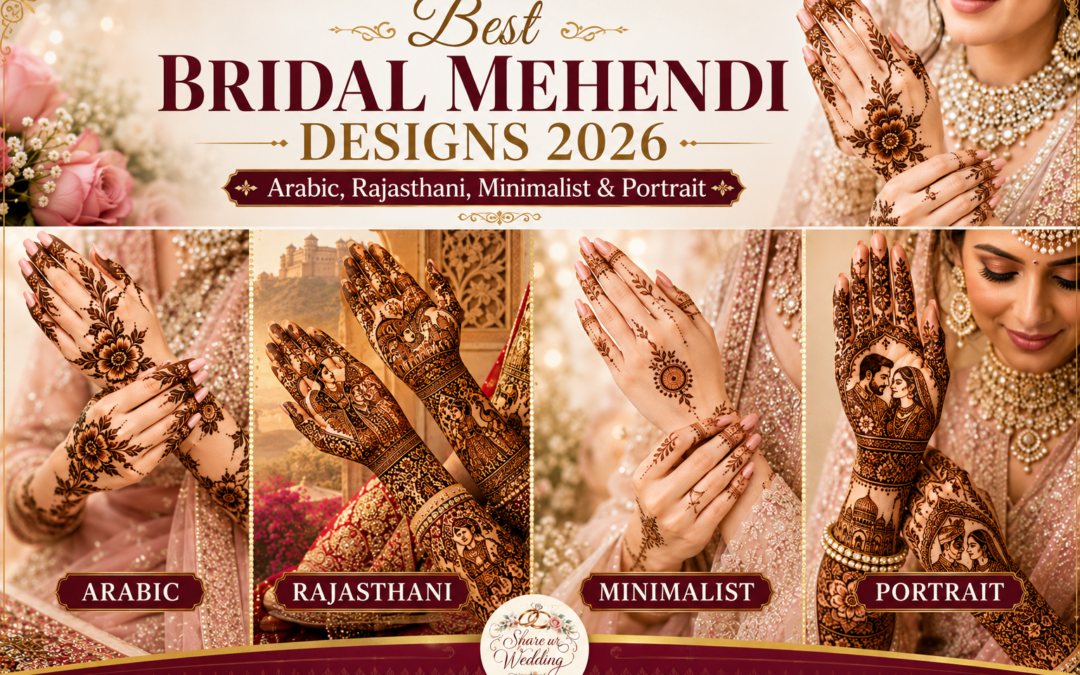
There is a ritual that happens in the quiet hours before any Indian mehendi ceremony that no one photographs and few people talk about. The bride sits with her artist, scrolling through images on a phone screen. This one. Not quite. Something like this, but with that. The conversation between a bride’s imagination and the artist’s hands is intimate, unhurried, and almost always the most honest exchange of the entire wedding week.
Because your mehendi is not just decoration. It is the first mark of your wedding on your body — before the sindoor, before the mangalsutra, before any ring. It is, depending on your tradition, a symbol of love, prosperity, luck, and the depth of your groom’s affection (yes, the old belief that the darker the mehendi, the more you are loved still makes everyone smile). And in 2026, it has become one of the most powerful forms of personal storytelling that any wedding element can offer.
This guide is for the bride who wants more than a printed reference sheet to hand her artist. We’re going deep into every major style — Arabic, Rajasthani, Minimalist, and Portrait — with the top designs, the honest trade-offs, and everything you need to walk into your mehendi ceremony knowing exactly what you want.
What’s Actually Changing in Bridal Mehendi in 2026
Before we explore each style, let’s talk about what’s genuinely different this year versus even two years ago.
The biggest shift is storytelling over coverage. Brides no longer feel obligated to fill every inch of their hands and arms. Many are choosing one strong focal motif — a portrait, a temple, a specific flower — surrounded by intentional negative space, rather than dense all-over coverage.
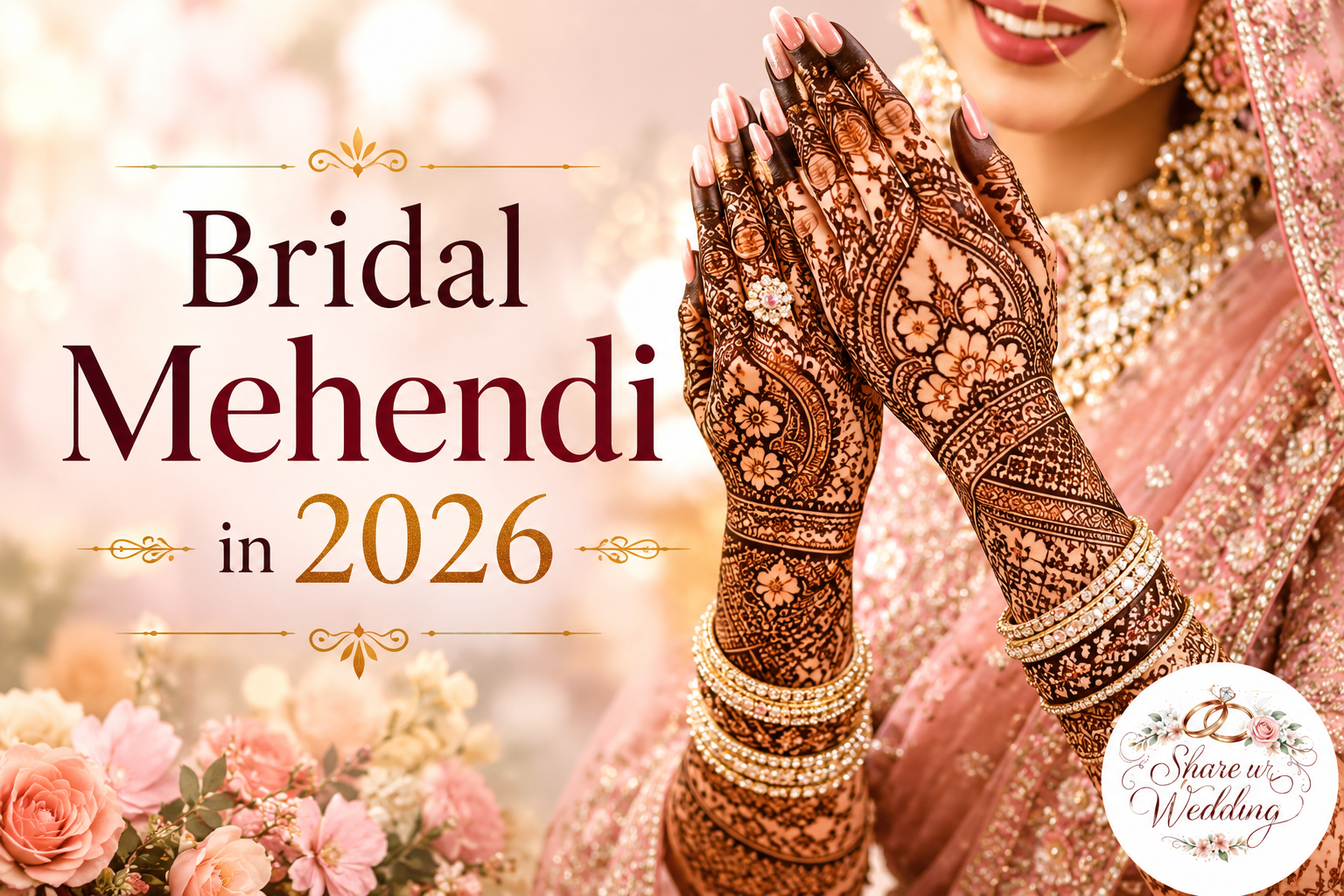
The second major shift is full-sleeve editorial designs. Arabic florals, Mughal jali lattice, and hidden storytelling details combined in one cohesive sleeve from fingertip to elbow. Maximalist but curated — like a fashion magazine spread rather than a traditional ceremony design.
And then there’s the personalization revolution. The most-requested bridal mehendi in 2026 includes portrait integration of the couple’s faces, wedding venue illustrations, and proposal story depictions in henna. Brides want their love story on their hands.
The result is a bridal mehendi landscape that is more varied, more personal, and more visually interesting than it has ever been.
Style 01: Arabic Mehendi — The Art of Beautiful Restraint
If you’ve ever seen a bridal mehendi design that looked effortlessly chic — bold florals with generous empty skin between them, flowing lines spiralling down the wrist, patterns that look almost like batik — that was Arabic mehendi.
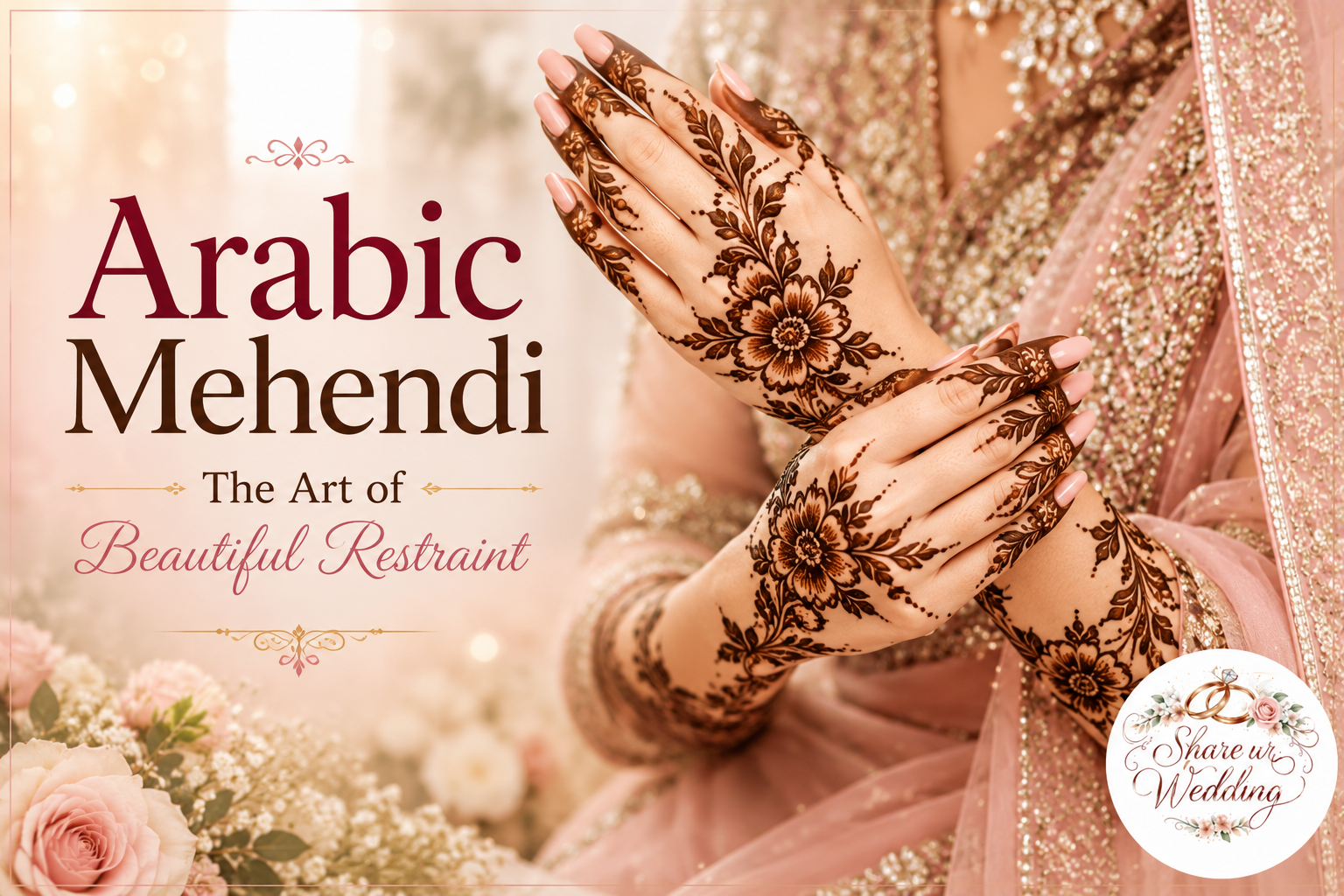
Arabic mehendi is defined by what it doesn’t do as much as what it does. Unlike traditional Indian mehendi, it deliberately does not fill every inch of skin. The negative space is part of the design. Bold, flowing lines create flowers, leaves, and vines that travel across the hand and wrist without density, without the geometric structure of Indian styles, and with a quality that photographs beautifully in both natural and artificial light.
Why brides love it: It’s faster to apply than Rajasthani (typically 1–2 hours per hand), it leaves the skin more visible so jewellery stands out clearly, and the open, airy quality looks incredibly modern.
What it pairs with: Arabic mehendi looks most beautiful with Banarasi sarees and embroidered salwar kameez — outfits with texture and pattern that complement rather than compete with the open design.
Top Arabic Bridal Mehendi Designs in 2026
Classic Rose Vine A single large rose at the center of the palm, with fine vines extending toward the fingers and wrist. Simple in concept, breathtaking in execution. The 2026 version uses extra-fine lines and adds micro-detail petals that only reveal themselves on close examination.
Full-Wrist Arabic Cuff Arabic floral patterns that concentrate at the wrist in a thick band, then thin out across the back of the hand and fingertips. Creates the effect of wearing a henna bracelet. Popular for brides who want the look of coverage without the weight.
Bold Leaf and Vine Back-Hand Large, graphic leaves — the kind you’d see on a vintage textile print — arranged across the back of the hand. Leaves rather than flowers give the design an organic, botanical quality that is very of-the-moment in 2026.
Finger-Only Arabic A design that concentrates entirely on the fingers, leaving the palm bare except for a small central motif. Particularly popular for minimalist brides who still want some coverage.
Indo-Arabic Fusion The most requested bridal style at Indian destination weddings in 2026. It combines the bold, open florals of Arabic mehendi with the intricate motif detailing of traditional Indian designs — elegance and cultural depth in the same design.
Arabic Mehendi: Practical Notes
- Application time: 1–2 hours per hand for a full design
- Darker stains are harder to achieve with Arabic designs (less paste coverage = less contact time). Ask your artist to use high-quality henna paste — Rajasthani or Yemeni henna produces the darkest stains — and leave the paste on for at least 6–8 hours under a sealed wrap.
Style 02: Rajasthani Mehendi — Where Heritage Lives
Rajasthani mehendi is not a design style. It is an entire world.
Born in the royal courts of Rajasthan — in the zenanas of Jaipur, Jodhpur, Udaipur, and Bikaner — this style evolved over centuries to become the most elaborate, most detailed, most narrative form of mehendi in the world. A full Rajasthani bridal design can take 5–7 hours to apply and contain hundreds of individual motifs, each with its own meaning and history.
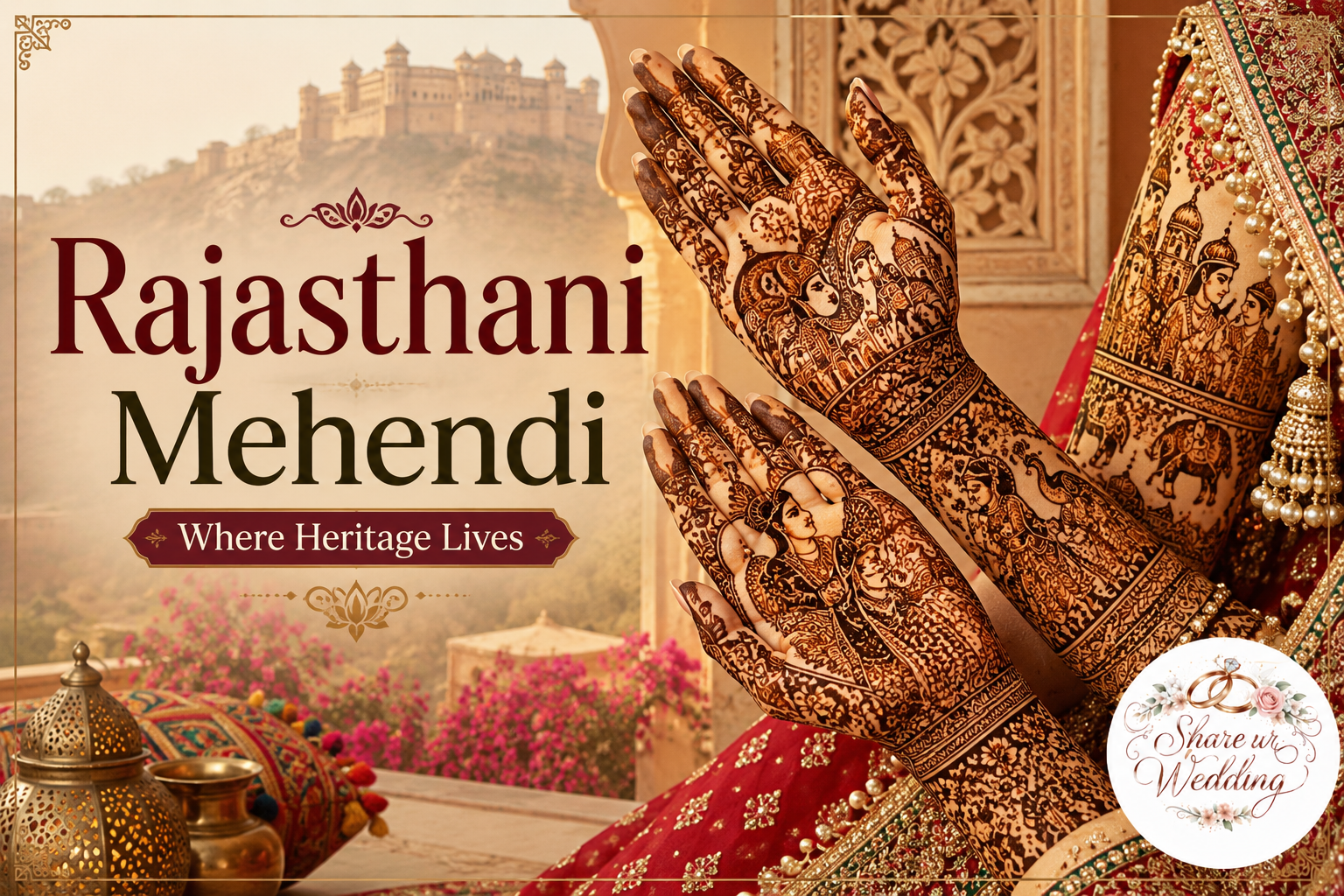
At the center of any Rajasthani design are scenes: the bride and groom meeting, the wedding procession, elephant and camel parades, palace architecture, women carrying water pots, peacocks spreading their tails. The entire palm becomes a miniature painting. Each finger carries its own intricate patterns. The arms — particularly from wrist to elbow — are covered in jali (lattice) patterns that create a mesh-like coverage of extraordinary density and beauty.
Why brides love it: It is, simply, the most spectacular bridal mehendi that exists. For brides who want their hands to be a conversation piece — at every function, in every photograph, for years afterward — nothing competes with a full Rajasthani design.
What it pairs with: Heavily embroidered lehengas or Kanjivaram silk sarees. The density and grandeur of the mehendi calls for an equally grand outfit.
Top Rajasthani Bridal Mehendi Designs in 2026
Classic Dulhan Scene The traditional scene of the bride (dulhan) at the palm center, surrounded by floral borders, peacock motifs, and lattice work on the arms. The 2026 version adds extra detail to the dulhan’s facial features, making her recognizably beautiful rather than a generic silhouette.
Palace Architecture Design The bride’s actual wedding venue or an iconic palace reproduced in miniature on the palm. For destination brides getting married at heritage properties, this is one of the most requested personalization touches of the year.
Elephant Procession A line of decorated elephants carrying the baraat across the back of the hand and wrist. Timeless, regal, and unique — no two designs ever look the same.
Peacock and Lotus Two of the most auspicious symbols in Indian culture, combined into a design that can range from densely traditional to almost minimalist depending on the number of fill patterns used. The peacock motif remains among the most universally loved bridal designs in 2026.
Dense Jali Full Coverage The jali (lattice/mesh) pattern covering the entire hand from fingertip to forearm, with detailed floral motifs inside each cell of the lattice. This is the most time-intensive Rajasthani design — from any distance, the hand appears covered in golden lace.
Ombre Density Effect A 2026 innovation: the design starts with maximum density at the fingertips and palm center, then gradually becomes more open and airy as it moves toward the wrist, creating an ombre effect through pattern density rather than colour. It modernises a traditional style beautifully.
Rajasthani Mehendi: Practical Notes
- Application time: 3–7 hours per hand. A full-arm Rajasthani design is typically split across two sessions.
- Book your artist at least 6 months in advance. The best artists fill their wedding season calendars that early.
- Confirm the artist’s specific expertise — Rajasthani mehendi requires distinct training. Not every mehendi artist executes all styles equally.
- Set aside the evening before your wedding day if possible, so the paste can stay on overnight and be removed in the morning for maximum colour depth.
Style 03: Minimalist Mehendi — The Modern Bride’s Secret Weapon
Minimalist bridal mehendi is the fastest-growing trend in 2026, and it deserves far more credit than it typically gets.
The concept is simple: instead of full-coverage traditional patterns, the bride chooses one or two strong focal motifs — a single mandala, a delicate vine, a precise geometric shape — placed deliberately on the hand, with as much empty space as design. Less pattern. More personality.
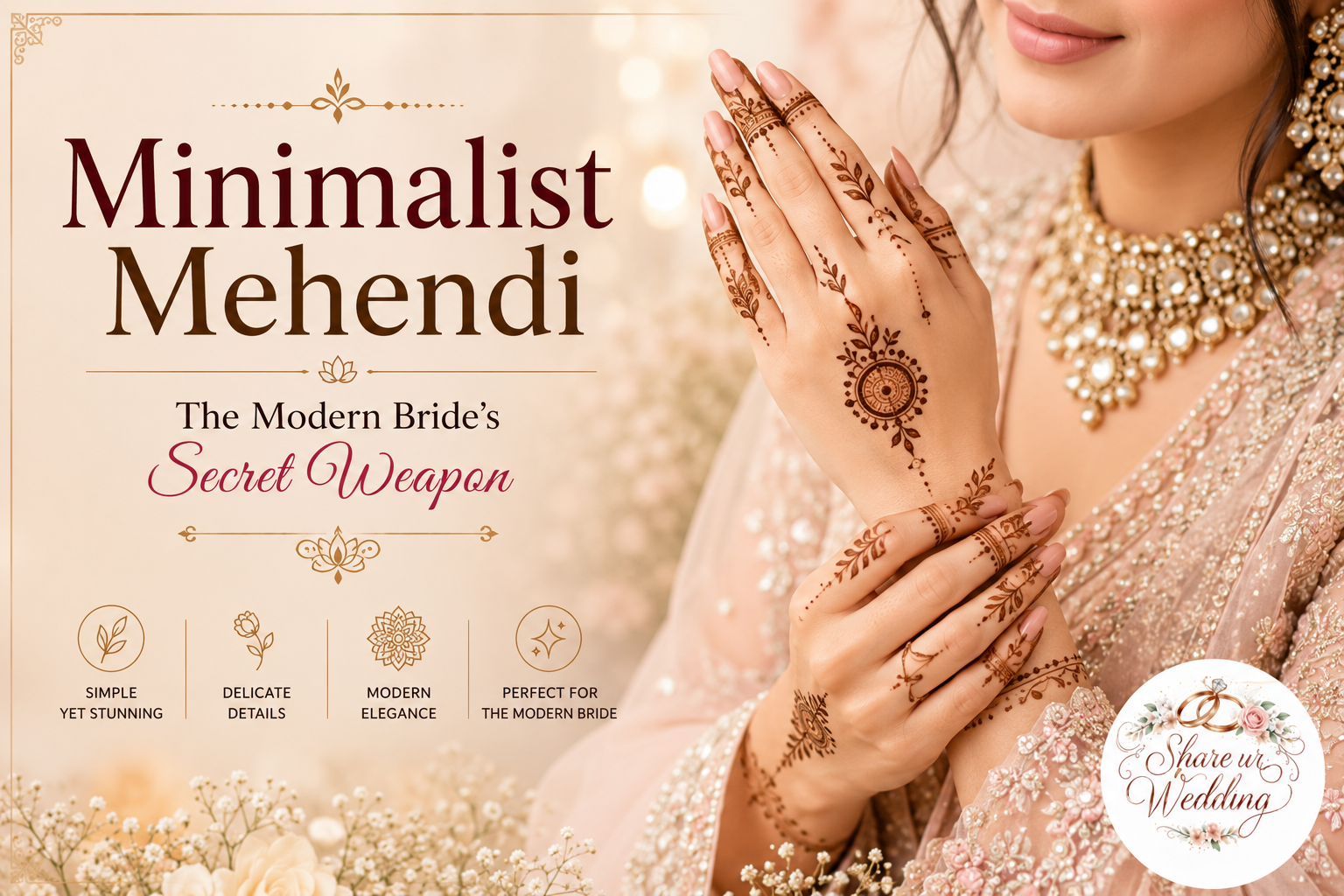
Minimalist mehendi against heavy polki or kundan jewellery creates one of the most photographed contrasts at modern Indian weddings — the ornate jewellery against bare skin with a small, precise design is striking precisely because of the contrast.
Why brides love it: It’s faster (typically 30–60 minutes), it lets jewellery take center stage, it suits contemporary and destination weddings perfectly, and it is genuinely unlike anything traditional. It’s also less risky — if your mehendi ceremony is the day before your wedding, there’s less chance of smearing or uneven coverage with a minimal design.
What it pairs with: Contemporary sarees, pre-draped organza, indo-western outfits. Minimalist mehendi looks particularly striking with indo-western or drape saree styles where the outfit itself is already making a modern statement.
Top Minimalist Bridal Mehendi Designs in 2026
Single Mandala Palm A single, perfect circular mandala — intricate within the circle, surrounded by completely bare skin — placed in the center of the palm. The contrast between the detailed circle and the empty space is the entire design.
Finger Caps Only Fine mehendi designs applied only to the tips and first joint of each finger, leaving the rest of the hand bare. Paired with statement rings and bangles, this creates an effect that is half-mehendi, half-jewellery.
Delicate Wrist Cuff A single thin band of fine mehendi at the wrist — mimicking the placement of a bracelet but in henna. Minimalist brides who still want the tradition of mehendi without full coverage find this deeply satisfying.
Geometric Thumb Design Bold, clean geometric shapes — a triangle, a diamond, a precise spiral — applied to the thumb only. Distinctive enough to photograph memorably, executable in under 30 minutes.
Feather & Botanical Single feather or botanical leaf motifs placed on the back of the hand or along a single finger, in extremely fine linework. The precision of the lines is what makes this work — it is minimal in coverage, but not in skill.
Monogram / Initials The bride and groom’s initials woven into a small, elegant design on the palm center. One of the most requested personalized minimal styles of 2026.
Minimalist Mehendi: Practical Notes
Here’s the truth most guides don’t tell you: minimalist designs require more technical skill, not less. When there’s heavy pattern coverage, small imperfections are hidden in the density. When there are two lines and a circle on an otherwise bare hand, every micro-wobble is visible.
Choose an artist specifically known for fine-line precision work — not just traditional heavy coverage. Always ask to see photographs of their minimalist designs specifically.
Style 04: Portrait Mehendi — Your Love Story on Your Hands
Portrait mehendi is the newest major bridal style in India, and it is extraordinary.
The concept: photo-realistic portraits of the bride and groom — their faces, silhouettes, or both — embedded into the mehendi design, typically at the palm center or across the back of the hand. At its most elaborate, it depicts scenes from the couple’s relationship: the proposal, a meaningful location, their first holiday, the moment they knew.
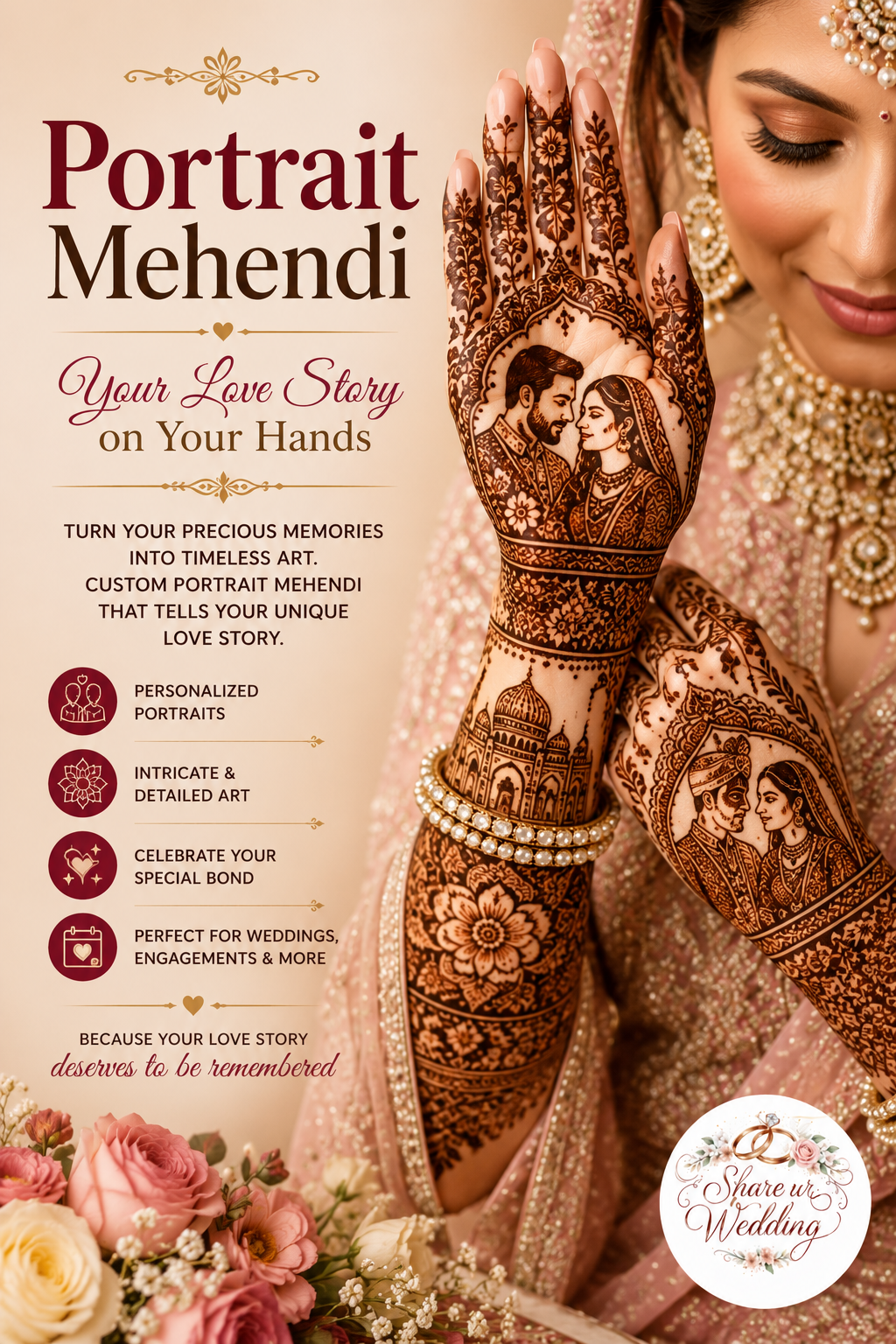
Portrait integration, wedding venue illustrations, and proposal story depictions are among the top three most-requested bridal mehendi styles in 2026. Bride-and-groom portraits on the palm area “add an impressive factor to wedding photos” — they become the first detail every guest leans in to see.
Top Portrait Mehendi Designs in 2026
Classic Silhouette Portrait The simplest and most elegant version — the side profiles of the bride and groom facing each other, placed at the palm center. Clean silhouettes rather than detailed features. Particularly beautiful when framed by fine Arabic florals.
Detailed Facial Portrait A technically demanding version where the artist renders recognizable facial features of the couple in henna. These require artists who specialize specifically in portrait work. The results, when executed well, are genuinely astonishing.
Proposal Scene The moment of the proposal — one partner kneeling, the other with their hand to their heart — rendered in miniature at the palm center. For brides who had a particularly special proposal, this is deeply personal.
Love Story Timeline Significant moments from the couple’s relationship depicted across the hand and arm as a sequence: the city where they met, a meaningful landmark, the proposal location, and the wedding venue. Each scene is small — the size of a thumbnail — but together they tell an entire story.
Wedding Venue Illustration The actual wedding venue — a palace in Jaipur, a temple in Tirupati, a farmhouse in Delhi, a beach in Goa — reproduced in fine-line mehendi. Venue illustrations are one of the defining personalization trends of 2026 bridal mehendi.
Hidden Groom’s Name The groom’s name hidden within the pattern of the design. Traditional for many communities, this remains one of the most charming bridal mehendi traditions alive — guests spend the entire ceremony trying to find it.
Portrait Mehendi: Practical Notes
Not every mehendi artist can execute portrait work. This is a specialization, not a skill gap — portrait mehendi requires the same technical ability as realistic illustration, applied in a medium (paste from a tiny cone on moving, living skin) that is genuinely difficult.
- Begin your search for a portrait specialist at least 6–8 months before your wedding.
- Look for artists whose portfolio shows verified portrait work — not just one exceptional photo.
- Ask for references from previous bridal clients.
- Be prepared to invest more — portrait work is priced higher than traditional styles because of the level of skill involved.
How to Get the Darkest Possible Mehendi Colour
Every bride wants this. Here’s the honest, practical guide.
Paste quality is everything. Natural henna from Rajasthan (particularly Sojat henna) and Yemen produces significantly darker stains than commercially prepared paste. High-quality artists mix their own paste — if your artist uses a pre-packaged cone, ask what henna it contains.
Leave it on as long as possible. The minimum for a good bridal stain is 6 hours. Overnight (8–10 hours) under a sealed wrap is better. Do not scrape the paste off — let it dry and crumble naturally.
Warmth deepens the stain. After removing the paste, gently warming your hands (near a warm lamp or diya) deepens the colour. Many brides sit near a candle for this reason.
Avoid water for 12 hours. Don’t wash your hands or let them get wet for at least 12 hours after the paste is removed. Water interrupts the oxidation process that deepens the colour.
Lemon-sugar solution helps. Many artists apply a mix of lemon juice and sugar to dried paste — it keeps the paste moist and adhered to skin, extending stain time.
How to Choose the Right Mehendi Artist
Beyond the design style, the artist you choose will determine the outcome more than any other single factor.
Specialisation matters. An artist who does everything competently is different from an artist who does one style exceptionally. If you want portrait mehendi, find a portrait specialist. If you want dense Rajasthani, find an artist whose entire portfolio is Rajasthani.
Check consistency, not highlights. Don’t just look at their best five photos. Look at their last 20 designs. Is the quality consistent? Or were those five photos exceptional days?
Communication is a signal. The best mehendi artists ask questions — about your outfit, your jewellery, your preference for coverage, your venue aesthetic. An artist who says “tell me the design” and starts immediately is less likely to give you something truly personalised.
Do a patch test. Anyone with sensitive skin should do a patch test at least two weeks before the wedding. Allergic reactions to henna paste — while uncommon — can be severe. Don’t take the risk.
Book early. The best bridal mehendi artists fill their wedding season calendars 4–6 months in advance. Don’t leave this until the last minute.
Mehendi Design by Wedding Theme
| Wedding Style | Best Mehendi Style | Key Motifs |
|---|---|---|
| Royal / Heritage (Palace, Fort, Haveli) | Full Rajasthani | Venue illustration, dense jali, peacock, dulhan scene |
| Beach / Destination (Goa, Kerala, Maldives) | Arabic or Minimalist | Botanicals, leaves, waves, shells |
| Contemporary / Urban (Farmhouse, Rooftop) | Minimalist or Indo-Arabic | Geometric, open florals, negative space |
| Temple / Traditional Wedding | Full Rajasthani | Classic dulhan, lotus, sacred motifs |
| Small / Intimate Wedding | Portrait Mehendi | Couple portrait, proposal scene, venue illustration |
For the Wedding Party: Bridesmaids, Sisters & Mothers
The same style principles apply — scaled down. Arabic and minimalist designs are the most common choice for wedding guests, as they apply quickly (multiple people at once) and don’t risk overshadowing the bride’s design.
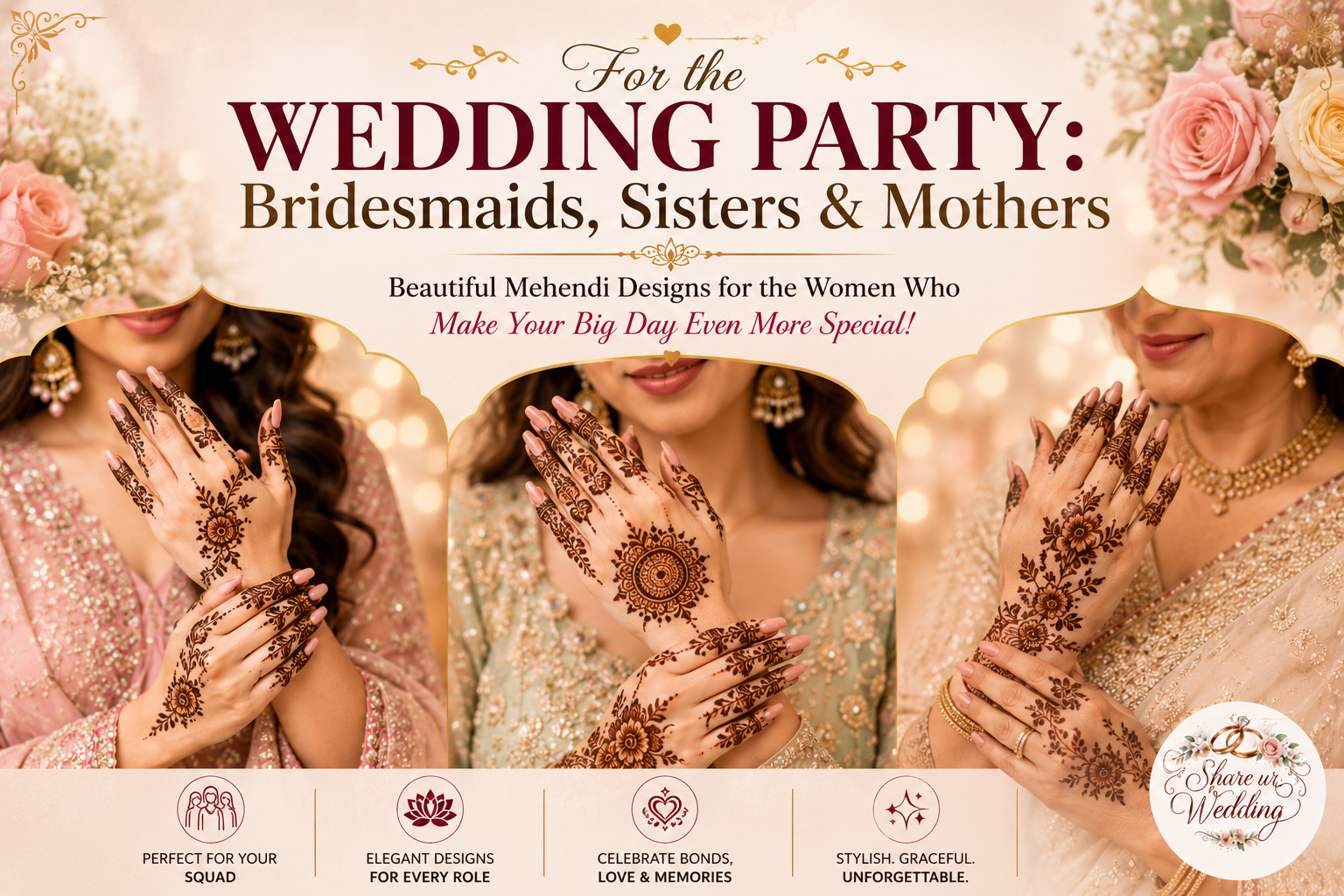
For the mother of the bride: A full-wrist Arabic cuff or a delicate finger-cap minimalist design is both appropriate and beautiful.
For bridesmaids and sisters: Matching Arabic wrist designs or coordinated minimal motifs create lovely group photos without competing with the bride.
For the groom’s side: Simple Arabic motifs or a single wrist band design are traditional in many communities and growing in others.
Final Thought
Your mehendi will begin to fade around the two-week mark. The photographs will last forever.
What you’re choosing today will be in those photographs — and in your memory — for the rest of your married life.
Choose a design that is genuinely, specifically, unmistakably you.