

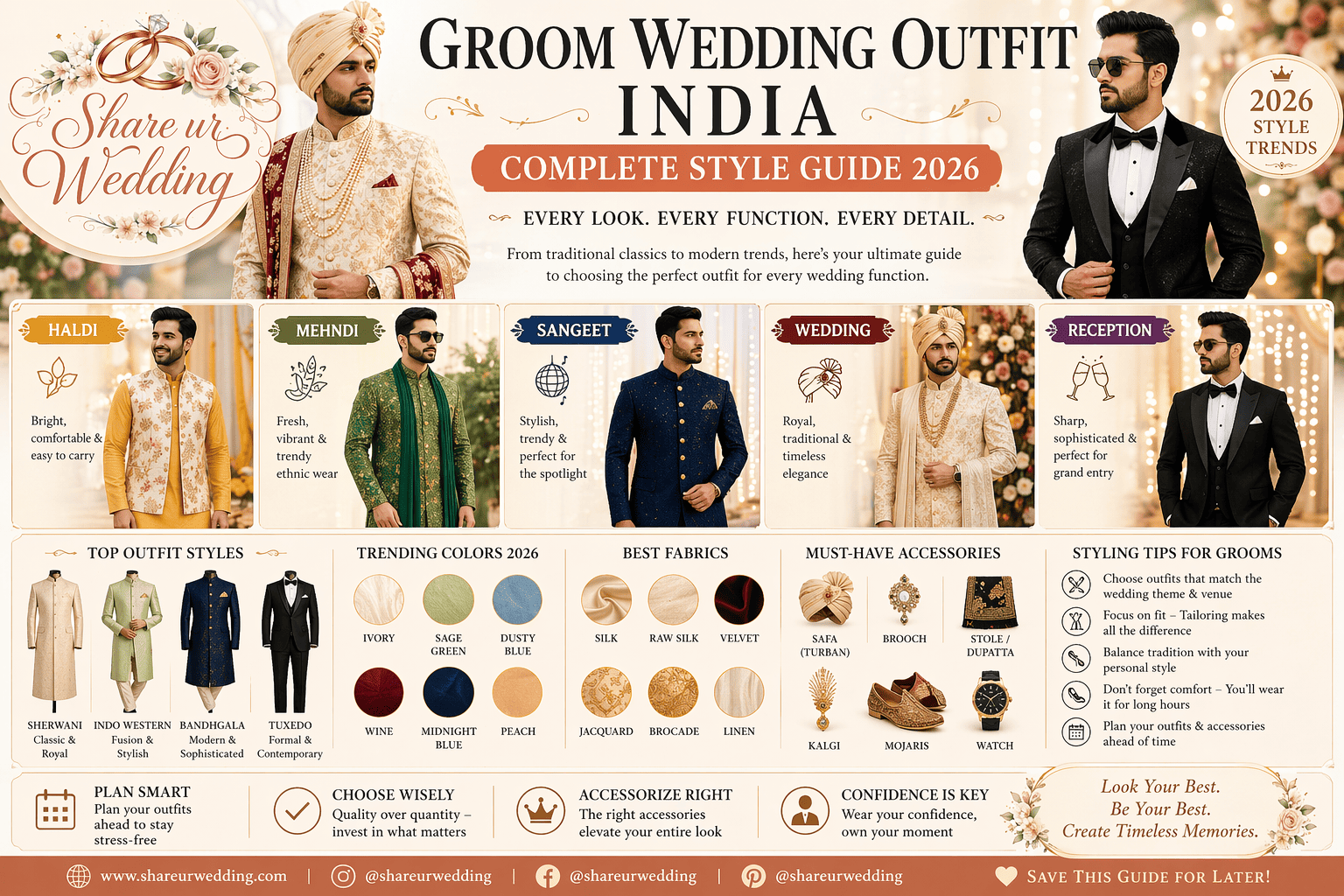
Let us be honest about something that every Indian bride quietly knows and every Indian groom is slowly starting to realise: groom fashion gets about 10 per cent of the attention it deserves.
Entire magazines are devoted to bridal lehengas. Pinterest boards overflow with bridal sarees. Instagram is saturated with makeup transformations and mehndi close-ups. And the groom? He gets a single rushed afternoon in a sherwani shop, three weeks before the wedding, while his mother points at the one ivory piece she likes and his father says anything will do.
In 2026, this is changing. The modern Indian groom is more fashion-conscious, more style-aware, and far more intentional about what he wears across the full wedding than any generation before him. And why not? Your wedding day is the most photographed day of your life. You will be in every photograph. You deserve to look extraordinary in all of them.
This guide is for every groom who wants to get his wedding wardrobe genuinely right. Not just the sherwani for the ceremony — but the complete outfit strategy across every event, from the haldi morning to the reception night. We will cover outfit types, colours, fabrics, styling, fit, budget, and all the small decisions that add up to a groom who looks like he actually tried.
The Groom Fashion Shift Nobody Talks About
For decades, the Indian groom’s wedding wardrobe had exactly one rule: wear ivory cream. The colour. Every wedding. Every region. Every groom. Cream sherwani, gold embroidery, matching turban. Done.
That rule is gone.
In 2026, grooms across India are choosing deep forest green, navy blue, terracotta, blush pink, slate grey, and rich maroon. They are pairing sherwanis with unexpected accessories. They are choosing bandhgala suits for receptions instead of a second sherwani. They are working with tailors to create personalised embroidery details — a meaningful motif, a wedding date sewn into the hem, their initials and their partner’s on the inside of the collar.
The most significant shift is this: grooms are now thinking about their wedding wardrobe as a wardrobe — a collection of outfits that work together across the full celebration — rather than a single outfit they happen to need for one day.
A well-dressed groom does not just complement the bride. He has a complete visual story of his own. That is the 2026 groom’s style philosophy.
The other shift worth naming is the coordination conversation. Couples today are actively discussing their outfits together — making sure the sherwani colour works with the lehenga, that the sangeet look has a connected thread to the ceremony look, that the reception outfit reads as a cohesive evolution rather than a random change. This is not about matching perfectly. It is about looking like two people who are genuinely on the same page.
What to Wear at Every Wedding Event — A Complete Groom Outfit Guide
An Indian wedding is not one event. It is five or six. Each one has its own atmosphere, its own energy, its own dress code. Getting this right — wearing the right thing at the right event — is the foundation of good groom style. Here is your event-by-event guide.
The Haldi Ceremony — Comfort First, Always
Haldi is the most deceptively simple event to dress for — and the one where grooms make the most mistakes. The ceremony involves turmeric paste being applied to your skin. Turmeric stains everything it touches. Permanently.
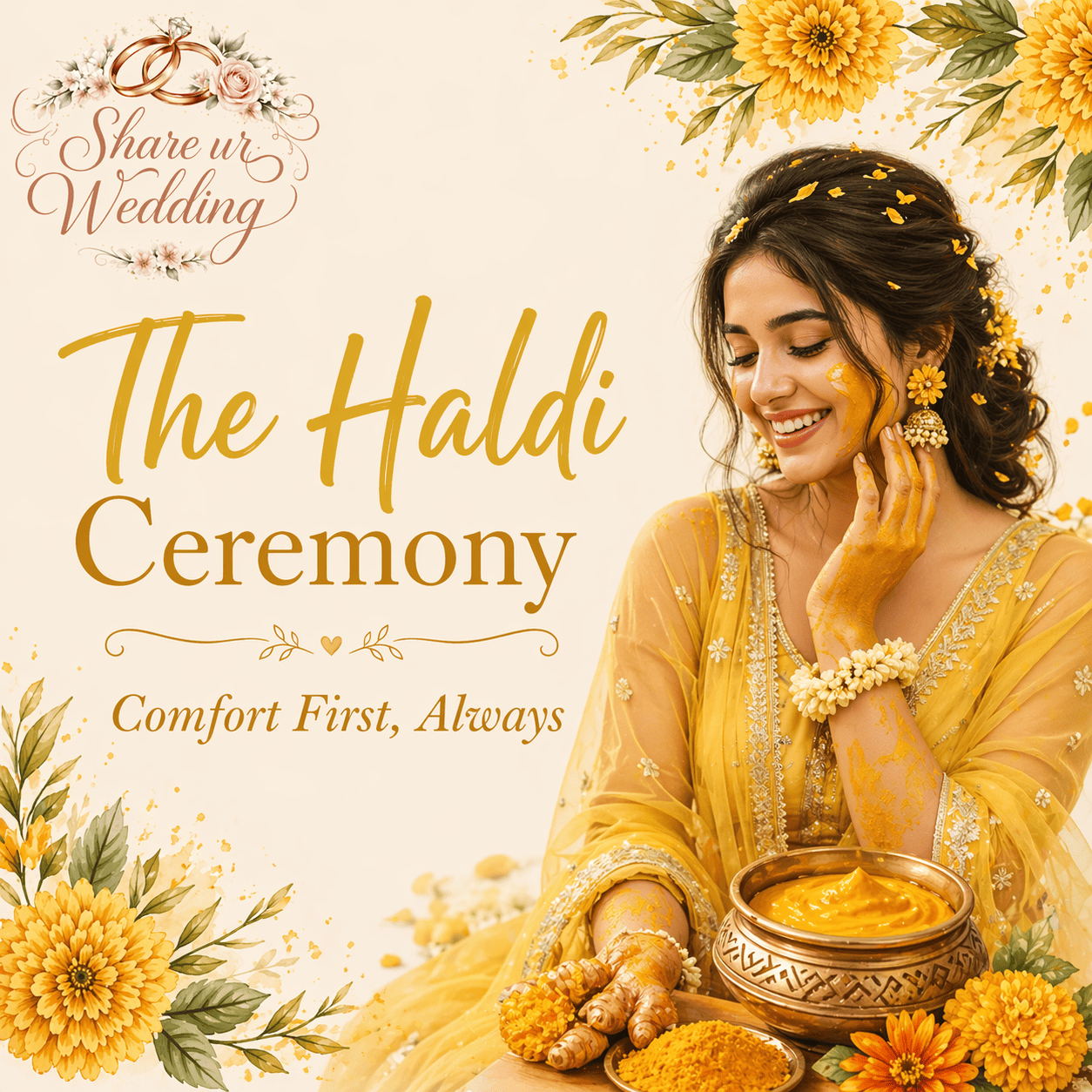
This is not the event for your beautiful new sherwani. This is the event for something you are genuinely willing to sacrifice to bright yellow paste.
Outfit:
Yellow or white kurta pajama in cotton, linen, or cotton-silk. Keep it simple and light. Embroidered chikankari kurtas add a festive touch without being overdressed.
Best Colours:
Yellow, mustard, ochre, ivory, off-white, soft peach
Fabric:
Cotton or linen — breathable, comfortable, and stain-friendly
Avoid:
New or expensive sherwanis, heavy silk fabrics, and dark colours that highlight turmeric stains
The colour choice matters more than you might think. Yellow and mustard are traditional because they camouflage the turmeric well. Ivory looks beautiful in photographs against the bright yellow paste. Avoid very dark colours — a midnight blue kurta covered in turmeric patches looks chaotic, not festive.
Practical Tip: Buy your haldi kurta from a good local shop for ₹800 to ₹2,000. It will be photographed, it will be meaningful, and it may never be worn again. That is completely fine. The memory is worth more than the garment.
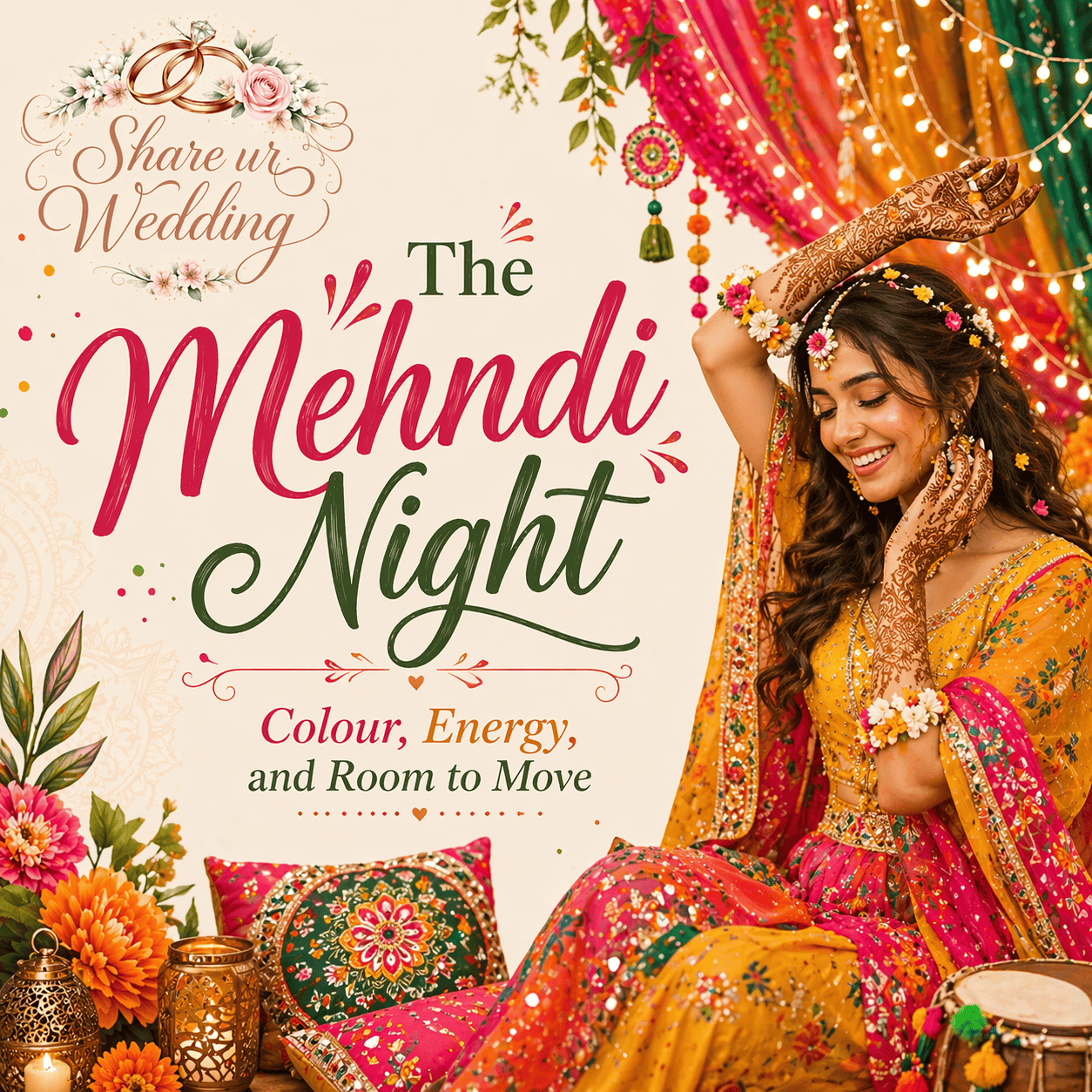
The Mehndi Night — Colour, Energy, and Room to Move
Mehndi is festive and colourful. It is usually a daytime or early evening event with music, dancing, and more laughter than ceremony. Your outfit should match that energy — vibrant, comfortable, and genuinely enjoyable to wear for several hours.
Outfit: Printed or embroidered kurta with a Nehru jacket or waistcoat. A colourful pathani suit works beautifully. Indo-western fusion kurtas with asymmetric hems are trending strongly in 2026.
Best colours: Earthy green, teal, powder blue, burnt orange, burgundy, bright royal blue
Fabric: Cotton-silk, georgette, or jacquard for texture — avoid anything too heavy
Avoid: A plain or boring outfit — mehndi is a photography event and your outfit should contribute to the frame.
The groom’s mehndi outfit is one of the most photographed of the entire wedding — not because it is the most formal, but because mehndi events produce some of the most joyful, candid images. Invest a little thought here. A well-chosen printed kurta with a good Nehru jacket will look wonderful in every photograph.
The Sangeet Night — This Is Your Fashion Moment
The sangeet is the event where grooms in 2026 are taking the biggest fashion risks — and mostly getting them gloriously right.
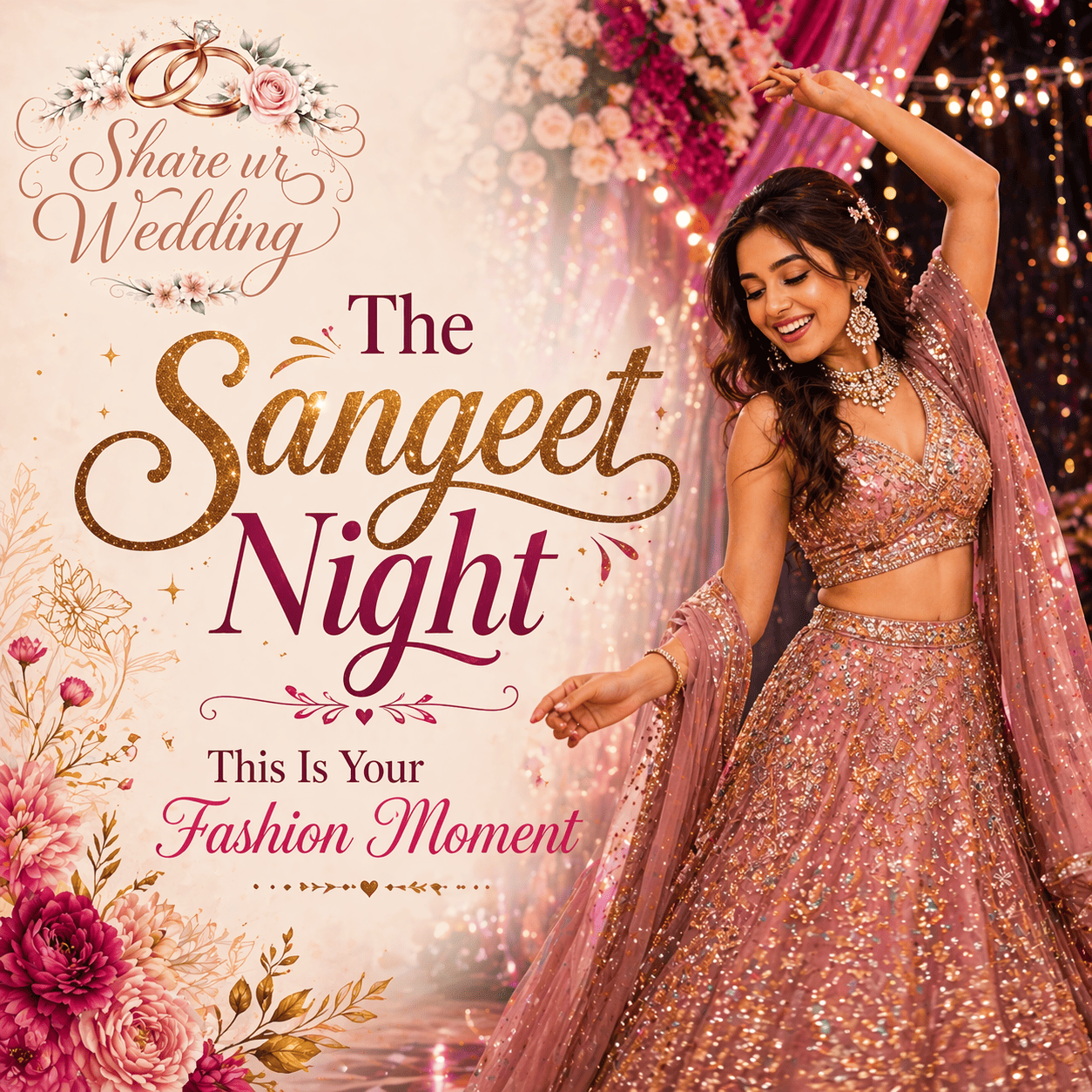
The sangeet is an evening event, typically the most energy-driven celebration of the entire wedding. It involves dancing, live performances, high production value, and a room full of people at their most celebratory. Your outfit needs to match this energy — and it needs to let you move.
Outfit: Indo-western sherwani with a structured jacket and embroidered inner kurta. A statement bandhgala in a rich jewel tone. A printed kurta set with heavy embroidery that reads evening-formal.
Best colours: Midnight blue, wine, emerald green, deep teal, charcoal with gold, navy with silver
Fabric: Silk, velvet for winter, raw silk or textured weave for summer and monsoon
Avoid: Anything too restrictive for dancing. Heavy full-embroidered sherwanis that belong at the ceremony. Very light casual kurtas that read underdressed.
The key tension to manage at sangeet is looking spectacular versus being able to actually move. The best sangeet outfits thread this needle beautifully — they have visual impact but are cut for movement. A fitted bandhgala jacket over a kurta, for instance, looks incredible and allows full range of motion. A very heavy sherwani with a stiff bottom can make dancing genuinely uncomfortable.
2026 Trend: Indo-western fusion sherwanis — with asymmetric layered jackets, printed inner kurtas, and structured outer pieces — are the most talked-about groom fashion trend of 2026. The sangeet night is the perfect occasion to try this look without it feeling out of place.
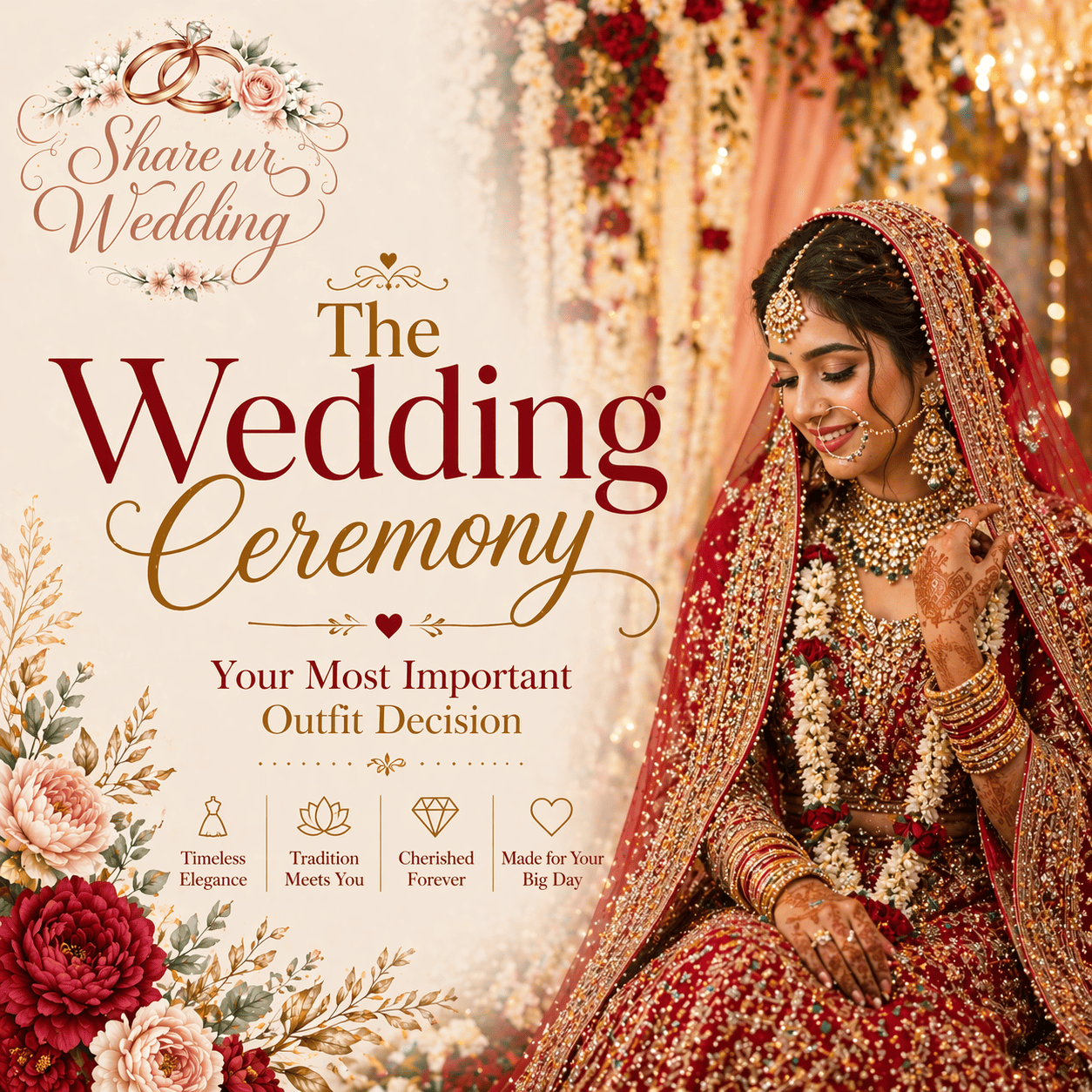
The Wedding Ceremony — Your Most Important Outfit Decision
Everything else is preparation. This is the photograph you will frame on your wall.
The wedding ceremony is the most culturally significant, most formally photographed, and most emotionally loaded event of the entire celebration. The outfit you choose for it should reflect that weight. This is where you invest the majority of your groom fashion budget. This is where you spend the most time with your tailor. This is the outfit that appears in every formal photograph and every family album and every anniversary collage for the rest of your life.
Wear a sherwani. Almost certainly.
Outfit: Full sherwani — long cut below the knee. Hand embroidery preferred. Paired with a matching or contrasting churidar, dupatta, mojaris, and a safa (turban). This is the non-negotiable main event of your wardrobe.
Best colours: Ivory and cream remain classic. Non-traditional: forest green, navy, deep maroon, terracotta, blush pink, slate grey. The colour should coordinate with your partner’s outfit without matching exactly.
Fabric: Pure silk or velvet for winter. Raw silk, brocade, or jacquard for summer. Georgette for lighter summer weddings.
Avoid: A casual kurta. Anything that looks underdressed relative to your partner’s outfit. Anything you have not tried on at least twice before the wedding day.
The Reception — Contemporary, Confident, Slightly Unexpected
The reception is the event where most grooms either wear their ceremony sherwani again — comfortable, logical, slightly uninspiring — or change into something that feels like a genuine style statement. In 2026, the second option is winning.
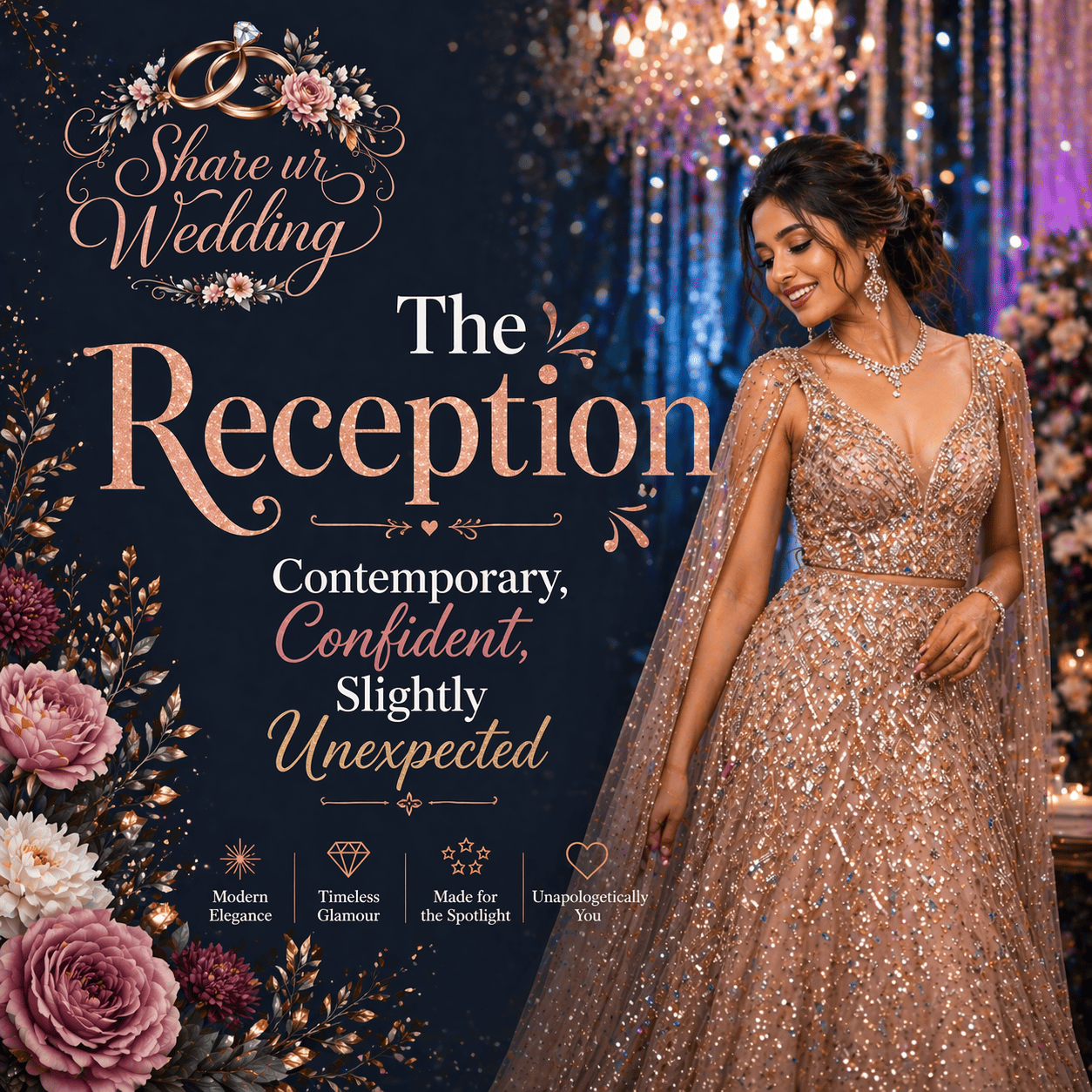
The reception tends to be more social and contemporary than the ceremony. It often runs late into the evening. It is the event where grooms feel most relaxed and least constrained by ritual requirements. This is the perfect occasion for a bandhgala suit, a well-tailored coat suit in a non-standard colour, or a second sherwani in a completely different colour family from the ceremony.
Outfit: Bandhgala suit in silk or velvet. A second sherwani in a different colour. A well-tailored Jodhpuri suit in navy, charcoal, or deep green. Contemporary grooms are increasingly choosing structured Indo-western looks that feel like high fashion.
Best colours: Navy blue, charcoal, deep burgundy, forest green, ivory, champagne — anything that reads confident and contemporary
Fabric: Wool blend or structured silk for bandhgalas. Rich silk for a second sherwani.
Avoid: An exact repeat of the ceremony outfit without any variation. Very casual or underdressed looks — the reception is still a formal event.
The Complete Sherwani Guide — Everything You Need to Know
The sherwani is the centrepiece of the Indian groom’s wedding wardrobe. It has been for generations, and it will continue to be. But choosing the right sherwani in 2026 is more nuanced than it has ever been — there are more styles, more colour options, more fabric choices, and more design approaches than at any previous point in Indian menswear history.
Here is how to navigate all of it.
Sherwani silhouettes — which style is right for you
| Silhouette | Length | Best For | Body Type Consideration |
|---|---|---|---|
| Classic long sherwani | Below knee to ankle | Traditional ceremonies, palace venues, heritage weddings | Works for all heights. Taller grooms carry the length magnificently. |
| Contemporary short sherwani | Hip to mid-thigh | Modern weddings, younger grooms, sangeet events | Excellent for shorter grooms — creates a longer leg line. |
| Layered jacket sherwani | Variable — outer jacket over inner kurta | Indo-western aesthetic, sangeet, reception | Creates visual breadth — suits lean builds beautifully. |
| Bandhgala / Jodhpuri suit | Jacket to hip | Reception, contemporary ceremonies, destination weddings | Structured silhouette suits all body types. Particularly flattering on athletic builds. |
| Nehru jacket set | Jacket to hip, worn over kurta | Mehndi, sangeet, semi-formal events | Versatile and comfortable — works across body types. |
Sherwani colours — and what each one says about you
The colour of your sherwani is the most personal fashion decision you will make for your wedding. It should reflect your personality, complement your partner’s outfit, and work with your venue’s aesthetic. Here is an honest guide to the major colour directions for 2026.
| Colour | What It Communicates | Skin Tone Notes | 2026 Trend Level |
|---|---|---|---|
| Ivory / Cream | Classic, timeless, traditional — the safest and most culturally resonant choice | Works best on medium to deep skin tones. Can wash out very fair complexions. | Always trending — never goes wrong |
| Deep Navy | Sophisticated, modern, confident — the 2026 alternative to the classic ivory | Universally flattering — one of the most forgiving colours for Indian skin tones | Very high — overtaking burgundy as the top non-traditional choice |
| Forest Green | Grounded, distinctive, increasingly mainstream — moves away from ivory without feeling radical | Particularly striking on medium and deep skin tones | High — growing significantly in 2026 |
| Terracotta / Rust | Warm, earthy, artistic — associated with heritage aesthetics and regional Indian tradition | Excellent for wheatish and deep skin tones | Strong and growing |
| Blush Pink | Confident, contemporary, fashion-forward — the bravest choice that consistently photographs beautifully | Flattering across skin tones. Pairs beautifully with gold embroidery. | Growing — no longer unconventional in metro cities |
| Deep Burgundy / Wine | Rich, regal, romantic — one step removed from the ceremonial red | Works across skin tones. Especially striking in velvet for winter weddings. | Established and consistent |
| Slate Grey / Charcoal | Understated, editorial, modern — the groom who cares about fashion but not about standing out | Works particularly well on fair skin. Can look muted on very deep skin tones. | Rising — popular for minimalist weddings |
| Champagne / Gold | Luxurious, warm, celebratory — photographs beautifully in all lights | Particularly flattering on fair and medium skin tones | Strong for evening ceremonies and receptions |
How to colour-coordinate with your partner — without matching exactly
This is a conversation every couple needs to have, and most couples have it too late. The goal is not to match. Two people in identical shades of the same colour family looks arranged, not natural. The goal is to coordinate — to choose colours that make visual sense together without looking like a theme park costume.
- If the bride is wearing deep red: try ivory, champagne, or deep navy for the groom. Contrast creates visual balance.
- If the bride is wearing blush pink or pastel: try ivory, slate grey, or dusty mauve. Similar tonal weight.
- If the bride is wearing emerald green: deep navy, ivory, or terracotta work beautifully alongside.
- If the bride is wearing ivory or off-white: forest green, navy, or champagne gold for the groom prevents both outfits from washing each other out.
- If the bride is wearing midnight blue or jewel tones: ivory or champagne for the groom creates the most timeless combination.
The Rule: Whatever you choose, the groom should never wear the same colour as the bride’s primary outfit. You are complementary, not identical. One partner stands out in warm tones, the other in cool — this creates natural visual interest in photographs.
Groom Sherwani Fabrics — What to Choose and Why
The fabric of your sherwani determines how it photographs, how it moves, how comfortable you are across a 12-hour wedding day, and largely how much it costs. Here is what you need to know before you walk into any store.
| Fabric | Look & Feel | Best Season | Price Range | Best Used For |
|---|---|---|---|---|
| Pure Silk | Lustrous, structured, richly coloured — the most prestigious fabric | All seasons but particularly winter | ₹25,000 – ₹2,00,000+ | Main ceremony sherwani — maximum formality |
| Raw Silk | Textured matte finish — contemporary and understated | Year-round, especially summer | ₹15,000 – ₹80,000 | Contemporary ceremony, reception |
| Velvet | Deep texture, rich colour, dramatic presence | Winter weddings exclusively | ₹20,000 – ₹1,50,000 | Winter ceremony and reception — especially jewel tones |
| Brocade / Jacquard | All-over woven pattern — pattern is built into the fabric | Winter and autumn | ₹18,000 – ₹1,20,000 | Ceremony — especially for heritage and traditional weddings |
| Cotton Silk | Lightweight, breathable, comfortable | Summer and monsoon season | ₹5,000 – ₹35,000 | Haldi, mehndi, summer wedding ceremonies |
| Georgette | Fluid, lightweight — very different to the structured silhouettes | Summer and destination weddings | ₹8,000 – ₹45,000 | Pre-wedding events and summer ceremonies |
Season Matters: Never buy velvet for a summer wedding or light cotton-silk for a December palace wedding in Rajasthan. The fabric must match the season — an uncomfortable groom is visible in every photograph. When in doubt, ask your tailor which fabrics are appropriate for your specific wedding month and location.
Accessories — The Details That Complete the Look
A beautiful sherwani worn with wrong or mismatched accessories looks unfinished. The accessories are not an afterthought — they are the punctuation that makes the outfit make sense.
The safa (turban) — wear one, please
Let us settle this debate directly: most Indian grooms look significantly better in a safa than without one. The safa adds height, frames the face, and creates the complete ceremonial silhouette that the sherwani is designed to work with. It is deeply traditional, culturally resonant, and — when chosen in the right colour and fabric — genuinely spectacular.
In 2026, safas are being chosen in contrasting colours to the sherwani — a navy sherwani with a champagne or ivory safa, a forest green sherwani with a deep burgundy safa — rather than the traditional exact-match approach. The contrast creates a more editorial look that photographs beautifully.
The most important rule: the safa must be tied by someone who knows what they are doing. A badly tied safa ruins an otherwise perfect outfit. Find a local safa specialist in your city, book them for the morning of the ceremony, and do not attempt to tie it yourself with a YouTube tutorial the night before.
Mojaris — the groom’s shoes matter more than most grooms think
Mojaris and jutti are the traditional footwear for Indian groom outfits, and they deserve proper attention. A beautiful sherwani paired with worn-out or poorly matched footwear is a combination that sharp-eyed wedding photographers will inevitably capture in a close-up at some point during your ceremony.
Choose mojaris that complement the sherwani’s colour and embroidery style. For ivory sherwanis, gold or silver mojaris work beautifully. For coloured sherwanis, a contrasting embroidered mojari or a neutral tone that does not compete with the outfit is the right choice.
Start breaking in your mojaris at least two weeks before the wedding. New leather mojaris on a 12-hour wedding day without prior wear is a recipe for genuine discomfort during the pheras.
The mala (garland necklace) — understated beats overdone
Many grooms wear a decorative mala or stole during the ceremony. The standard pearl mala or floral garland is traditional and universally appropriate. For contemporary weddings, a simple strand of pearls or a rudraksha mala with gold caps provides understated elegance. Avoid heavy, oversized costume jewellery that competes with the sherwani’s embroidery.
Watch, brooch, and kara — the small details
- Watch: If you wear one, choose something formal and metal — not a sports watch. A simple gold or silver dress watch, or no watch at all, works best with a sherwani.
- Brooch (kalgi): A decorative brooch or kalgi on the safa adds a traditional touch that photographs beautifully in close-up portraits.
- Kara: A simple gold or silver kara (bracelet) is appropriate for Sikh and many Hindu grooms and adds meaningful cultural detail to the ceremonial look.
- Pocket square: For bandhgala and Jodhpuri suit receptions, a well-chosen pocket square in a complementary colour elevates the overall look significantly.
Groom Wedding Outfit Budget — A Realistic Guide for 2026
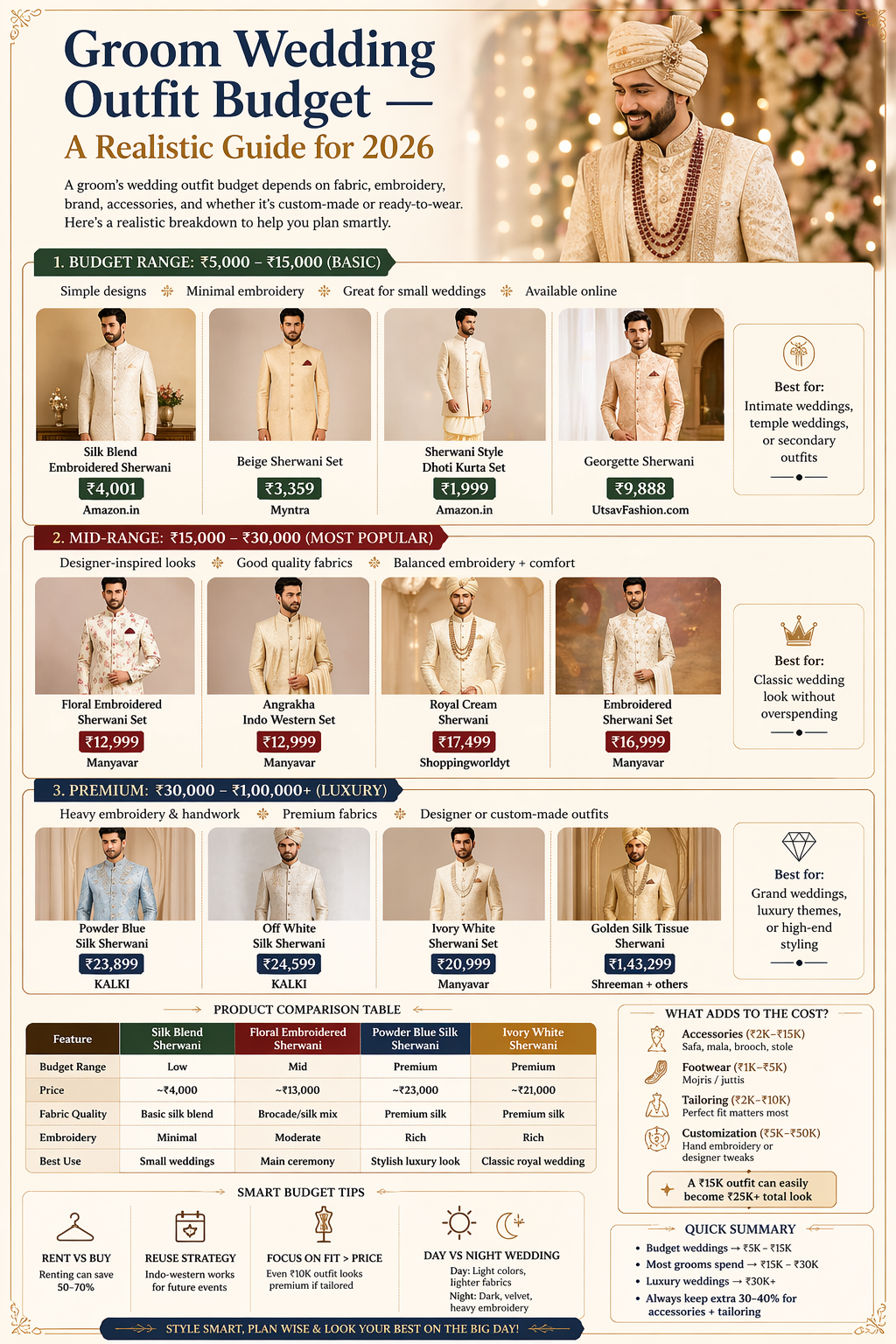
Groom wedding fashion budgets in India span an enormous range. Here is a realistic framework for what you can expect at different price points in 2026.
| Budget Range | What You Get | Best Suited For |
|---|---|---|
| Under ₹15,000 | Machine embroidery on synthetic fabric. Ready-to-wear with minimal customisation. Limited colour options. | Very tight budgets, haldi and mehndi outfits |
| ₹15,000 – ₹40,000 | Mix of hand and machine embroidery. Cotton-silk or raw silk base. Good local boutiques. | Mehndi and sangeet outfits. Budget ceremony sherwanis. |
| ₹40,000 – ₹1,00,000 | Genuine hand embroidery. Quality silk or brocade. Reputed regional stores. Custom fitting included. | Most Indian grooms — excellent quality for ceremony and reception |
| ₹1,00,000 – ₹3,00,000 | Premium hand embroidery. Pure silk. Established designers. Multiple fittings. Personalisation possible. | Luxury market — genuine craftsmanship and longevity |
| ₹3,00,000+ | Manyavar designer collections. Bespoke tailoring houses. Exhibition pieces. | Top-tier investment pieces for those who want the absolute best |
| ₹3,00,000+ | Manyavar designer collections. Bespoke tailoring houses. Exhibition pieces. | Top-tier investment pieces for those who want the absolute best |
A note on budget allocation across events: put 50 to 60 per cent of your total groom outfit budget on the ceremony sherwani. This is the outfit in the most photographs, the one most people associate with your wedding look, and the one you will most want to remember perfectly. Allocate 20 to 25 per cent to the reception outfit. The remaining budget covers mehndi, sangeet, and haldi outfits — keep these simpler.
How to Shop for Your Wedding Sherwani — A Practical Guide
Most grooms leave this too late. Then they rush through a few shops in an afternoon, choose the first thing that fits reasonably well, and wonder later why the photographs do not quite reflect the vision they had. Here is how to do it properly.
When to start shopping
- Custom or bespoke sherwani: Start 5 to 6 months before the wedding. Multiple fittings are required and the best tailors book months in advance.
- Designer or boutique sherwani: 3 to 4 months before. Alterations and additional embroidery work take time.
- Ready-to-wear with alterations: 2 to 3 months before is generally sufficient.
- Pre-wedding event outfits (mehndi, sangeet): 1 to 2 months before is fine for these.
How to evaluate a sherwani before buying
- Hold it up to natural light and look at the embroidery closely. Hand embroidery has slight imperfections and variations — machine embroidery is perfectly regular and slightly flat-looking. For anything above ₹50,000, hand embroidery should be the expectation.
- Check the fabric by feel. Pure silk has a cool-to-the-touch sensation and a specific weight. Synthetic blends feel lighter and slightly slippery. Run a small thread from the hem between your fingers — pure silk fibres feel smooth and slightly warm from friction.
- Try the full outfit: sherwani, churidar, and dupatta together. Never evaluate a sherwani in isolation. The complete look is what matters, not any individual component.
- Move in it. Sit down, stand up, raise your arms above your head. If anything feels restrictive at rest, it will be significantly more uncomfortable after six hours of pheras and dancing.
- Check the lining. A well-made sherwani has a full lining that keeps the garment’s shape, prevents the heavy outer fabric from chafing, and ensures the sherwani hangs properly. A poorly lined or unlined sherwani loses its silhouette quickly.
- Ask about the alteration process. How many fitting sessions are included? How much can the sherwani be taken in or let out? Know exactly what the alterations cover before you pay the deposit.
Most Important Advice: Do a complete outfit trial at least 3 weeks before the wedding — full sherwani, churidar, mojaris, safa, and accessories together. This is when you catch fit issues, accessory mismatches, and comfort problems. Discovering on the morning of your wedding that the churidar is too tight is an experience you want to avoid.
Sherwani Styles for Different Body Types
The right sherwani silhouette depends significantly on your height and build. Here is an honest guide — not a flattery exercise, but a practical framework for choosing what will photograph best.
| Build | Best Sherwani Style | Colours That Help | Avoid |
|---|---|---|---|
| Tall and lean | Full-length traditional sherwani carries beautifully. Any silhouette works. This is the build the classic sherwani was designed for. | Rich jewel tones add visual weight. Champagne and ivory look spectacular. | Nothing is off-limits — experiment confidently. |
| Short (under 5'7") | Shorter cut sherwani (above knee) elongates the leg line significantly. Vertical embroidery patterns draw the eye upward. | Lighter colours and tonal embroidery. Avoid bold horizontal patterns. | Ankle-length sherwanis that cut visual height. Very wide dhoti-style bottoms. |
| Athletic / broad build | Well-structured silhouettes that acknowledge rather than hide the build. A good bandhgala suit or fitted sherwani. | Deep jewel tones and dark colours are particularly flattering. | Very wide or loose silhouettes that add visual bulk. Oversize embroidery. |
| Heavy-set build | A-line sherwani that flows outward from the shoulder creates the most flattering drape. Structured bandhgala with good tailoring. | Dark colours — navy, forest green, deep maroon — create a slimming vertical line. | Very tight, body-hugging silhouettes. Broad horizontal embroidery bands. |
Frequently Asked Questions
What is the best groom wedding outfit in India for 2026?
For the wedding ceremony, a sherwani remains the most culturally appropriate and visually magnificent choice for most Indian grooms. In 2026, ivory and cream are still popular but deep navy, forest green, terracotta, and blush pink are all gaining significant ground as alternatives. For the reception, a bandhgala suit or Jodhpuri suit offers a contemporary alternative that many modern grooms prefer. The best outfit is always the one that fits perfectly, reflects your personality, and coordinates well with your partner’s outfit without matching exactly.
How much does a groom sherwani cost in India in 2026?
Groom sherwanis in India range from approximately ₹15,000 for good ready-to-wear pieces at reputed stores, to ₹40,000 to ₹1,00,000 for hand-embroidered sherwanis from quality boutiques, to ₹1,00,000 and above for designer and bespoke pieces. The best value for most Indian grooms lies in the ₹40,000 to ₹80,000 range — you get genuine hand embroidery, quality fabric, and personalised fitting without paying a premium designer price.
What should an Indian groom wear for the haldi ceremony?
For the haldi ceremony, choose a yellow, mustard, ivory, or off-white kurta pajama in cotton or linen. Keep it comfortable, breathable, and — most importantly — affordable and stain-resistant. Turmeric permanently stains any fabric it contacts, so do not wear anything new or expensive. A well-chosen cotton kurta in a festive yellow photographs beautifully and costs between ₹800 and ₹3,000.
What should a groom wear for the sangeet night?
The sangeet calls for a fashion-forward outfit that allows freedom of movement. Indo-western sherwanis with layered structured jackets, statement bandhgalas in rich jewel tones, or a heavily embroidered kurta set all work beautifully. Choose midnight blue, wine, emerald green, or charcoal for evening sangeet events. The key is that your outfit should look spectacular under event lighting while letting you actually dance comfortably.
How early should a groom start shopping for his wedding sherwani?
For a custom or bespoke sherwani, start 5 to 6 months before your wedding. The best tailors book months in advance and multiple fittings are required. For a designer boutique sherwani that needs alterations, 3 to 4 months is generally sufficient. Ready-to-wear with minor alterations can be sorted 2 to 3 months before. The most common mistake grooms make is leaving it to 4 to 6 weeks before the wedding — this limits your choices significantly and creates unnecessary stress.
A Final Word for Every Groom Reading This
You are going to be in every photograph from one of the most important days of your life. Your partner has spent months thinking about how they look. Your guests will notice and remember how you look. Your wedding photographs will be shared, printed, framed, and looked at by your children one day.
That is not pressure. It is an invitation to take this seriously.
You do not need to spend a fortune. You do not need a celebrity stylist. You need to start early enough to make good decisions without rushing, think about each event genuinely, find a tailor you trust, and do a proper trial fitting at least three weeks before the wedding.
The groom who looks extraordinary on his wedding day is not the one who spent the most money. He is the one who cared enough to think it through.
| The best-dressed groom at any Indian wedding is the one who looks like himself — just the most magnificently turned out version of himself he has ever been. |