

There is something different about the mehndi ceremony. It moves slowly. The bride sits in the centre of the room for hours, surrounded by the women who have loved her longest. The henna artist works in near silence while everyone else laughs, feeds each other, and cries a little. The light — almost always natural, almost always warm — falls across fabric and flowers and faces in a way that no other wedding event quite replicates.
That slowness is what makes the mehndi the most photographed daytime event of the entire wedding. The photographer has hours with the family. There is no rushing from one ritual to the next. What this means, practically, is that your mehndi decoration will appear in more final images — more shared images, more printed images — than the backdrop at almost any other function.
In 2026, couples have stopped treating mehndi decoration as an afterthought. It is no longer the ceremony where you “just put some flowers and marigold strings.” It is an intentional visual statement — a room dressed specifically for one person, on one particular day. Your mehndi photographs will be shared more than almost any other images from your wedding. This is what thoughtful decoration looks like.
Why Mehndi Decoration Matters More in 2026 Than Ever Before
The mehndi unfolds differently from every other wedding event. At the sangeet, things move fast. At the reception, there are hundreds of guests and the light is artificial and flat. But at the mehndi, a good photographer has four to six hours of uninterrupted access to candid emotions, hand close-ups, detail shots, and environmental portraits in whatever natural light the morning or afternoon brings.
Natural light is the most flattering light. It is also the most unforgiving of bad decoration choices. A busy printed flex backdrop looks catastrophic in a wide shot. Clashing colours overwhelm the subject. A flat, poorly considered staging area leaves nothing for the eye to rest on except the distractions.
The core principle that experienced decorators and wedding photographers are both pushing in 2026 is this: every decoration element should be chosen by asking, “how will this look in the photograph?” Not just “does this look nice in person,” but — will this read beautifully in a 4×5 frame? Does the colour palette complement the bride’s lehenga? Does the backdrop have enough texture and dimension to create visual depth without competing with the subject in the foreground?
This one shift in thinking — decoration chosen photographically, not just aesthetically — is what separates the mehndi setups that produce extraordinary images from the ones that look generic in every album.
Part 1: The 6 Most Popular Mehndi Decoration Themes for 2026
Theme 1: Rajasthani Haveli
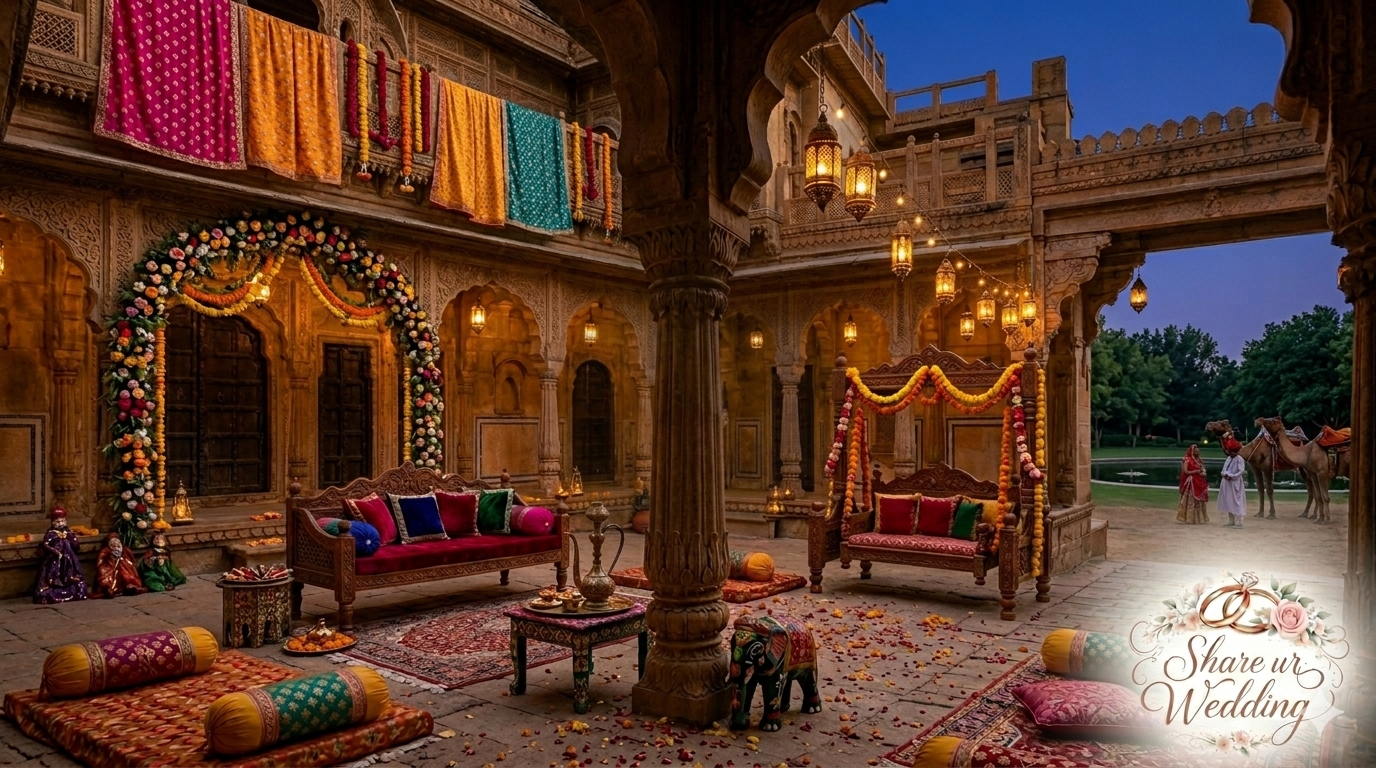
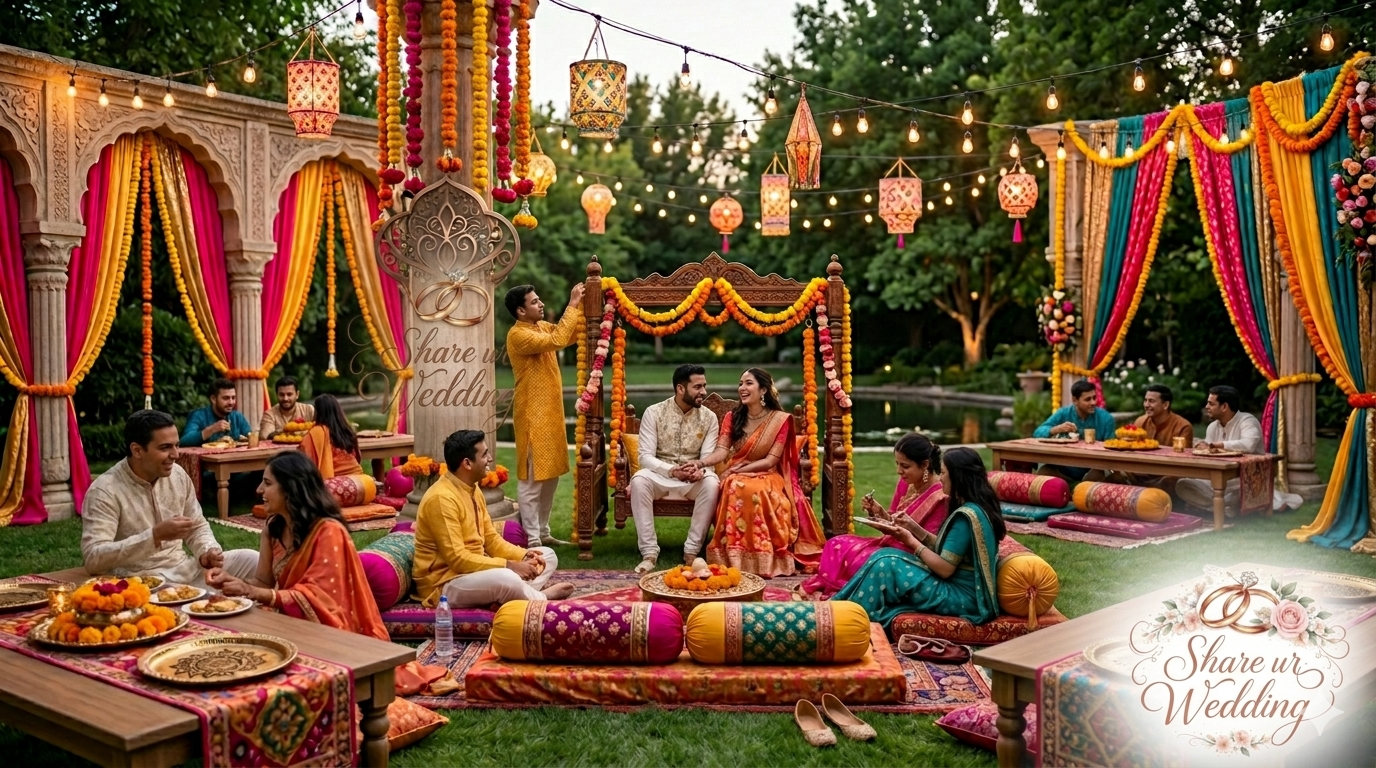
Walk into a Rajasthani Haveli-themed mehndi and your eyes have nowhere neutral to land — everything is warm, textured, intentional. The palette is mustard, rust, and turquoise. Hand-blocked fabrics hang as drapes and table runners. Arched jharokha panels frame the bride’s seating area in carved wood or painted MDF. Brass diya arrangements cluster on the floor in odd numbers. Terracotta pots overflow with fresh marigolds at varying heights. The bride sits low on a gadda cushion in jewel-toned silk, surrounded by cushions in clashing-but-harmonising prints.
Key elements: Jharokha arch backdrop, hand-blocked fabric drapes, brass diyas, terracotta pot clusters, marigold strings, gadda floor seating, low wooden side tables.
Colour palette: Mustard, rust, burnt orange, turquoise, ivory accents.
Best for: Lawns, farmhouses, banquet halls with neutral walls, haveli venues.
2026 addition: A vintage bullock cart or a decorated cycle rickshaw placed at the entrance as an arrival prop — guests photograph it immediately and it sets the register for the rest of the decor.
Photography note: This theme photographs magnificently in both bright daylight and warm artificial light. The terracotta and brass tones create extraordinary warmth in images. Wide shots look layered and editorial. Close-up hand shots against the hand-blocked fabrics are particularly striking.
Theme 2: Modern Boho
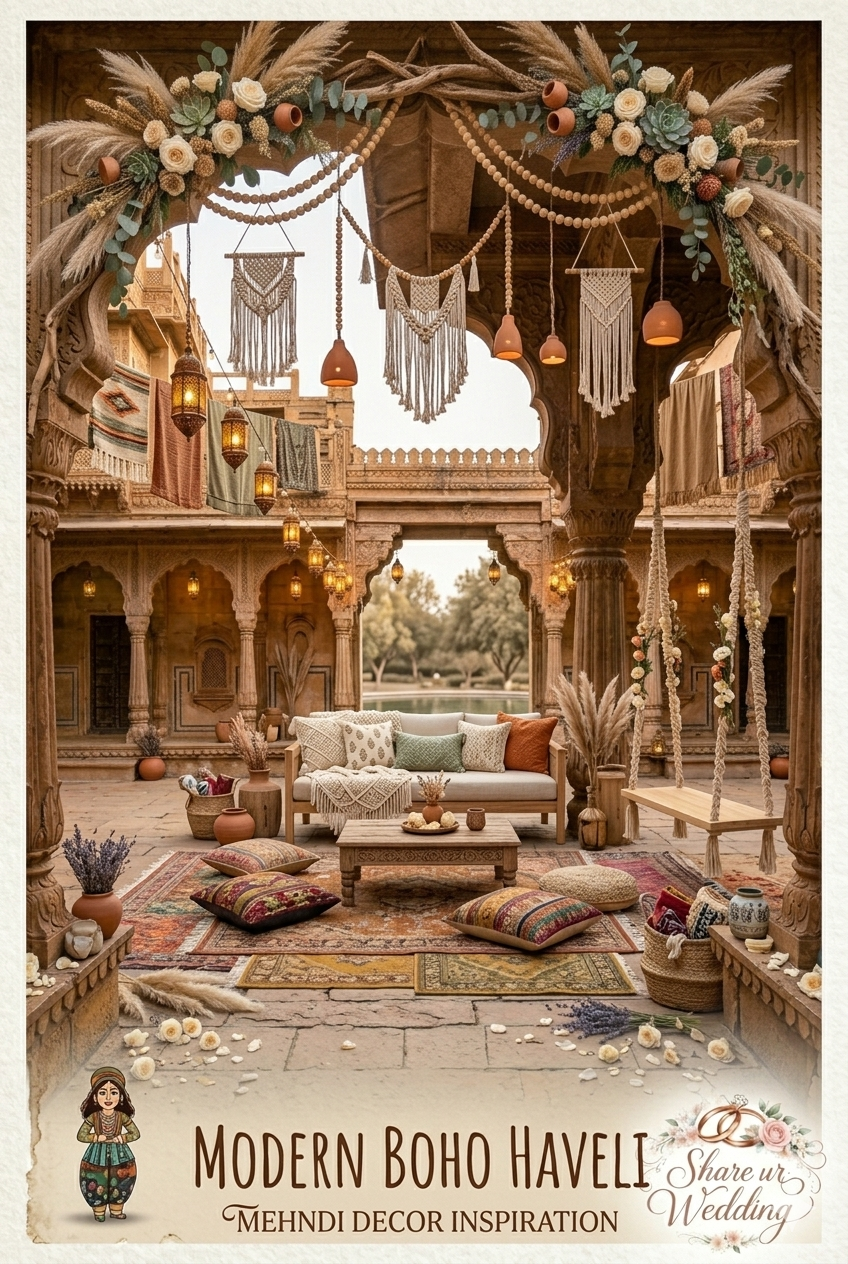
The Modern Boho mehndi has been building momentum since 2023 and in 2026 it is fully mainstream — but when done well, it still feels considered rather than generic. The signature is organic texture: macramé wall hangings in natural jute, pampas grass arranged in earthy terracotta or matte white vases, dried floral arrangements in blush and cream, wicker armchairs or love seats for the bride and groom seating, and hanging rattan pendant lights overhead.
The palette is deliberately restrained. Muted terracotta, warm ivory, dusty rose, sage green. Nothing saturated. Nothing that would look at home at a traditional function.
Key elements: Macramé wall hanging as central backdrop, pampas grass in clusters, dried florals, wicker or cane furniture, rattan pendants, linen table cloths, natural jute runners.
Colour palette: Ivory, blush, dusty rose, terracotta, sage, warm white.
Best for: Rooftop functions, farmhouse lawns, contemporary apartment courtyards. The open sky adds enormously to the organic mood. Works for intimate guest lists.
Photography note: The boho palette produces an editorial, airy quality in natural light that is almost impossible to achieve with saturated colour schemes. Images have a consistent, timeless quality that holds up well in both digital and print formats.
Theme 3: Floral Minimalist
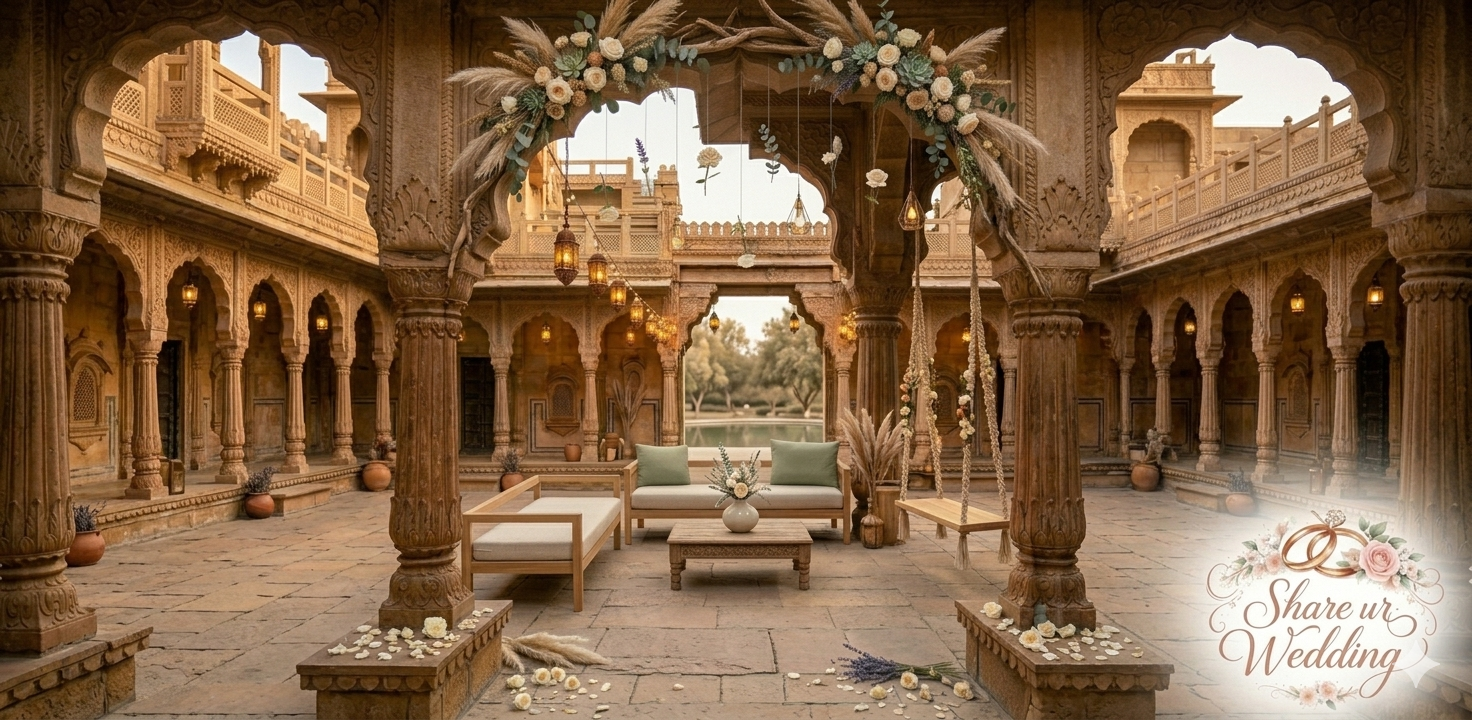
The Floral Minimalist theme is a study in restraint. Where most mehndi setups use eight or ten flower varieties, this approach commits to two or three premium blooms only — perhaps white tuberoses and blush garden roses, or ivory ranunculus and sage eucalyptus. The discipline is the point. When you reduce variety, every element reads with more intention.
The backdrop is sculptural rather than flat: an asymmetric arch of branches or a geometric metal frame with flowers clustered at specific points, rather than a solid wall of blooms. Linen drapes frame the seating area in off-white or sage. Furniture is clean-lined — cane or painted white wood, never ornate.
Key elements: Two or three premium flower varieties only, sculptural (not flat) floral backdrop, linen drapes, cane or painted wood furniture, simple candle clusters on the floor.
Colour palette: Ivory and blush, or sage and white. No more than three colours in the entire setup.
Best for: Contemporary apartment interiors, intimate guest lists, couples whose aesthetic leans minimal and modern. Works exceptionally well for small spaces where a large floral wall would overwhelm.
Photography note: Minimalist setups produce images with extraordinary editorial depth. The layers of texture — linen, petal, candlelight — create visual complexity that busy, saturated setups cannot. Wide shots look like magazine editorials. Close-up details of hands against the linen or petals are stunning.
Theme 4: Phulkari Punjab
The Phulkari Punjab theme is unabashedly joyful. Embroidered phulkari dupattas — in every colour the family owns — are used as backdrop drapes, hung from a bamboo or pipe structure and allowed to fall in folds that catch the light. More dupattas are folded as table runners. Brass peacock figurines accent the seating area. The colour story is bold and unapologetic: deep magenta, electric blue, emerald green, gold.
Traditional earthen dahi handis make inexpensive and photogenic centrepieces. If the family is inclined, a live dhol player for the entrance changes the energy of the entire room immediately.
Key elements: Phulkari dupattas as backdrop and table runners, brass peacock accents, earthen dahi handis, bold cushion clusters, flower garlands, optional live dhol.
Colour palette: Deep magenta, electric blue, emerald, gold, ivory. High saturation throughout.
Best for: Punjabi families, couples who want a traditional and energetic atmosphere, venues where bold colour is appropriate.
Photography note: The embroidery texture in close-up is extraordinary — the threadwork catches light in a way no printed fabric can replicate. Wide shots of the full phulkari backdrop are visually spectacular and distinctively regional.
Theme 5: Old Delhi Vintage
The Old Delhi Vintage setup borrows the layered, slightly chaotic beauty of a Delhi mohalla — narrow lanes, piled textures, objects with history. Vintage printed fabric canopies hang overhead in overlapping layers. Old newspaper or brown paper wrapping is used as a prop material for some centrepieces. Cycle petal installations (bicycle wheels woven with marigolds) act as focal points. Chai kullad centrepieces cluster on low wooden tables. Jhumka (earring-shaped) installations hang from above at different heights.
The colour story is deep jewel tones — magenta, electric blue, emerald — against warm wood, aged brass, and terracotta.
Key elements: Vintage fabric canopy overhead, cycle petal installation, chai kullad centrepieces, jhumka hanging installation, old brass accents, marigold strings, wooden props.
Colour palette: Deep jewel tones against warm wood and aged brass. Very rich and layered.
Best for: Large lawns or courtyards where the canopy structure can be properly rigged. Works well for North Indian families with a nostalgic, traditional sensibility.
Photography note: The layered vintage aesthetic creates extraordinary depth in photographs — there is always something interesting at every focal plane, from the foreground props to the canopy overhead.
Theme 6: Tropical Fiesta
The Tropical Fiesta is the most seasonally specific theme — it belongs in the morning and afternoon of late winter or spring, at a garden function, in states where the light is bright and the air is warm. Palm fronds fan out from vase arrangements. Bright hibiscus blooms in orange, yellow, and hot pink cluster as centrepieces. Banana leaves line every table surface as runners. Coconut shell candle holders sit between flower arrangements.
Key elements: Palm fronds, hibiscus centrepieces, banana leaf table runners, coconut shell candles, tropical green foliage throughout, cane furniture.
Colour palette: Deep tropical green, bright orange, hot pink, yellow, ivory accents.
Best for: Garden mehndi functions, morning and afternoon timings, South Indian mehndi ceremonies (where banana leaves are already culturally relevant), coastal families, and outdoor venues in warm climates.
Photography note: Tropical green photographs spectacularly in morning natural light — the depth of the green creates extraordinary contrast with warm skin tones and bright flower colours.
Part 2: Mehndi Night Backdrop and Seating Ideas
The backdrop and the bride’s seating are the two most important elements of any mehndi setup. The backdrop appears in virtually every wide shot and most close-up portraits. The seating determines how comfortable the bride is for four to six hours and how the seating area photographs at different times of day.
Backdrop Ideas (7–12)
- Sculptural Flower Arch In 2026, the flat square flower wall is being replaced by the curved or asymmetric arch — a freestanding structure with florals clustered at the top and sides, with open negative space in the centre. The curve adds movement and dimension that a flat wall cannot achieve. Budget: ₹8,000–₹25,000 depending on flower choice. Photography tip: the open centre frames the subject rather than competing with her.
- Suspended Floating Florals Flowers hung from an overhead structure at different heights, creating the impression that they are suspended in mid-air. The vertical movement draws the eye upward and creates an unusually three-dimensional backdrop. Works best when at least 40–50% of the installation is above the subject’s eyeline. Budget: ₹12,000–₹35,000. Photography tip: shoot from slightly below to capture both subject and floating flowers in the same frame.
- Layered Fabric Canopy Three or four different fabric textures — linen, net, a silk dupatta, a phulkari — layered and draped from a central point to create a canopy effect behind and above the seating area. Inexpensive, highly textured, and warmly photogenic. The layering creates depth without any flowers at all. Budget: ₹2,000–₹6,000 using family fabrics. Photography tip: the fabric layers create extraordinary depth in wide shots.
- Jharokha Carved Wooden Panel A freestanding carved wooden jharokha arch — either rented from a prop vendor or made in MDF — as the central backdrop. Frame it with fresh marigold strings and clusters of diyas. The arch creates an architectural frame around the bride that no flat backdrop can replicate. Budget: ₹5,000–₹15,000 for rental, ₹3,000–₹8,000 for painted MDF. Photography tip: the arch naturally draws the viewer’s eye to the subject.
- Macramé Wall Hanging A large handmade macramé piece as the central backdrop element, flanked by pampas grass clusters and dried florals. Ideal for Modern Boho setups. The texture of the macramé knotwork creates visual complexity in close-up photography. Budget: ₹3,000–₹10,000 depending on size. Photography tip: macramé photographs exceptionally in direct natural light — the shadows it casts add depth.
- Flower Curtain Vertical garlands of flowers hung densely from a horizontal rod — essentially a curtain of blooms. Marigold, tuberose, and rose are the most common choices. Inexpensive relative to its visual impact when marigold is used as the primary flower. Budget: ₹3,000–₹10,000. Photography tip: the vertical lines create a strong directional structure that suits portrait-orientation shots particularly well.
Seating Ideas (13–18)
- Low Cushion / Gadda Floor Seating The most traditional mehndi seating arrangement: a large gadda (thick floor mattress) in a jewel-toned or embroidered cover, surrounded by smaller cushions in complementary or contrasting prints. It brings the bride to ground level, which creates a more intimate and candid photography dynamic. Every guest who sits down beside her is at the same level. Budget: ₹2,000–₹8,000 depending on cushion quality.
- The Swing / Jhula for the Bride This is the single most-photographed mehndi seating element in 2026. A decorative wooden or iron swing hung from an overhead beam or freestanding frame, dressed with flowers, fabric drapes, and cushions. The bride seated on a swing creates movement, height variation, and visual interest that static seating cannot replicate. It is also an extraordinarily beautiful portrait setup. Budget: ₹6,000–₹20,000. Styling tip: dress the chains with flower garlands and hang a canopy above.
- Cane or Rattan Furniture A matched set of cane armchairs and a low coffee table. Warm, organic, and naturally photogenic. Suits Modern Boho and Tropical Fiesta themes particularly well. Widely available for rent from wedding prop vendors. Budget: ₹4,000–₹12,000 for rental. Styling tip: layer with cushions and a linen throw.
- Lounge Cluster Seating Instead of a formal single seating arrangement, create a cluster: one central armchair or gadda for the bride, two lower cushion seats for the groom and mother, a small side table, and soft scatter cushions on the floor around the edges. The cluster creates an intimate circle that photographs warmly. Budget: ₹5,000–₹15,000.
- Pallet Seating with Cushions Wooden pallets stacked and dressed with thick foam cushions and embroidered covers. A popular DIY option that creates an elevated floor-level seating area with built-in texture. Suits Boho and Vintage themes. Budget: ₹1,500–₹5,000. Styling tip: use a large area rug underneath to define the space.
- Traditional Wooden Charpai A vintage or antique charpai (string cot) dressed with a thick mattress, cushions, and a dupatta thrown across the back. Deeply traditional, inexpensive, and produces remarkable photographs. Particularly suitable for outdoor morning mehndi functions in North India. Budget: ₹500–₹3,000 (often a family item). Styling tip: place a terracotta pot with marigolds at each corner.
Part 3: Entrance, Lighting, and Photography Corner Ideas
Most couples invest heavily in the main seating backdrop and underinvest in three elements that have disproportionate impact: the entrance (which every single guest walks through and photographs immediately), the lighting (which determines how the space feels as the function extends into the evening), and the photography corner (which gets used dozens of times by guests and appears in more candid images than almost any other element).
Entrance Decoration Ideas (19–23)
- Marigold Toran with Mango Leaves A traditional marigold toran strung across the entrance doorway or gate, combined with fresh mango leaf strings on either side. Highly auspicious, universally loved, and inexpensive. The bright orange against green is one of the most reliably beautiful colour combinations in all of Indian decoration. Budget: ₹300–₹800. Always invest in a toran before anything else.
- Sculptural Floral Entrance Arch A freestanding arch placed at the venue entrance — matching the main backdrop theme. Even a budget version (bamboo poles with flower clusters at the top) creates a frame that makes entrance photographs exceptional. Budget version: ₹3,000–₹6,000. Premium version with dense florals: ₹12,000–₹30,000. Photography tip: the arch frames subjects naturally for entrance shots.
- Jhumka Hanging Installation from Doorframe Jhumka-shaped hanging decorations (made from fabric, mirror work, or metal) hung from the top of the entrance doorframe at different lengths, creating a curtain effect. Distinctive, lightweight, and highly photogenic. Budget: ₹1,500–₹4,000. Styling tip: combine with a marigold toran above for maximum impact.
- Rangoli Welcome Panel with Diya Border A large welcome rangoli on the floor just inside the entrance — either handmade or using a pre-cut stencil — surrounded by a border of diyas. The rangoli creates an immediate visual statement that signals care and intention. Budget: ₹800–₹3,000 depending on size and complexity. Photography tip: shoot the rangoli from directly above for a stunning overhead detail shot.
- Terracotta Pot and Fairy Light Flanking Large terracotta pots with marigolds and greenery placed on either side of the entrance, with warm fairy lights wound around the pots and up the door frame. Simple, warm, and immediately inviting. Budget: ₹1,200–₹3,000. Works with almost every theme.
Lighting Ideas (24–28)
- String Lights Canopy Overhead Warm white fairy lights strung in a dense canopy pattern overhead — either across the entire function area or just above the seating zone. This is the single most impactful lighting investment for an evening or dusk-extending mehndi. The canopy of lights makes every photograph taken below it warm and luminous. Budget: ₹3,000–₹10,000 for rental including rigging. Photography tip: expose for the ambient light, not the lights themselves, and the result is magical.
- Lantern Clusters at Different Heights A mix of lantern sizes and shapes — Moroccan punched metal, coloured glass, terracotta — clustered in groups of three or five at different heights throughout the space. Creates pools of warm light rather than flat overall illumination. Budget: ₹2,000–₹8,000. Styling tip: odd numbers always photograph better than even.
- Diyas Floating in Urli Bowls Large brass or terracotta urli bowls filled with water, flower petals, and floating diyas placed at key points — at the entrance, at the corners of the seating area, alongside the backdrop. The reflection of the flame in the water creates an extraordinary depth in photographs. Budget: ₹1,500–₹4,000. Photography tip: shoot with the urli in the foreground for an out-of-focus bokeh effect of the diya reflections.
- Ring Light Corner for Photography Zone A dedicated ring light placed at the photography corner (see ideas 29–31) for the evening portion of the function when natural light fades. A single ring light in the right position means every guest photograph taken after sunset is well-lit and flattering. Budget: ₹800–₹2,500 for a basic ring light rental.
- Personalised Neon Sign The bride’s name, a phrase in Hindi or Urdu script, or a symbol (mehndi hand, lotus) rendered in warm neon and placed either behind the seating area or in the photography corner. A single neon sign is now available for ₹3,500–₹8,000 for custom orders. Photography tip: the neon creates a warm backlit quality in photographs taken close to it in the evening. Important note: keep the neon as an accent, not the dominant light source — it supplements rather than replaces natural and ambient light.
Photography Corner Ideas (29–31)
- The Dedicated Theme-Matched Photography Corner Every guest at your mehndi carries a smartphone camera that is, in 2026, capable of producing images of remarkable quality. A dedicated photography corner — a 4×5 ft area with a controlled backdrop, 2–3 prop elements, and good light — will be used dozens of times throughout the function. The key is to match the corner to the broader decor theme rather than creating a generic “photo booth” that looks disconnected from everything else.
For a Rajasthani Haveli setup: a jharokha panel backdrop, a brass diya arrangement, and a marigold string frame. For Modern Boho: a macramé hanging, pampas grass, and a linen drape. The corner should feel like a small extension of the main seating area, not a separate installation.
- Hand Close-Up Photography Station A specific station designed for the thing every mehndi guest wants to photograph: the henna hands. A small table with a beautiful surface (embroidered fabric, flowers, brass tray), a ring light positioned at the correct angle, and a printed instruction card asking guests to place their hands on the surface. An entirely distinct concept from the general photography corner, and it produces the most-shared individual images from any mehndi. Budget: ₹1,500–₹3,000.
- Dupatta and Props Basket A basket or trunk placed near the photography corner with a selection of props guests can use: dupattas in complementary colours, flower crowns, decorative fans, a vintage frame, a mehndi cone wrapped in ribbon. Simple to assemble, completely DIY, and it generates enormous spontaneous photography activity throughout the function. Budget: ₹800–₹2,000.
Part 4: Budget Mehndi Decoration Ideas That Look Expensive
Not every family has a ₹50,000 decoration budget. The good news is that the mehndi is the one ceremony where restraint and simplicity — executed well — genuinely outperform expensive but generic styling. Here are four under-budget approaches that photograph beautifully.
- The All-Marigold Setup (under ₹3,000) Marigold is the most photogenic flower in Indian decoration. A setup built almost entirely around marigold — strings, pot arrangements, floor clusters, toran — with warm fairy lights and a fabric drape from home has been producing extraordinary photographs for generations. Total budget for a 20-guest intimate mehndi: ₹1,500–₹2,500 in fresh marigold from the local phool mandi, ₹300 for extra fairy lights if needed, and your own family fabrics. The total investment is under ₹3,000 and the results are richer and warmer than many setups costing ten times as much.
- Family Dupatta Backdrop (under ₹800) Collect every embroidered, printed, or coloured dupatta in the family — from grandmothers’ wardrobes, the bride’s collection, the mother’s saree collection. Hang them from a bamboo rod or a curtain rail in overlapping layers as a backdrop. The resulting installation is uniquely personal, free, and photographically extraordinary because of the layers of real embroidery and vintage fabric. The only cost is a bamboo rod (₹200–₹400) and the labour of arrangement.
- Terracotta Pot Garden Cluster (under ₹1,500) Twelve to fifteen terracotta pots in different sizes, filled with marigold and seasonal greenery from the garden, clustered asymmetrically around the seating area. Supplement with a few floating diya urli bowls on the floor. This arrangement has a hand-made, unhurried quality that expensive florals often cannot match because the imperfection is part of the beauty. Budget: ₹800–₹1,500 for pots, flowers, and diyas.
- Fairy Light and Dried Flower Canopy (under ₹2,000) A canopy of warm string lights overhead, with bunches of dried flowers (available inexpensively at most wholesale markets) tied to the light strings at intervals. The dried flowers add texture and movement without the perishability or cost of fresh blooms. The canopy works for indoor and covered-outdoor settings. Budget: ₹1,200–₹2,000. This is the single highest-ROI decoration investment for a mehndi extending into the evening.
Mehndi Night Decoration Planning Checklist
| Task | Timeframe | Responsibility |
|---|---|---|
| Finalise theme and colour palette | 6–8 weeks before | Bride + family |
| Book decorator or assign DIY responsibilities | 5–6 weeks before | Bride’s family |
| Order rental items (jhula, furniture, jharokha) | 4 weeks before | Decorator or family |
| Purchase fabric drapes and cushions | 3 weeks before | Family |
| Confirm flower order with phool vendor | 3–4 days before | Designated family member |
| Assemble prop basket and dupatta backdrop materials | 2 days before | Family |
| Set up all non-perishable elements | Evening before | Decorator + family |
| Arrange fresh flowers and diyas | Morning of mehndi | Decorator + family |
Mehndi Decoration Budget Guide 2026
| Budget | What to Expect | Best Ideas from This Article |
|---|---|---|
| Under ₹5,000 | DIY setup using family fabrics, marigold, diyas, and fairy lights. Intimate and beautiful when well-executed. | Ideas 32–35, fabric canopy (9), gadda seating (13), marigold toran (19) |
| ₹5,000–₹15,000 | Basic rental backdrop (jharokha or macramé), fresh flower arrangements, string light canopy. Looks considered and complete. | Ideas 7, 10, 11, 14, 20, 24, and one of the 6 themes executed in a restrained way |
| ₹15,000–₹25,000 | Full theme execution with professional florals, rented furniture, sculptural backdrop, lighting setup, and photography corner. | Any one of the 6 themes fully executed with all listed elements |
| ₹25,000–₹50,000 | Premium florals, custom installations (neon sign, floating florals), professional lighting rig, matching photography corner. | Rajasthani Haveli or Old Delhi Vintage at full scale; Tropical Fiesta with premium tropical imports |
| ₹50,000+ | All of the above plus professional decorator, complete entrance arch, live dhol or musician, and custom-built props. | Phulkari Punjab or Rajasthani Haveli at maximum scale; suspended floating floral installation |
Frequently Asked Questions
What is the best colour palette for mehndi decoration that photographs well?
Warm earth tones — mustard, rust, terracotta, ivory — and deep jewel tones — magenta, emerald, electric blue — both photograph beautifully in natural daytime light. The combinations to avoid are cool-toned palettes (grey, navy, stark white) which flatten in daylight, and neon or highly saturated colours that overwhelm the henna detail in close-up photographs. If your bride’s outfit is a specific colour, build the palette to complement rather than match it — too close a match creates visual confusion in the frame.
How can I do a beautiful mehndi decoration on a budget under ₹5,000?
The most photographically successful budget mehndi setups use three things: marigold from the phool mandi, warm fairy lights, and family fabrics used as drapes. A bamboo rod from the hardware store (₹200), six embroidered dupattas from the family wardrobes, twelve terracotta pots with marigold (₹800–₹1,200), one strand of fairy lights (₹400), and a marigold toran at the entrance (₹300) creates a setup that costs under ₹3,000 and photographs more beautifully than many expensive installations.
What is the most popular mehndi seating trend for 2026?
The swing or jhula is the single most popular mehndi seating element in 2026. A decorated wooden or iron swing hung from an overhead beam or freestanding frame, dressed with flower garlands and cushions, creates movement, height variation, and visual interest that no static seating arrangement can replicate. It is also genuinely more enjoyable for the bride — she can move slightly rather than sitting rigidly still for hours.
How early should I start planning the mehndi decoration?
Book your decorator or finalise DIY responsibilities at least five to six weeks before the function. For rental items — jhulas, jharokha panels, cane furniture, neon signs — four weeks is the minimum lead time during peak wedding season (November–February). Fresh flower orders should be confirmed three to four days before. The greatest risk is leaving decoration planning to the last two weeks, when rental items are often already booked and good vendors are unavailable.
Should the mehndi decoration match the other wedding functions?
It should share a visual register — the same level of care and intentionality — but it does not need to match literally. In fact, a mehndi that looks completely different from the reception is often more interesting. What it should match is the bride’s personal aesthetic. A bride who loves traditional textiles and warm colours will feel uncomfortable in a stark minimalist setup regardless of how beautifully it photographs. The decoration should feel, above everything else, like it was chosen specifically for her.
The Room Dressed for Her
The mehndi is the ceremony where the bride does not go anywhere. She does not walk down an aisle or stand at a mandap or move between tables at a reception. She sits, in one place, for hours — and everyone who loves her comes to her.
The decoration is the frame for that stillness. It is the room that says: we dressed this space for you, specifically. The colour of the cushions was chosen because it suits you. The flowers were chosen because you love them. The fabric hanging behind you belonged to your grandmother.
When the decoration is done with that intention — not with the intention of impressing guests or following a trend, but with the intention of creating a room that feels like it was made for one particular person on one particular day — the photographs take care of themselves. The light falls correctly. The colours work. The expressions are real because the setting feels real.
That is what the best mehndi decoration actually does. It creates a space where people feel comfortable enough to be themselves, photographed.