

You will forget most of what was said at your wedding.
The exact words of the priest during the pheras. The speech your best friend gave at the reception. Even parts of the conversation you had with your partner in that quiet moment before the ceremony began.
Memory works like that. It keeps the feeling and loses the detail.
But there are certain images — not the posed ones, not the formally arranged group photographs, but the quiet, unguarded moments — that your brain holds onto with extraordinary clarity. The way your mother’s face looked when she first saw you in the lehenga. The expression on your partner’s face during the varmala when something made them laugh so hard they almost dropped the garland. Your grandmother’s hands folded together during the pheras, praying quietly.
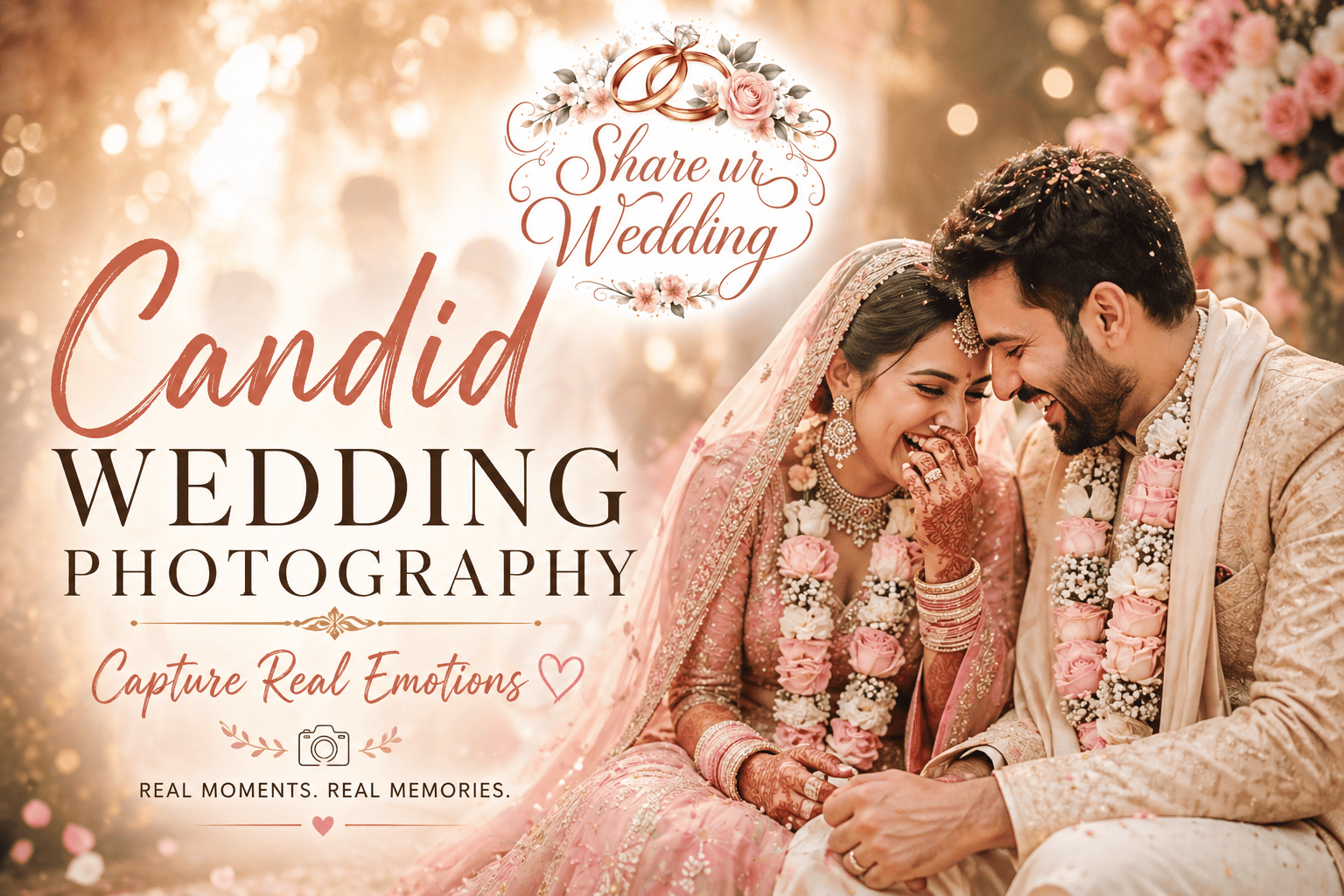
Candid wedding photography is how those moments survive beyond memory.
This guide is for couples who want to understand what candid photography actually means — not just the Instagram description, but the real practice of it. What makes it different from traditional photography. Why Indian weddings are uniquely suited to it. How to find a photographer who genuinely does it well (and how to spot one who just says they do). What it costs. And what your role is in making it work.
What is candid wedding photography? (Quick answer)
Candid wedding photography is the art of capturing genuine emotion and authentic moments without directing or interrupting them. Unlike traditional photography — which requires couples and guests to pose — candid photography works by observing and anticipating, using long lenses and available light to document real expressions, unscripted reactions, and the natural flow of the day. The goal is not a beautiful photograph. The goal is a true one.
What Candid Wedding Photography Actually Is — And What It Is Not
Here is where the confusion usually starts. Many couples request candid photography without being entirely sure what they are asking for. And unfortunately, many photographers call themselves candid photographers while delivering work that is simply posed photography with a slightly more relaxed expression.
Let us clear this up properly.
What it is
Candid photography is documentary observation applied to a wedding day. The photographer moves through the event like a quiet, well-dressed guest — present everywhere, intrusive nowhere. They use longer lenses to shoot from a comfortable distance, which means the subjects in the frame have not registered being photographed. They work with available light rather than directing people into specific spots for better illumination. They stay alert to the emotional texture of the day — reading body language, anticipating ritual moments, recognising when something genuine is about to happen — and they position themselves accordingly.
The result is photographs that look like they were taken by a thoughtful observer who happened to be standing in exactly the right place at exactly the right moment. Because that is precisely what happened.
What it is not
Candid photography is not secretly photographing people. It is not low-quality or unplanned photography. It is not the same as simply turning the flash off. And perhaps most importantly, it is not incompatible with beautiful, well-composed images. The best candid wedding photographs are technically excellent — sharp, correctly exposed, thoughtfully framed. They just happen to contain people who are being completely themselves.
The term is also used, sometimes dishonestly, to describe what is more accurately called directed photography — where the photographer gives specific instructions (‘stand here’, ‘look at each other’, ‘smile’) but with slightly less rigidity than a formal portrait session. This is not candid photography. It is directed photography. There is nothing wrong with directed photography — it produces beautiful results in the right context — but if you are paying for candid and receiving directed, you should know the difference.
The best candid photographs look effortless because they are. Not because the photographer did not work hard — but because the moment was genuinely happening and they were genuinely ready for it.
Candid vs traditional wedding photography — the real differences
Most wedding photographers offer both candid and traditional styles, often blending them throughout the day. Understanding the difference helps you know which moments call for which approach — and how to communicate your preferences clearly.
| Factor | Candid Photography | Traditional Photography |
|---|---|---|
| Core approach | Observer — documents what happens | Director — creates what is photographed |
| Emotion captured | Genuine, unguarded, raw | Polished, presented, composed |
| Guest experience | Guests feel relaxed, forget photographer is there | Guests are aware, sometimes nervous or impatient |
| Ritual moments | Captures them as they happen, in real time | Often restaged or repositioned for better framing |
| Photographer visibility | Low — blends into the event | High — actively directs people |
| Editing style | Natural, true-to-life colours, minimal processing | Often more heavily processed or retouched |
| Best for | Emotional moments, rituals, family reactions | Formal portraits, group photographs, architectural detail |
| Album feel | Living narrative — like reliving the day | Curated showcase — the highlights in their best light |
| Typical cost | Equal to or slightly above traditional | Mid-market to budget end of market |
The real answer: You need both. The best wedding photography is a blend — candid for the emotional story and the genuine moments, traditional for the formal family groups that grandmothers need for the mantelpiece. A 70:30 ratio of candid to traditional is what most Indian couples find most satisfying looking back on their albums.
Why Candid Photography Dominates Indian Weddings in 2026
Indian weddings were always going to produce the greatest candid wedding photographs in the world. Think about what is actually happening across a typical Indian wedding celebration.
Three generations of family in one space, many of whom see each other only at occasions like this. Multi-day events that move from intimate to grand to chaotic to sacred within the same afternoon. Rituals that have been performed in largely the same way for centuries, carrying emotional weight that is completely disconnected from any photographic consideration. Hundreds of guests, each one a story, each one a relationship with the couple that is different from every other.
A skilled candid photographer at an Indian wedding does not have to manufacture moments. The moments are happening continuously, in every corner of the venue, across every event. The job is to be in the right place and to be ready.
The 10 moments that only candid photography can capture at Indian weddings
These are the images that couples consistently describe as their most treasured. None of them can be posed. None of them can be recreated once they have passed.
- The baraat energy — the groom on the decorated horse or car, the family dancing behind him, the dhol player in full swing, the pure joy of a procession moving toward something that everyone has been anticipating for months.
- A parent adjusting something small — a mother straightening the bride’s dupatta, a father tying the groom’s safa. These quiet acts of care, done without any audience awareness, contain more love than any posed portrait.
- The varmala laughter — the garland exchange is genuinely unpredictable. The bride refuses to bow her head. The groom’s brothers lift him to make it impossible. Someone loses their grip. The result is usually helpless laughter from everyone in the frame. A burst-mode photographer catches the entire sequence. This is irreplaceable.
- Grandparents during the pheras — the expression on a grandmother’s face as she watches her grandchild begin their married life is one of the most emotionally complex photographs any wedding can produce. Pride, love, memory, time. A posed portrait cannot capture this. A candid observer, positioned correctly and paying attention, can.
- The sindoor application — the moment of sindoor is sacred and time-specific. A candid close-up of the groom’s hands and the bride’s expression at the exact moment of application is the image most couples say they wished they had but often do not.
- Siblings teasing the bride — the dynamic between siblings at an Indian wedding is a whole story within the story. The teasing, the protectiveness, the last-day-of-being-single energy, the shared memory of a lifetime together. Candid photography captures this; a posed photograph cannot.
- Children at the wedding — children at Indian weddings are simultaneously chaotic and magnificent. A child falling asleep on a grandparent’s shoulder during the ceremony. A small cousin dressed in a miniature version of the lehenga, completely oblivious to anything except the sweets table. These images always end up being favourites.
- The joota chupai chaos — the Punjabi tradition of the bride’s sisters stealing the groom’s shoes is one of the most genuinely comedic moments at an Indian wedding, and it is entirely unpredictable. A photographer on alert in burst mode produces images that cannot be replicated.
- The vidaai moment — the farewell. This is the most emotionally intense moment of the entire wedding for most families. A candid photographer who is positioned correctly and stays quiet will produce images from the vidaai that will be the most looked-at photographs in the album for the next fifty years.
- The post-ceremony exhale — immediately after the ceremony concludes, before the reception chaos begins, there is often a quiet moment where the couple simply sits together and breathes. They are married. They have done it. The expressions in this moment — exhaustion, relief, joy, disbelief — are completely unguarded and completely beautiful.
Candid Wedding Photography Styles in 2026 — Which One Is Right for You?
Candid photography is not a single approach. In 2026, it covers a spectrum of styles that each have a distinct look, a distinct working method, and a distinct emotional quality. Understanding the differences helps you choose a photographer whose style matches what you actually want.
Documentary / Photojournalistic
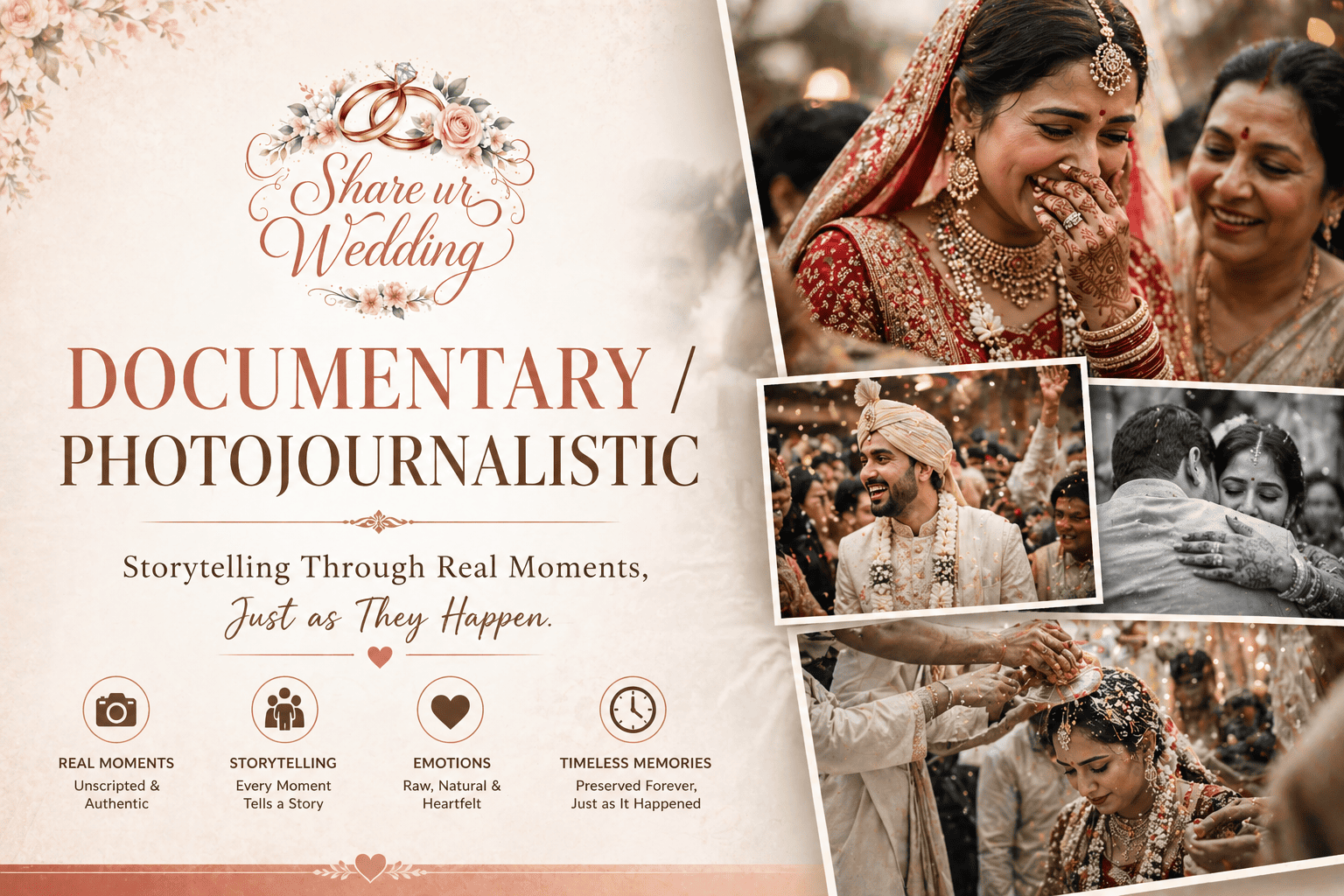
The purest form of candid photography. The photographer observes everything and directs nothing. Zero prompts, zero positioning, zero interference with the natural flow of events. They move through the wedding like a silent witness, using long lenses and available light, shooting continuously and selecting the best frames in editing. The resulting images have an unfiltered, raw quality that feels like the truest possible record of what actually happened.
Best for: Couples who are naturally expressive, comfortable ignoring cameras, and want genuine authenticity above visual polish
Cost signal: Mid-to-premium market — requires exceptional skill and preparation
Directed Candid (Most Popular in India 2026)
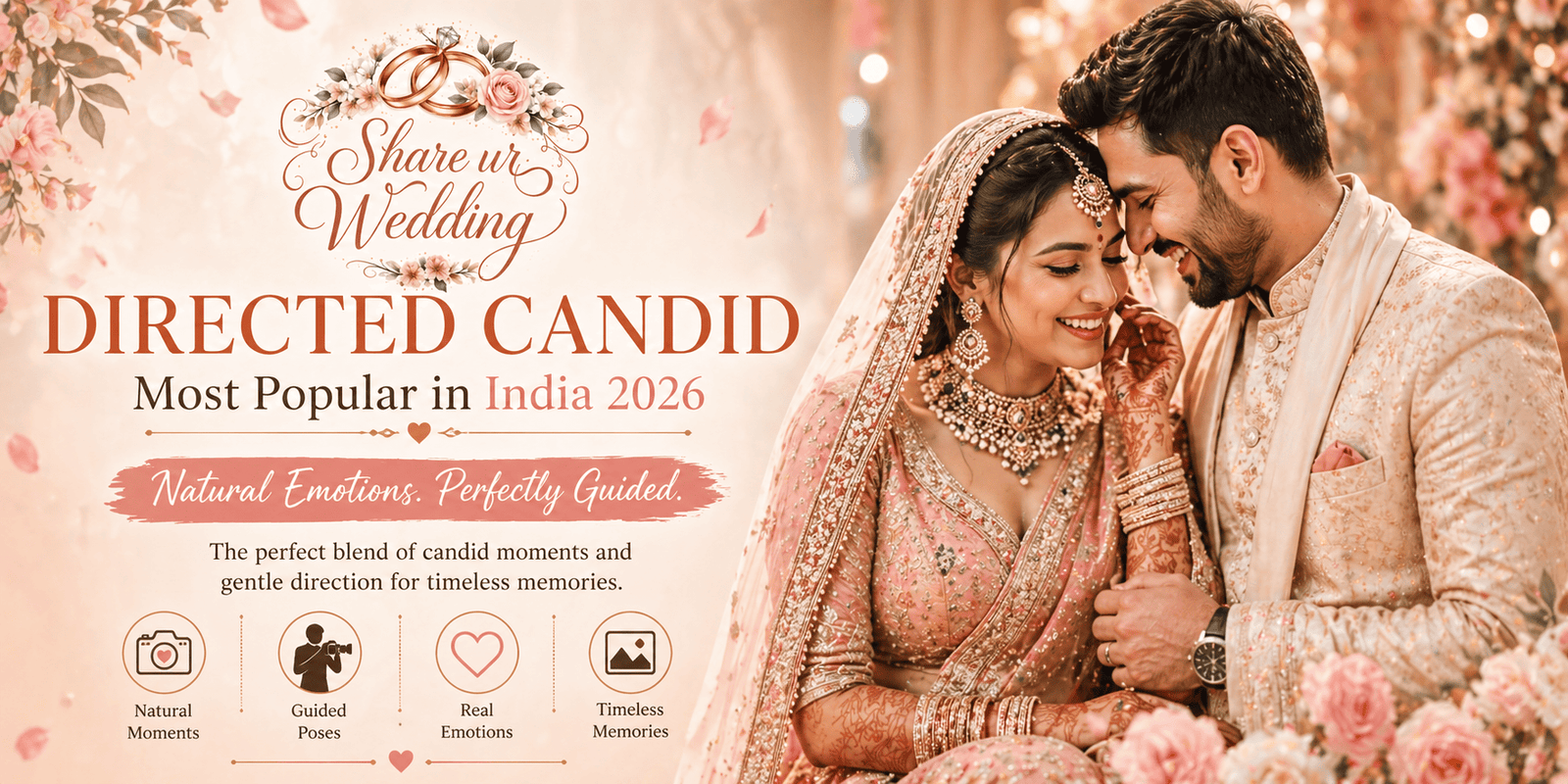
The photographer gives gentle prompts that produce natural-looking movement and emotion rather than stiff posed results. ‘Walk toward me slowly.’ ‘Whisper something that makes them laugh.’ ‘Hold hands and keep walking, just keep talking.’ The prompts are directions toward natural behaviour, not instructions toward a specific pose. The results look candid because the emotion is genuine — the couple is actually laughing, actually holding hands, actually talking. They are just doing it in a frame that the photographer has composed thoughtfully. This is what most Indian couples receive when they book a ‘candid photographer.’
Best for: Most couples — especially camera-shy people who need a little guidance to stop self-consciously performing
Cost signal: Most widely available — mid-market to premium
Loose Editorial (The 2026 Emerging Style)
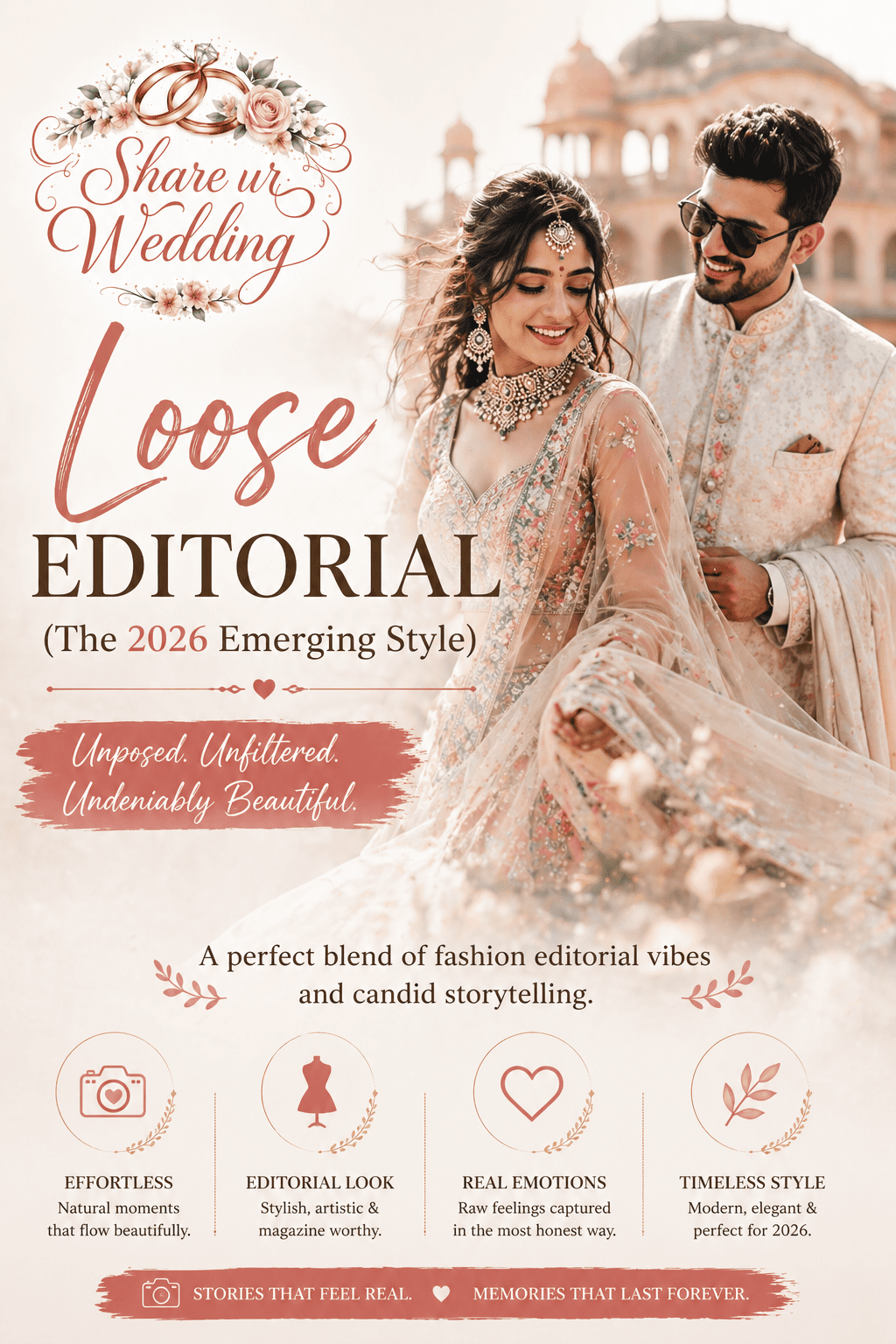
A newer style sitting between documentary storytelling and fashion editorial. The photographer has a strong compositional and aesthetic eye — images are carefully seen and framed — but the emotion within the frame is always genuine, never performed. Think of it as documentary photography with the visual intelligence of a fashion photographer. The result feels effortless but is rooted in real skill. Images have a magazine-editorial quality without the artificiality of a fashion shoot. This style is growing rapidly among younger Indian couples in metro cities who consume a lot of international wedding photography content.
Best for: Couples with strong visual taste who want both emotional authenticity and aesthetic excellence
Cost signal: Premium to luxury market — requires significant creative experience
Film Emulation and Grain Aesthetic
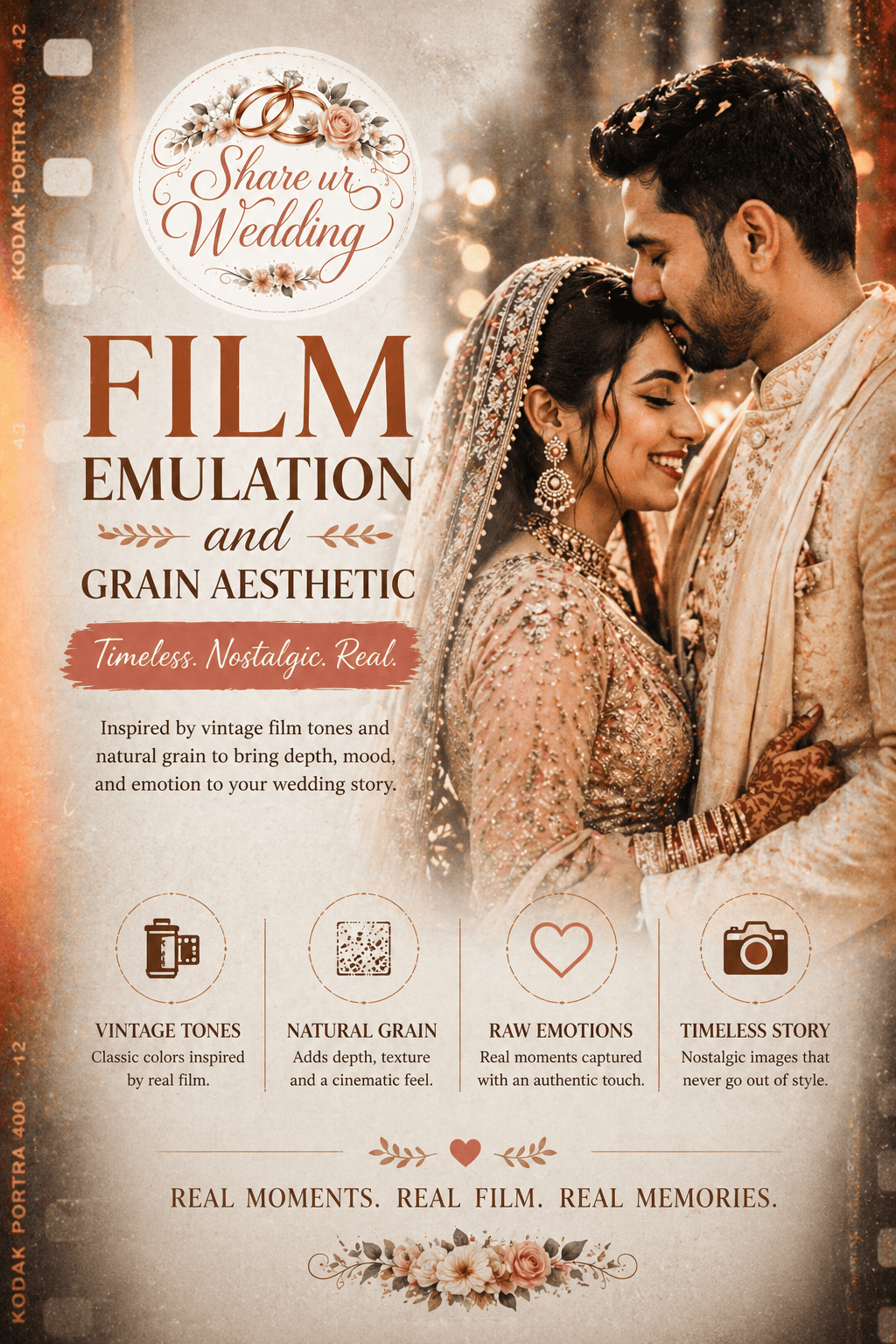
Digital photography processed to look like 35mm or 120mm medium format film. Warm, slightly underexposed, with visible grain and the characteristic colour rendering of film stocks like Kodak Portra or Fuji 400H. This is a deliberate aesthetic choice — the photographer shoots digitally but processes the images to feel nostalgic, imperfect, and emotionally warm. This style is trending very strongly in 2026, particularly among couples who love the vintage warmth of film without the unpredictability and cost of actual film photography.
Best for: Couples who love a warm, vintage, emotionally intimate aesthetic over sharp and heavily processed images
Cost signal: Mid-to-premium market — widely available but quality varies significantly
2026 Direction: The strongest trend in Indian wedding photography for 2026 is the move toward documentary storytelling combined with emotional authenticity. Couples are actively moving away from photographers who over-edit — muting colours, smoothing skin to unrealistic levels, applying heavy presets that make every wedding look the same. The request is increasingly: show us what it actually looked like.
How to Evaluate a Candid Photographer’s Portfolio — Honestly
This is the section that most candid photography guides skip. They say ‘check their portfolio’ as if that is sufficient instruction and move on. It is not sufficient. There is a significant skill involved in reading a candid photography portfolio — and couples who miss this step end up disappointed with images that are technically fine but emotionally hollow.
Here is how to look at a candid portfolio with real discernment.
Always ask for full wedding galleries, not highlight reels
Every photographer’s highlight reel contains their 30 best shots from 1,000 photographs. Of course it looks spectacular. The question is what the other 970 look like — because those are what you will actually receive.
Request to see three complete wedding galleries from recent events. Look at the full sequence. Are the non-hero shots still good? Does the storytelling hold throughout the day, not just at the peak emotional moments? Is the quality consistent from the morning getting-ready session through to the late-night reception? A photographer who can only produce 30 excellent photographs from a full wedding day is not the right candid photographer for you.
Look at the expressions, not the compositions
Many photographers produce beautiful compositions with technically mediocre expression work. The light is good, the framing is elegant, the colour is consistent — but the people in the frame look slightly stiff, slightly aware, slightly posed. This is directed photography sold as candid.
When you look at a portfolio, cover the composition with your hand and look only at the faces. Are the expressions genuinely unguarded? Is there real emotion in the eyes, not just the mouth? Are the subjects looking at each other rather than into the lens in ways that feel natural rather than performed? These are the signals of truly candid work.
Check the variety of moments
A genuine candid portfolio does not contain only the obvious moments — the first look, the varmala, the first dance. It contains the spaces between those moments. The grandmother sitting quietly in the corner. The child who has given up on staying clean and is now completely delighted about it. The groom’s brother making everyone laugh during the baraat. The quiet conversation between the bride and her mother in the dressing room. A photographer who only captures the designated emotional peaks has not been paying attention to the whole day.
7 questions to ask before hiring a candid wedding photographer
- How do you position yourself during religious rituals — specifically the pheras and the sindoor? The answer tells you how much they understand Indian ceremony timing and whether they will be in the right place when it matters most.
- How do you handle camera-shy couples or guests? A skilled candid photographer has techniques for this — prompts that produce natural behaviour rather than stiffness. A weak answer here is a red flag.
- How many weddings are you covering in the two weeks around my date? A photographer who is covering 4 or 5 events in rapid succession is physically and creatively depleted. You want someone who is alert, rested, and genuinely excited about your wedding specifically.
- What is your equipment backup plan if your primary camera body fails on the day? Equipment failure happens. A professional always has backup gear. No backup gear means no backup plan.
- Do you work with a second shooter? For multi-day Indian weddings, a second shooter is almost always necessary. Two events happening simultaneously — the bride getting ready and the baraat departure — cannot be covered by one person.
- What is your editing style and turnaround time? Ask specifically whether they use heavy presets or whether they edit each image individually. Ask to see both the before and after on a few images from a recent wedding.
- Can I speak with two or three couples from your last six months of work? Not testimonials on their website. Real couples you can message directly. The conversation you have with previous clients tells you more than any portfolio.
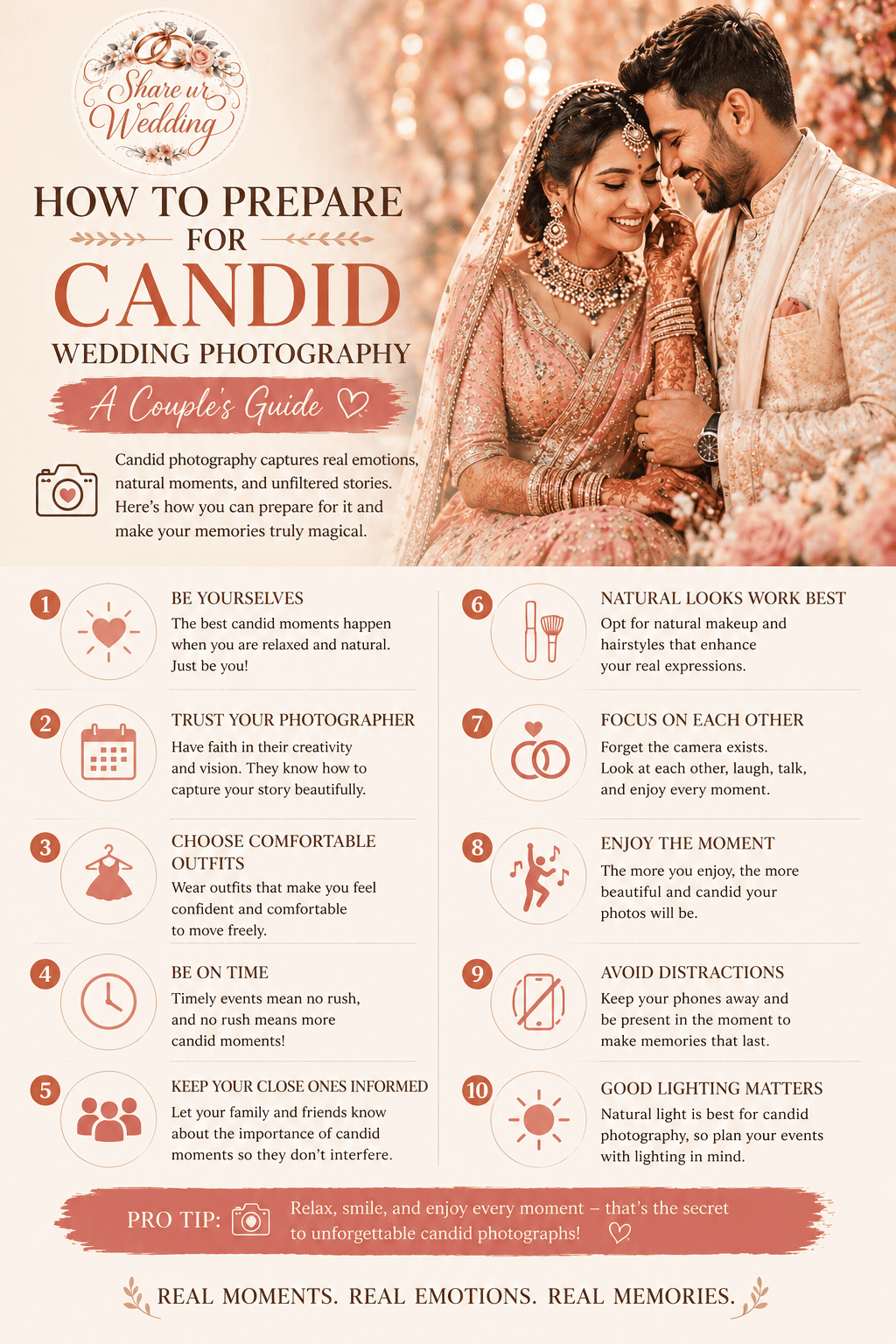
How to Prepare for Candid Wedding Photography — A Couple’s Guide
Here is something that most candid photography guides never tell couples: your behaviour on the wedding day determines the quality of your candid photographs as much as the photographer’s skill does.
This sounds counterintuitive. Is not the whole point that you do not have to do anything? The photographer handles it?
Partially. The photographer handles the technical work, the positioning, the anticipation. But the emotional quality of the images — the genuineness of the expressions, the naturalness of the interactions — depends entirely on how present and relaxed you actually are. And that is something you can prepare for.
The most important thing: stop performing
The single biggest obstacle to beautiful candid wedding photography is a couple that is constantly aware they are being photographed. You can see it in their body language — slightly stiff, slightly elevated, monitoring their expressions. The moments these couples forget the photographer is there are the moments their photographs become beautiful.
The paradox of candid photography is that the harder you try to look natural, the less natural you look.
How do you actually relax? Three things help enormously. First, do a pre-wedding shoot with your photographer. Spending two hours together in front of the camera before the wedding day creates a comfort level and working relationship that shows up in the wedding photographs. Second, arrive at the wedding genuinely rested — the fatigue of a poor night’s sleep shows on faces in every photograph. Third, on the day itself, focus on each other and on the people around you. The best candid photographs come when the couple has completely forgotten about the camera because they are fully absorbed in the moment they are actually living.
Brief your photographer on the people and moments that matter most
Your photographer cannot capture what they do not know to look for. A skilled candid photographer pays attention to everyone — but they pay more attention to the people you tell them about in advance.
Before the wedding, have a conversation with your photographer about the specific people and moments you want documented. The grandmother who flew from abroad for the wedding. The father who does not show emotion easily but who might break down at the vidaai.
The group of college friends who are reuniting for the first time in five years. The tiny cousin who is wearing a miniature version of the bride’s outfit. The elderly uncle who taught the groom everything about the ritual and who will be participating in the ceremony.
Give your photographer names. Give them context. Show them photographs so they can recognise people. This is what separates a wedding album that tells your specific story from one that could belong to any couple at any Indian wedding.
Protect the golden hour session
Schedule 25 to 30 minutes during the golden hour — the window of time between the ceremony and reception, ideally timed for the 30 minutes before sunset — for a private couple portrait session. Just the two of you and the photographer. No family, no friends, no wedding coordinator showing you things to sign.
This session produces the most beautiful couple images of the entire wedding. The light is warm and directional in a way that cannot be replicated at any other time of day. You are both past the nerves of the ceremony and not yet into the social performance of the reception. You have just been married. The images from this half-hour consistently become the most displayed photographs in the wedding album.
The session is also the single most threatened 30 minutes of any wedding day — everyone needs something from the couple between the ceremony and the reception. Protect this time. Put it in the day-of schedule. Brief your coordinator, your family, and your guests that this time is unavailable. It is worth defending.
Practical Tip: Tell your coordinator and both families that your portrait session is 45 minutes long. In reality, it is 25 minutes. The extra 15 minutes of buffer means that when someone inevitably needs you for ‘just one thing,’ the portrait session still happens.
The pre-wedding shoot — why it matters more than couples realise
A pre-wedding shoot is not just about the photographs it produces (though those are lovely). It is about what it does to your relationship with the photographer before the wedding day. Two hours of being photographed together — walking, laughing, existing in front of a camera — builds a comfort level and trust that is almost impossible to achieve on the wedding day itself, when everything is moving quickly and the emotional stakes are high.
Couples who do a pre-wedding shoot are consistently more relaxed in front of the camera at their wedding. Not because they have ‘practiced posing’ — but because the photographer has stopped feeling like a stranger. They feel like someone who was already part of an important day. That shift in perception changes the energy in every photograph that follows.
Candid Wedding Photography Cost in India — A Realistic 2026 Guide
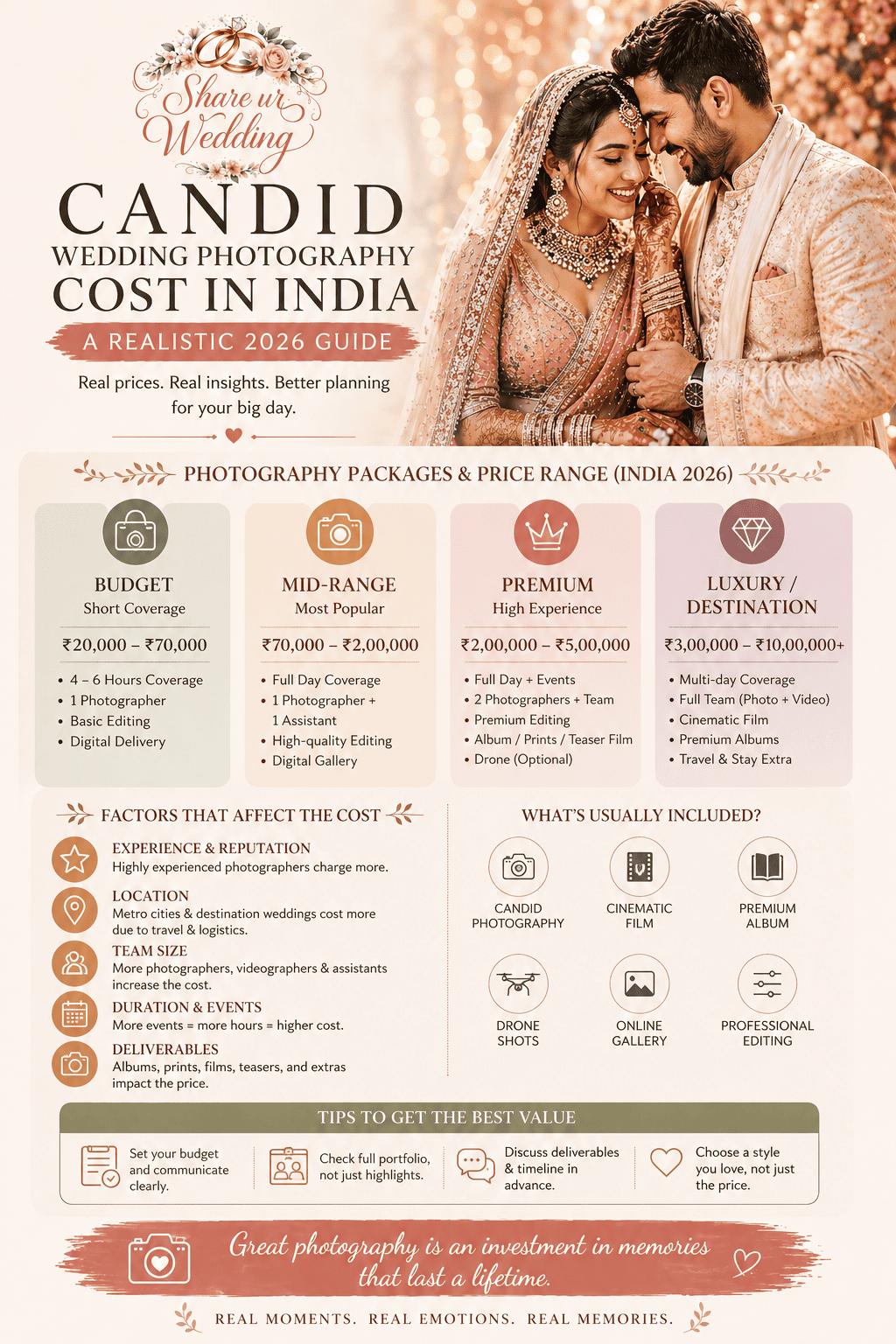
Candid wedding photography pricing in India is one of the most confusing aspects of the entire wedding planning process, largely because ‘candid photographer’ is used to describe everyone from a fresh graduate with a new camera to a seasoned professional with a decade of Indian wedding experience.
Here is a realistic framework for what you can actually expect at different price points in 2026.
| Budget Range | What You Realistically Get | Best Suited For |
|---|---|---|
| Under ₹25,000 | Entry-level or new photographer. Limited low-light capability. Possibly no second shooter. Editing may be heavy or inconsistent. Portfolio is thin. | Very small, simple weddings. Couples who prioritise documentation over artistry. |
| ₹25,000 – ₹60,000 | Established local photographers with 2–4 years of experience. Decent candid capability. May work solo or with one assistant. Quality varies significantly — portfolio review is essential. | Budget-conscious couples who do thorough research and choose carefully. |
| ₹60,000 – ₹1,50,000 | Strong mid-market candid photographers with genuine skill in Indian wedding environments. Usually work with a second shooter. Consistent quality across the day. Film emulation and documentary styles are common here. | Most Indian couples — this range offers the best overall value. |
| ₹1,50,000 – ₹3,50,000 | Premium photographers with significant experience, distinctive personal style, and a portfolio that is immediately recognisable. Often booked 10–14 months in advance. Includes second shooter and full editing. | Couples for whom photography is a top budget priority. |
| ₹3,50,000 – ₹10,00,000+ | Top-tier studios and photographers. Consistent editorial quality. Full team coverage. Luxury album included. Often destination wedding specialists. | Large-scale or destination weddings where photography is central to the experience. |
Important Warning: The ₹25,000 to ₹60,000 range contains both excellent value and significant risk. This is where the most dishonest marketing happens — photographers who use the word ‘candid’ freely but deliver work that is neither genuinely candid nor particularly good. Portfolio review is non-negotiable in this range. Ask to see full galleries, not highlights.
One more thing about cost that couples rarely consider: the editing is as important as the shooting. A photographer who shoots beautifully but applies heavy, trend-chasing presets to the final images will produce a gallery that looks dated in three years. Ask to see unedited versus edited comparisons before hiring. If the editing dramatically changes the true colour and feel of the images, that is a signal worth paying attention to.
The Balance: Candid and Traditional Together
There is a version of this conversation where couples feel they have to choose — candid or traditional. They do not.
The most satisfying wedding albums combine both. Candid photography captures the emotional story — the narrative of the day as it actually felt. Traditional photography captures the record — the family groups, the formal couple portraits, the ritual moments documented with care and clarity. Both serve a purpose. Both are irreplaceable in a complete wedding album.
The ratio that most experienced photographers recommend for Indian weddings is roughly 70 per cent candid to 30 per cent traditional. The 70 per cent is the living story of the day — the moments of joy, grief, laughter, and love that happen without direction. The 30 per cent is the record — the photographs that grandparents frame and families display. Both matter. Both serve different but equally important functions.
When to specifically request traditional photography
- Formal family group photographs — every family needs these. Grandparents, siblings, cousins, the extended family arranged together. These are the photographs that get framed and placed on living room walls for decades. They require direction.
- Ritual close-ups — the mangalsutra, the sindoor, the thaali tying. While the emotional moment itself should be captured candidly, a specific close-up of the ritual detail — the jewellery, the hands, the sacred objects — often benefits from deliberate framing by the photographer.
- Venue detail shots — the decorated mandap, the floral arrangements, the table settings at their most pristine. These environmental photographs benefit from the photographer actively composing and framing rather than passively observing.
- The first look portrait — if you choose to do a first look before the ceremony, this is a moment where gentle direction from the photographer — positioning, distance, where to stand — produces significantly better results than pure observation.
| The best wedding album tells two stories simultaneously: what your wedding looked like, and what your wedding felt like. Traditional photography tells the first story. Candid photography tells the second. You need both. |
Frequently Asked Questions
What is candid wedding photography?
Candid wedding photography is the practice of capturing genuine emotion and authentic moments without directing or interrupting them. Unlike traditional posed photography, candid photographers work by observing and anticipating — using longer lenses and available light to document real expressions, unscripted reactions, and the natural flow of the wedding day. The goal is to produce images that look like they were taken by a thoughtful observer who happened to be in the right place at the right moment, because that is precisely what happened.
What is the difference between candid and traditional wedding photography?
Traditional wedding photography requires direction — the photographer tells people where to stand, how to look, and when to smile. The results are polished and formally composed. Candid photography is observational — the photographer documents what naturally happens without directing it. The results are emotionally genuine and often unpredictable in the best way. Most Indian couples benefit from a blend of both: candid for the emotional story of the day, traditional for the formal family groups and deliberate portrait sessions. A ratio of approximately 70 per cent candid to 30 per cent traditional suits most weddings.
How much does candid wedding photography cost in India in 2026?
Candid wedding photography in India ranges from approximately ₹25,000 for entry-level photographers to ₹60,000 to ₹1,50,000 for strong mid-market professionals with genuine candid skills and a second shooter, to ₹3,50,000 and above for premium photographers with distinctive editorial styles. The ₹60,000 to ₹1,50,000 range offers the best overall value for most Indian couples. Always review full wedding galleries rather than highlight reels, and ask to see editing comparisons before committing.
How do I find a good candid wedding photographer?
Ask to see three complete wedding galleries from recent events — not highlight reels. Look at the expressions in the photographs, not just the compositions. Check whether the non-hero shots are still genuinely good. Ask seven specific questions: how they position during rituals, how they handle camera-shy subjects, how many weddings they cover near your date, what their equipment backup plan is, whether they use a second shooter, what their editing style and turnaround time are, and whether you can speak with recent clients directly. Photographers who answer these questions confidently and specifically are the ones worth hiring.
What moments should candid wedding photography capture at an Indian wedding?
The most treasured candid moments at Indian weddings include: the baraat energy and procession, a parent adjusting the bride’s dupatta or tying the groom’s safa, the varmala laughter and chaos, grandparents during the pheras, the sindoor application close-up, siblings teasing the bride, children at the wedding, the joota chupai (shoe stealing) chaos, the vidaai moment, and the quiet post-ceremony exhale. Brief your photographer on the specific people and relationships to watch for — the grandmother who flew from abroad, the father who rarely shows emotion. Photographers who know what to look for produce images that tell your specific story, not a generic wedding narrative.
A Final Thought
Your wedding day will pass faster than you can imagine. The morning will feel slow — the rituals moving at the pace they have always moved, the family arriving in waves, the ceremony unfolding with the gravity it deserves. And then suddenly it is evening, and you are at the reception, and the photographer is showing you something on the back of their camera, and you are looking at a photograph of a moment that happened six hours ago that you had already half-forgotten — and it is the most beautiful thing you have ever seen.
That is what good candid wedding photography does. It gives you back the moments that move so fast that memory cannot hold them fully.
Choose your photographer carefully. Brief them well. Trust them on the day. And then be completely, unreservedly present in your wedding — because the camera will handle the rest.