

If the wedding ceremony is the sacred heart of an Indian wedding, the sangeet is its beating, dancing, laughing soul.
No other event in the entire wedding celebration gives your family and friends the freedom to actually enjoy themselves the way the sangeet does. The ceremony has its rituals and its reverence. The reception has its formalities and its social obligations. But the sangeet belongs to everyone equally — the bride’s youngest sister who has been choreographing for six months, the groom’s college friends who have created an elaborate video montage, the parents who are secretly nervous about their performance but cannot wait to see their children’s faces when they watch.
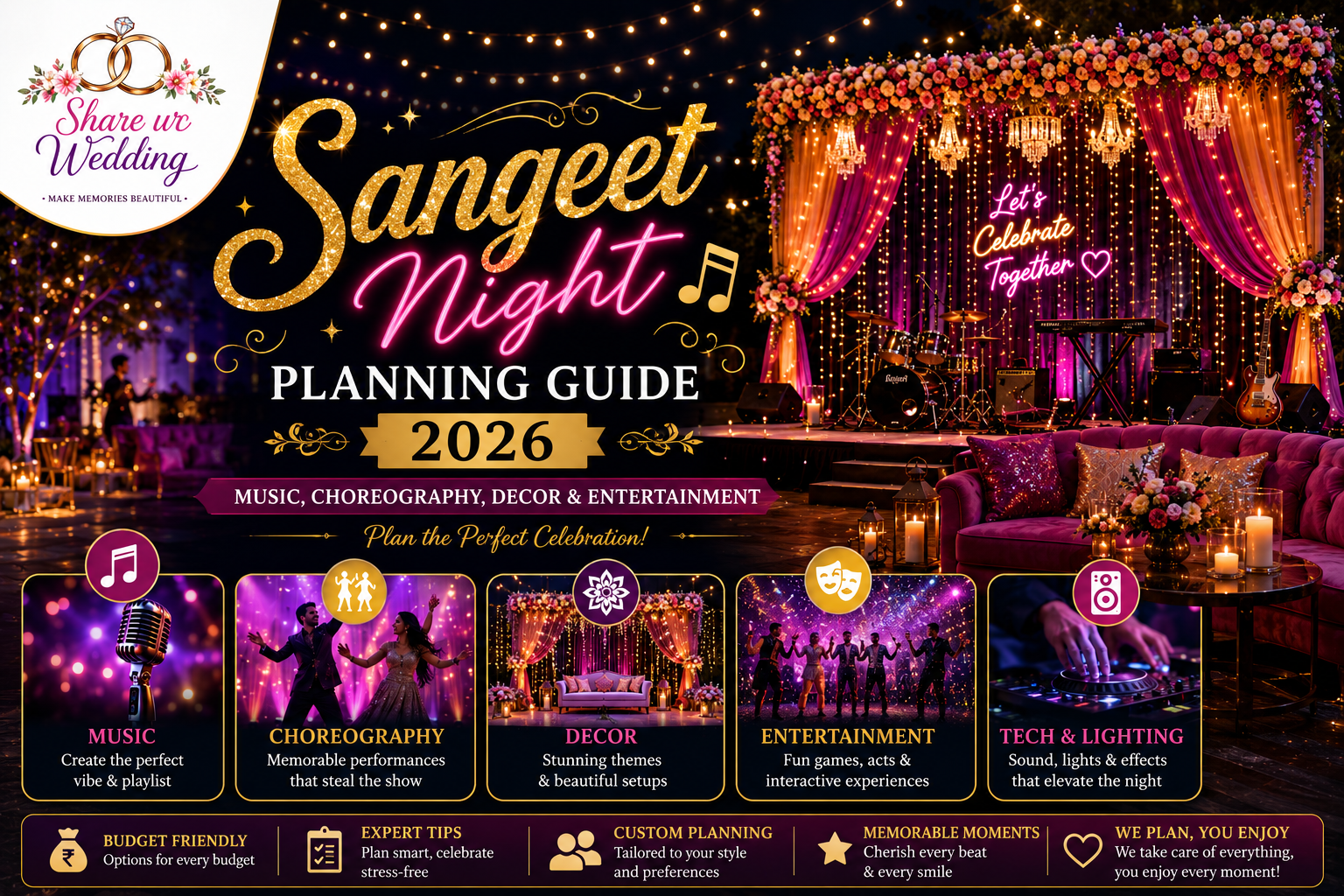
The sangeet night in 2026 has evolved significantly from the family-function-with-a-dhol that it was a generation ago. Today’s sangeet is a produced event — with professional choreographers, lighting rigs, themed decor, DJ sets that move seamlessly between Bollywood and contemporary, and in some cases, fully scripted narratives that tell the couple’s love story through dance. But even the most modest sangeet, planned with care and genuine intention, can be one of the most joyful celebrations of any wedding.
This guide gives you everything you need to plan a sangeet night that feels right for your family — whether you are planning a 50-person intimate performance or a 500-guest spectacular production.
Understanding the Sangeet — What It Is and What It Has Become
The sangeet originates as a pre-wedding ceremony where women from both families gather to sing traditional wedding songs — compositions specific to the region, the community, and the family tradition. This origin still shows in many sangeet celebrations today — the older women of both families singing traditional gathas or boli, the younger women responding, the rhythm of call and response that has been at Indian weddings for centuries.
But the modern sangeet has expanded enormously around this core. What began as a women’s singing ceremony now encompasses the full wedding family from both sides, performances by every generation, Bollywood dance numbers choreographed over months, video montages of the couple’s relationship, roasts, and in many cases, a full concert-style production with professional lighting and sound equipment.
In 2026, the most memorable sangeet nights are the ones that preserve something of both — the genuine family emotion of traditional songs and the joyful chaos of a professionally choreographed evening. The families who skip the traditional element entirely sometimes describe something feeling slightly missing. The families who skip the choreographed Bollywood segment often have a less energetic second half of the evening.
The 2026 Trend: The biggest sangeet trend of 2026 is storytelling through performance — creating a narrative arc across the evening that tells the couple’s love story through connected dance sequences. Instead of disconnected performances, each group act serves a chapter of the story. By the end of the evening, guests have watched a complete love story unfold through music and dance.
Planning Your Sangeet Night — The 6-Month to Day-of Timeline
| Timeframe | Tasks | Priority |
|---|---|---|
| 6 months before | Decide the scale (intimate/mid/grand). Confirm the date and venue. Begin choreographer search. | Critical |
| 4–5 months before | Book choreographer. Assign performance groups. Begin song selection. Book DJ and live musician. | High |
| 3 months before | Confirm all performers and their performance order. Begin decoration design. Confirm catering concept. | High |
| 2 months before | Choreography rehearsals underway. Confirm AV and lighting requirements with venue. Finalise decoration. | Medium |
| 6 weeks before | Order/arrange costumes for performers. Final confirmation of DJ playlist and performance running order. | Medium |
| 2 weeks before | Full dress rehearsal at the venue if possible. Confirm all vendor final payments and arrival times. | High |
| 1 week before | Share the complete evening running order with all performers, DJ, and MC. | Critical |
| Day of | Sound check at least 3 hours before guests arrive. Stage set and lighting test complete before first guest. | Critical |
The Performances — How to Organise Your Sangeet Program
The performance lineup is the soul of the sangeet evening. Getting it right — the right number of acts, the right running order, the right length — makes the difference between an evening that flows beautifully and one that feels exhausting.
How many performances is the right number?
For most sangeets, 4 to 6 group performances with an additional couple’s performance and an opening traditional number is the ideal structure. This works out to approximately 60 to 90 minutes of performances, which is long enough to feel satisfying and short enough that no guest is checking their phone waiting for dinner.
The most common mistake is including too many performances. Every family wants their group included and the pressure to add more acts is real. But 12 performances of 7 minutes each means an audience sitting through 84 minutes of continuous performance — and by performance 8, the energy in the room has genuinely dropped regardless of how good the performance is.
The solution is performance length, not performance number. If more groups want to participate, limit each to 5 minutes rather than reducing the number of groups. 8 groups of 5 minutes each (40 minutes) keeps the energy significantly higher than 8 groups of 10 minutes each (80 minutes).
The ideal running order
- Opening number: A traditional song performed by the older women of both families — the original sangeet spirit, done first while the audience is freshest and most attentive.
- High-energy opener: The first Bollywood choreographed act, designed to set the tone and bring immediate energy. Usually the bride’s or groom’s siblings’ group — the most invested and typically best-rehearsed performers.
- Mid-program variety: Alternate between dance, video content, and couple-related moments. A 3-minute video montage of the couple’s story breaks up consecutive dance performances and creates an emotional anchor.
- The parents’ performance: If parents are performing — and they should be encouraged to — place this in the mid-program section where the emotional stakes of watching them perform land most effectively.
- Penultimate act: The bride or groom’s closest friends. Usually the most energetic and most rehearsed act of the evening.
- The couple’s performance or joint family performance: The final planned act before the open dance floor. Should end on the highest emotional note.
- Open floor: DJ takes over, all guests invited. This should last at least 90 minutes and is where most of the genuine dancing of the evening happens.
Music, DJ, and Entertainment — The Sound of Your Sangeet Night
The DJ vs live musician question
The most popular sangeet entertainment combination in 2026 is a professional DJ plus a live dhol player. The DJ handles the Bollywood and contemporary tracks that the performances are choreographed to, while the dhol player adds live energy during transitions, the open dance floor, and key high-energy moments. This combination is more versatile and typically more reliable than a live band while capturing more of the energy and spontaneity of live performance than a DJ alone.
Live bands — specifically bands that can play both Bollywood and traditional numbers — are the premium option. A good wedding band can read the room in real time and adjust their setlist based on how the audience is responding. They can extend a song when the dance floor is packed, or shift tempo when energy drops. This responsiveness is not available from a pre-curated DJ playlist. The trade-off is cost — a quality wedding band is 3 to 5 times the cost of a good DJ.
2026 sangeet music trends
- Retro Bollywood revival: 1970s–1990s Bollywood is dominating sangeet playlists in 2026. Songs from that era carry cross-generational recognition — the older guests are delighted, the younger guests have rediscovered them through reels and retro aesthetic content.
- Regional music integration: Telugu, Tamil, Punjabi, and Rajasthani folk elements being woven into otherwise Bollywood-heavy playlists. Particularly popular among couples who want to celebrate their regional identity.
- International crossover: A sangeet playlist that moves between Hindi film music and international tracks — particularly Latin rhythms that work well as dance music — is gaining traction among urban couples in their late 20s.
- Live tabla or percussion during open floor: A tabla or percussionist playing alongside the DJ during the open dance floor creates an energy that pure DJ cannot achieve. Increasingly popular in 2026.
How to brief your DJ
Your DJ is only as good as the brief you give them. Before the sangeet, have a meeting or call covering: the complete performance running order with specific song cues for each act, the transition plan between performances, the music style you want for the open floor, any songs that must be played and any that must be avoided, the noise curfew at the venue, and any specific moments (cake cutting, special entry) that need specific tracks.
Share the meeting summary in writing. A DJ who has a written brief makes far fewer errors than one working from a verbal discussion.
Sangeet Night Choreography — Making the Performances Spectacular
Should you hire a professional choreographer?
For sangeets where multiple groups are performing and where the performances are a central part of the evening’s appeal, yes — a professional choreographer is worth the investment. Not because your family members cannot create good choreography themselves, but because a professional creates unity of vision across different groups, manages the rehearsal process professionally, ensures performances are stage-ready rather than living-room-ready, and reduces the stress on family members who are trying to both perform and enjoy the wedding simultaneously.
The typical professional sangeet choreographer in Indian cities charges between ₹15,000 and ₹75,000 depending on the number of groups, the number of rehearsal sessions, and their experience level. For a sangeet with 5 to 7 performing groups, a choreographer charging ₹25,000 to ₹40,000 who oversees all groups (rather than the cheapest choreographer available) almost always produces a better evening.
Choreography tips that actually make a difference
- Choose songs that performers actually enjoy dancing to. Forced enthusiasm is visible. Genuine enthusiasm is spectacular.
- Make the first 30 seconds extraordinary. Audiences form their impression of a performance in the first half-minute. If the opening is strong, they will forgive minor errors in the middle.
- End every performance on the highest-energy note possible. The audience’s applause is largely determined by the final 10 seconds of a performance.
- Include moments of genuine emotion in the couple’s closest friends’ and family’s performances — a line sung to the bride’s face, a moment of connection that makes the couple feel seen. These are the moments everyone remembers.
- Practice on the actual stage at least once before the sangeet. Living room rehearsals do not prepare performers for the spatial reality of the stage, the stage lighting, or the distance from the audience.
Sangeet Night Decoration — Creating the Right Atmosphere
The sangeet decoration has one primary job: create an atmosphere where people want to dance. This means warmth, energy, and a sense of occasion — not the quiet elegance of a ceremony setup or the formal grandeur of a reception. The sangeet should feel like the best party anyone has ever been to.
Colour palettes for sangeet decoration in 2026
| Palette | Primary Colours | Lighting | Best For |
|---|---|---|---|
| Classic Jewel Tones | Deep emerald, royal blue, gold, burgundy | Warm amber uplighting, coloured stage lighting | Traditional families who want festivity with elegance |
| Romantic Pastels | Blush, lavender, ivory, rose gold | String lights + candle-effect uplighting | Contemporary couples, intimate sangeet evenings |
| Bollywood Gold | Orange, hot pink, yellow, gold | Dynamic coloured lighting, bold stage spots | High-energy, maximum colour sangeet celebrations |
| Monochrome Navy | Deep navy and gold exclusively | Blue-tinted stage lighting with gold accents | Editorial, fashion-forward couples |
| Terracotta Earthy | Terracotta, burnt orange, copper, ivory | Warm golden lighting throughout | Bohemian and eco-conscious couples |
The stage and performance area
The performance stage is the centrepiece of the sangeet decoration and must receive the most attention and budget. A stage with good uplighting, a backdrop that photographs beautifully, and adequate depth for the performing groups is non-negotiable.
- Stage backdrop options: Flower walls (marigold or fresh florals), LED walls with dynamic content, fabric draping with fairy lights, or thematic props specific to your sangeet theme.
- Stage uplighting: Coloured LED uplighting on the stage that can be changed dynamically between performances is one of the highest-value additions to sangeet decor. A red-lit stage for a Bollywood item number, a blue-lit stage for a romantic performance, a white-gold lit stage for the couple’s moment.
- Stage depth: Ensure your stage has at least 4 to 5 metres of depth for groups of 8 to 10 performers. Many sangeet disasters involve choreography designed for a space larger than the actual stage.
The guest seating and experience area
Sangeet seating should encourage participation, not passive watching. Semicircular seating arrangements that face the stage while leaving the centre floor open for dancing — both during performances and for the open dance floor — work better than traditional banquet-style rows. Create designated VIP seating for both parents and grandparents with clear sight lines to the stage. And leave enough aisle space for guests to join spontaneous dancing without disrupting seated guests.
Sangeet Night Catering — Food That Works for an Entertainment Evening
Sangeet catering is fundamentally different from ceremony or reception catering. Guests are watching performances and dancing — they are not sitting at tables focused on eating. The food must work around the entertainment, not compete with it.
- Pre-performance: Serve starters and snacks on passed trays or from live counter stations accessible from the seating area. Guests can eat without leaving their seats or missing performances.
- Between performances: Light food counters that guests can access during transitions. Chaats, satays, and finger foods work better than full meals at this point.
- Post-performances: Main dinner service begins after the planned performances conclude, typically on the open dance floor section of the evening. Buffet works better than plated service for sangeet because it allows guests to eat at their own pace and return to dancing quickly.
- Dessert station: A dessert station open throughout the evening — particularly sweet items like meetha paan, mithai displays, and mini desserts — gives guests something to engage with during any lull in energy.
- Drinks: A well-stocked mocktail bar with fresh juices and flavoured waters keeps energy high throughout the evening. For sangeet events that include alcohol service, ensure the bar service does not compete visually or physically with the performance space.
Sangeet Night Budget Guide 2026
| Budget | Scale | Entertainment | Decor | Food |
|---|---|---|---|---|
| Under ₹1,00,000 | Intimate (50–100 guests) | DJ only | Basic flower backdrop + fairy lights | Home-catered or simple buffet |
| ₹1L – ₹2.5L | Mid-scale (100–200 guests) | DJ + dhol player | Stage backdrop + uplighting + tablescapes | Full buffet with live counter |
| ₹2.5L – ₹5L | Full-scale (200–400 guests) | DJ + dhol + choreographer for 3–4 groups | Professional stage, LED uplighting, full decor | Full catering + passed starters + dessert bar |
| ₹5L – ₹10L | Grand (300–600 guests) | DJ + dhol + live musician + professional choreographer | Full production stage, dynamic lighting, designer decor | Premium catering with multiple live counters |
| Above ₹10L | Spectacular (500+ guests) | Live band + DJ + dhol + celebrity appearance possible | Full concert-style production setup | Premium wedding catering full service |
Frequently Asked Questions
What is a sangeet night in Indian weddings?
The sangeet is a pre-wedding celebration where family and friends from both sides come together for an evening of music, dance, and performances. It originates from the tradition of women singing folk songs at weddings, but has evolved into a full entertainment event featuring choreographed dance performances, DJ music, live musicians, video montages, and open dancing. The sangeet typically takes place one to two days before the wedding ceremony and is considered the most joyful and energetic event of the entire wedding celebration.
How much does a sangeet night cost in India?
Sangeet night costs in India in 2026 range from approximately ₹75,000 to ₹1,00,000 for an intimate celebration of 50 to 100 guests with basic DJ and decoration, to ₹2,50,000 to ₹5,00,000 for a full-scale event of 200 to 400 guests with choreographer, live dhol, professional decor, and full catering, to ₹8,00,000 and above for grand productions with live bands and elaborate setups. The biggest cost variable is typically decoration — a professionally lit stage with dynamic lighting and a designer backdrop represents a significant investment that dramatically elevates the visual quality of the event.
How early should I book a sangeet choreographer?
Book your sangeet choreographer 4 to 5 months before the sangeet event. The best choreographers — particularly those experienced in managing multiple groups simultaneously — fill their calendars 4 to 6 months in advance during peak wedding season. Booking early gives the choreographer maximum time to work with each performing group and ensures rehearsals are completed comfortably without rushing. For a sangeet with 6 or more performing groups, the choreographer needs a minimum of 8 to 10 rehearsal weeks to bring all groups to performance-ready level.
What music is popular for sangeet nights in 2026?
Retro Bollywood (1970s–1990s) is dominating sangeet playlists in 2026, with songs from that era generating cross-generational recognition and enthusiasm. Alongside retro, contemporary Bollywood and regional music (Telugu, Punjabi, Tamil folk elements) are being woven into sangeet playlists. The most popular entertainment combination is a professional DJ plus a live dhol player — the DJ manages the choreographed performance tracks and the open dance floor, while the dhol player adds live energy at transition moments and key celebration points.
How many performances should a sangeet have?
Four to six group performances is ideal for most sangeet nights. This provides approximately 30 to 50 minutes of planned performances — enough to feel satisfying and celebratory without fatiguing the audience. Each performance should be 5 to 8 minutes maximum. If more groups want to participate, limit performance length rather than adding more acts. A sangeet with 10 performances of 10 minutes each (100 minutes of consecutive watching) is significantly less enjoyable than 6 performances of 6 minutes each, even with the same number of participating families.
Final Thought
A sangeet night is one of those rare events that no amount of planning fully prepares you for. You can choreograph the performances, curate the playlist, light the stage beautifully, and organise the catering perfectly. And then your grandmother gets up to sing a song she has not sung since her own children’s weddings, and the entire room goes quiet, and there are tears everywhere.
That moment is not in anyone’s running order. It cannot be planned. It happens because the people who love you most are all in the same room, sharing something that matters deeply, and the conditions exist for something genuine to emerge.
Plan the sangeet well. And then leave room for the unplanned moments to happen. They are always the ones people remember longest.