

You have sent the invitations. You have confirmed your caterer, your florist and your photographer. And then — somewhere between choosing centrepieces and finalising your playlist — you open a blank spreadsheet to work out who sits where, and your brain completely shuts down.
You are not alone. Wedding seating is consistently one of the most stressful tasks couples face in the final weeks of planning. Between managing family dynamics, honouring dietary needs, accommodating last-minute RSVPs and trying to create a seating plan that actually makes guests feel comfortable, the whole thing can spiral quickly.
The good news? With the right approach, the right table layout and a few practical tools, you can build a seating chart that works beautifully — no matter the size of your venue, the shape of your tables or the complexity of your guest list.
This guide walks you through everything: from choosing the right table configuration for your venue to handling the trickiest seating scenarios. We have also included free digital tool recommendations and a printable template to make the whole process feel much more manageable.
| Quick Tip
Start building your seating chart as soon as RSVPs are collected — ideally 3 to 4 weeks before the wedding. Leaving it to the last week creates unnecessary pressure and limits your flexibility. |
Why Your Wedding Seating Chart Matters More Than You Think
Most couples underestimate how significantly seating affects the guest experience. A thoughtfully arranged room creates natural conversation, allows the evening to flow smoothly and ensures everyone — from your grandmother to your college friends — feels considered and welcomed.
A poorly arranged plan, on the other hand, can create awkward silences at tables where guests have nothing in common, isolate elderly relatives near noisy speakers, place estranged family members within eyeshot of each other, or result in guests at the back feeling disconnected from the celebration.
The seating chart is not just a logistical exercise. It is an act of hospitality. Done well, it is one of the most meaningful things you can do for the people who have shown up to celebrate with you.
Round vs Long vs Mixed Tables: Choosing the Right Configuration
Before you can assign a single seat, you need to understand how your venue is laid out and which table configuration suits your guest count, your aesthetic and the atmosphere you want to create.
Round Tables
Round tables are the most common choice for Indian and international wedding receptions. They seat 8 to 10 guests comfortably, encourage conversation across the table, and create a warm, inclusive atmosphere. They work well in banquet halls and ballrooms with generous floor space.
The main limitation is that round tables can feel slightly impersonal at very large receptions — when a room has 30 or more round tables, it can start to resemble a conference dinner more than a wedding. Combat this by investing in centrepieces that create height and warmth, and ensure there is a clear sightline from every table to the stage or dance floor.
Long Banquet Tables
Long rectangular or banquet tables are growing in popularity, particularly for garden weddings, intimate barn events and modern receptions with 80 to 150 guests. They create a sense of togetherness, are stunning in photographs and allow you to display a continuous row of floral arrangements and candles down the centre.
However, long tables have a practical challenge: guests seated at the far ends of a very long table may struggle to converse with those in the middle. The sweet spot is a table seating 12 to 16 guests maximum. Beyond that, consider breaking into multiple long tables arranged in a U-shape or parallel rows.
Mixed Configurations
Combining round tables for the main guest area with a long head table for the wedding party is increasingly popular. This gives the couple and their immediate family or bridal party a focal point while keeping the reception floor flexible. Mixed configurations also work well when your guest list has distinct groups — for example, a long family table for elders and rounds for younger guests.
| Table Style | Best For |
| Round (8-10 guests) | Banquet halls, ballrooms, 100+ guests, formal receptions |
| Long banquet (12-16) | Garden venues, barns, intimate weddings, styled shoots |
| U-shape / E-shape | Smaller family weddings (30-60 guests), mehendi/sangeet events |
| Mixed (long + rounds) | Weddings with distinct guest groups, large head tables |
| Cocktail (no seating) | Receptions after a seated lunch, informal evening parties |
How to Group Guests: A Practical System That Works
The most common mistake couples make is thinking about individual seats too early. Instead, start with tables. Fill tables, not seats — then assign specific seats as a second step.
- Start with anchor guests. Identify the tables that are non-negotiable: the immediate family table, the wedding party table and the couple’s sweetheart table (if any). These form your room’s skeleton.
- Group by relationship, not just by how you know someone. People who have something in common will have a better time. Your university friends who have never met but share a similar sense of humour will often do better at a shared table than your two separate groups of cousins who were raised very differently.
- Consider generation and energy. Mixing generations at every table can feel charming in theory but awkward in practice. A table of your parents’ friends who go to bed at 10pm will not have the same evening as a table of 28-year-olds who will be on the dance floor until midnight. Seat thoughtfully.
- Place elderly guests and guests with mobility needs near the entrance, away from speakers, and with clear sightlines to the main event. This is a small detail that will be noticed and deeply appreciated.
- Keep young children close to their parents. Ideally, families with young children get a table with easy access to exits — for the inevitable nappy change, meltdown, or sugar crash.
- Finalise seat assignments within each table last. Once your table groupings feel right, go in and assign individual seats — this is where you decide who sits next to whom.
| Pro Seating Tip
Create a colour-coded spreadsheet with one colour per table group (family, friends, colleagues, childhood, partner’s family etc.). This makes it visually obvious if you have accidentally isolated anyone or over-weighted one group at a single table. |
Handling Tricky Seating Situations (With Real Solutions)
Seating charts bring family dynamics into sharp focus. Here is how to handle the scenarios that cause the most stress:
Divorced or Separated Parents
This is the most common sensitive scenario. The rule of thumb: seat divorced parents at different tables, on different sides of the room if possible, each surrounded by people they genuinely enjoy. Avoid placing them where they have a direct sightline to each other. If one parent has remarried and there is tension, their new partner’s presence at the same table makes that table a social bubble — plan accordingly.
Feuding Relatives
You cannot fix family history at a wedding. Your job is simply to manage the geography. Seat feuding relatives at tables that are as far apart as the room allows. If they are in the same close family group (say, two competing aunts), consider buffer guests — warm, socially comfortable people who can keep conversation flowing and naturally prevent any direct engagement.
Unmatched Plus-Ones
When a guest brings a plus-one who does not know anyone, seating them next to someone with a similar profession, hobby or age group gives them an immediate conversation starter. Avoid seating them at a table where every other guest has a history and inside jokes that pre-date the plus-one by 15 years.
Very Large Single Tables (The Extended Family Problem)
Indian weddings often involve a large, close-knit extended family who all want to be together. Rather than forcing them into multiple small rounds, consider a long family table or an E-shaped arrangement that keeps them connected while remaining manageable. Make sure at least one English-speaking guest per table can help with any venue communication on the day.
Best Free and Paid Digital Tools for Building Your Seating Chart
The days of pencil, eraser and a badly-printed venue map are over. These digital tools make seating significantly easier:
| Tool | Best For | Cost |
| Seating Arrangement (seatingarrangement.com) | Simple drag-and-drop, clean interface | Free |
| AllSeated | Full venue diagramming + guest management | Free plan + paid |
| Social Tables | Large-scale events, 200+ guests | Paid |
| WeddingWire Seating Chart | Integrated with WeddingWire tools | Free with account |
| Canva (custom table map) | Beautiful visual displays, printable | Free / Pro |
| Google Sheets + colour coding | Best control, fully customisable | Free |
For most couples with under 150 guests, a combination of Google Sheets (for assignment logic) and Canva (for display design) covers everything you need without any cost.
Seating Strategies by Venue Type
Banquet Hall or Hotel Ballroom
These venues typically offer the most flexibility. Use a grid layout with round tables arranged in rows, leaving a 150 cm minimum aisle between tables. Keep the dance floor central and ensure the head table has a clear sightline to every corner of the room. Many banquet halls have fixed floor plans — request the room’s table map from your coordinator early.
Outdoor Garden or Farmhouse Wedding
Outdoor venues require you to account for uneven ground (check that tables are stable), wind (weigh down printed seating charts and tent cards), and natural shade. Long tables work beautifully in garden settings. Create a natural flow from ceremony to reception by using the existing landscape — hedges, paths and tree lines can act as natural dividers between seating zones.
Heritage or Palace Venue
Heritage venues often have irregular room shapes, pillars and raised stages that create natural sightline challenges. Map out sightlines from every table to the stage before assigning seats. Avoid placing any table directly behind a pillar unless it is a children’s table or a quiet family table that will leave early.
Small Intimate Venue (Under 60 Guests)
Smaller weddings have the luxury of seating everyone at one or two long tables. This creates an extraordinary sense of togetherness — more like a family dinner than a reception. The challenge is that with no escape to another table, guest compatibility matters enormously. Spend more time on individual seat assignments for intimate weddings.
10 Creative Ways to Display Your Seating Chart at the Venue
Once you have built your chart, how you display it on the day becomes part of your decor. Here are ten ideas ranging from classic to creative:
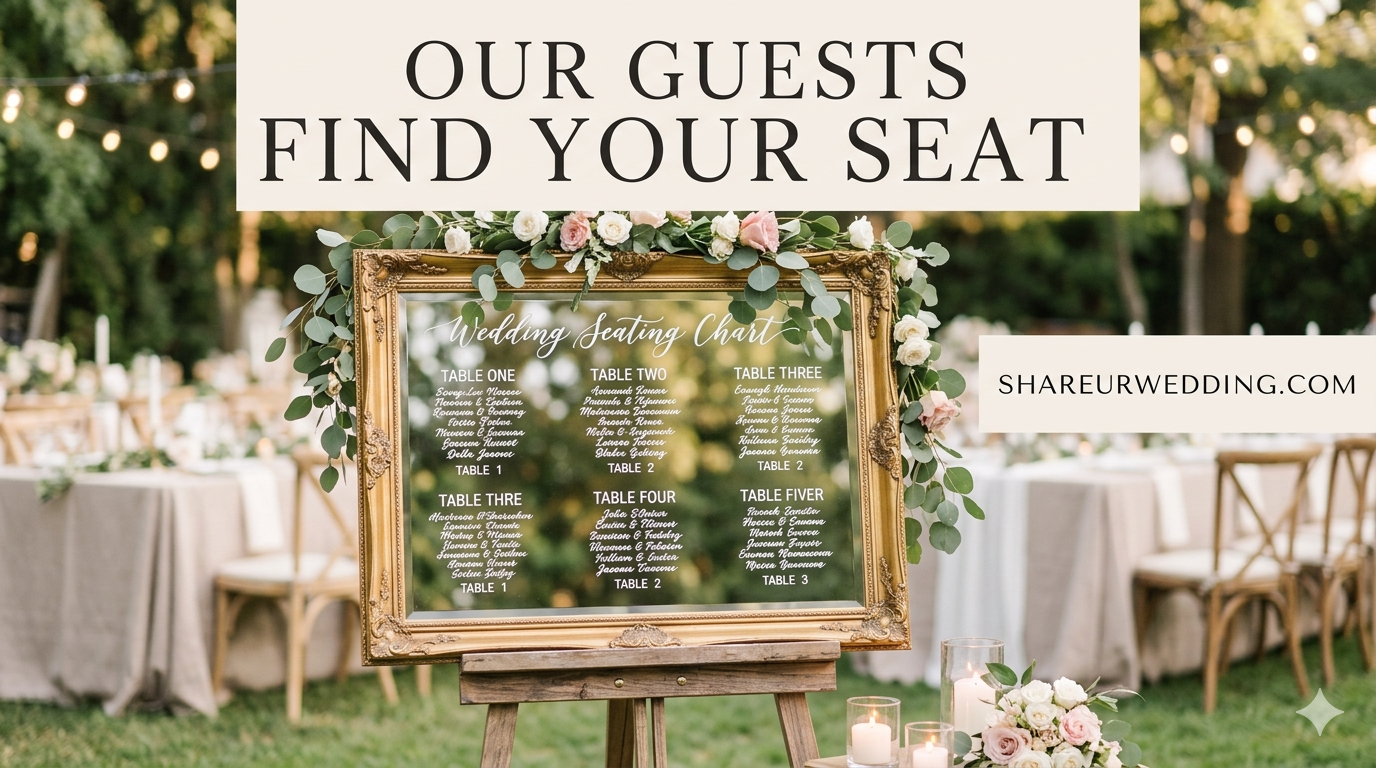
- Framed calligraphy board — a large, framed mirror or board with guests’ names in elegant script, arranged by table number
- Acrylic seating chart — printed on clear acrylic for a modern, floating effect that photographs beautifully
- Escort card display — individual cards in individual slots on a decorative frame, board or floral installation
- Wreath or floral wall — small escort cards tucked into a hanging floral arrangement or dried pampas grass wreath
- Rustic wood slice display — names laser-engraved or hand-written on individual wood slices hung on a tree branch
- Book-themed display — for literary couples: each table named after a book, with escort cards as mini bookmarks
- Shadow box / vintage frame gallery — multiple small frames arranged gallery-style, each displaying a table’s guest list
- Chalkboard wall — a large chalkboard with hand-lettered names, particularly beautiful at barn and garden weddings
- Potted plant escort cards — each small potted plant labelled with a guest’s name and table, doubling as a favour
- Digital display screen — a looping slideshow on a monitor at the venue entrance, searchable by guest name
| Design Tip
Whatever display format you choose, always have a backup printed list with your MC or venue coordinator. Digital displays can fail. Printed boards can blow over. A backup list ensures no guest stands confused at the entrance for more than a minute. |
Free Printable Wedding Seating Chart Template
A good seating chart template should capture the following information for each table:
| Field | Why It Matters |
| Table Number / Name | Your reference system for the venue layout |
| Table Capacity | Prevents overcrowding or awkward half-full tables |
| Guest Full Name | Avoids confusion when multiple guests share a first name |
| Meal Choice (if applicable) | Essential for caterers at plated-meal receptions |
| Dietary Restrictions | Passes to the catering team on the day |
| Seat Number (if assigned) | For formal receptions with specific seat assignments |
| RSVP Status | Track any last-minute changes or no-shows |
| Notes | Mobility needs, plus-one details, children at table |
Download the free template from ShareUrWedding and customise it for your guest list. The template is available in Google Sheets and Excel format, colour-coded by family group, with a separate tab for your table summary and a room layout diagram.
5 Common Seating Chart Mistakes (And How to Avoid Them)
- Starting too late. Leave yourself at least three weeks after your final RSVP deadline. Guest lists change. Build in revision time.
- Assigning seats before finalising the room layout. Always confirm the venue’s floor plan and maximum table count before you start grouping guests.
- Ignoring accessibility. Every venue should have at least one table with easy mobility access near the entrance. Do not assume the venue will handle this — confirm it explicitly.
- Over-mixing guest groups in an attempt to ‘blend’ families. Sometimes a table of close family who already know each other is exactly right. Not every table needs to be a new social experiment.
- Forgetting to confirm head count with the venue 72 hours before. Last-minute no-shows and additions are inevitable. A final confirmation call prevents surprises.
Your Pre-Wedding Seating Chart Checklist
- Venue floor plan confirmed with table count and dimensions
- Final RSVP list locked with dietary requirements noted
- Table assignments completed (family, friends, colleagues, etc.)
- Individual seat assignments finalised for formal events
- Display format chosen and ordered / designed
- Backup printed list prepared for MC and venue coordinator
- Final head count confirmed with caterer and venue 72 hours out
- One trusted person briefed to handle last-minute seating changes on the day
Final Thoughts
A well-planned seating chart is one of those behind-the-scenes details that guests never consciously notice — but absolutely feel. When it works, the room has energy. Conversations spark naturally, laughter carries across tables, and by the time the first dance happens, your guests have already formed the memories they will talk about for years.
The key is to start early, think in tables before seats, and prioritise your guests’ comfort over your own aesthetic preferences. Use the tools available, lean on your venue coordinator’s experience, and remember that no seating plan survives first contact with the guest list perfectly — build in flexibility and have a backup plan.
You have put an enormous amount of care into every other detail of this wedding. Your seating plan deserves the same.
| Share This Article
Found this guide helpful? Share it with a friend who is currently planning their wedding — this is exactly the kind of stress-free content that helps couples feel in control and excited rather than overwhelmed. |
You Might Also Like:
- Complete Wedding Planning Checklist: 12-Month Timeline
- How to Create a Wedding Budget: Template + Cost Breakdown India
- Best Wedding Guest Gift Ideas Under Rs.500